YubNub Social YubNub Social
    #racism #elections #conservatives #gerrymandering
    Advanced Search
  • Login
  • Register

  • Night mode
  • © 2026 YubNub Social
    About • Directory • Contact Us • Developers • Privacy Policy • Terms of Use • shareasale • FB Webview Detected • Android • Apple iOS • Get Our App

    Select Language

  • English
Night mode toggle
Featured Content
Community
New Posts (Home) ChatBox Popular Posts Reels Game Zone Top PodCasts
Explore
Explore
© 2026 YubNub Social
  • English
About • Directory • Contact Us • Developers • Privacy Policy • Terms of Use • shareasale • FB Webview Detected • Android • Apple iOS • Get Our App
Advertisement
Stop Seeing These Ads

Discover posts

Posts

Users

Pages

Blog

Market

Events

Games

Forum

Intel Uncensored
Intel Uncensored
1 y

Israeli loyalty test, on live TV
Favicon 
api.bitchute.com

Israeli loyalty test, on live TV

MIGA :-( Mirrored - Smoke & Mirrors
Like
Comment
Share
The Lighter Side
The Lighter Side
1 y

How ‘Superblocks’ Can Create People-Centered Cities
Favicon 
reasonstobecheerful.world

How ‘Superblocks’ Can Create People-Centered Cities

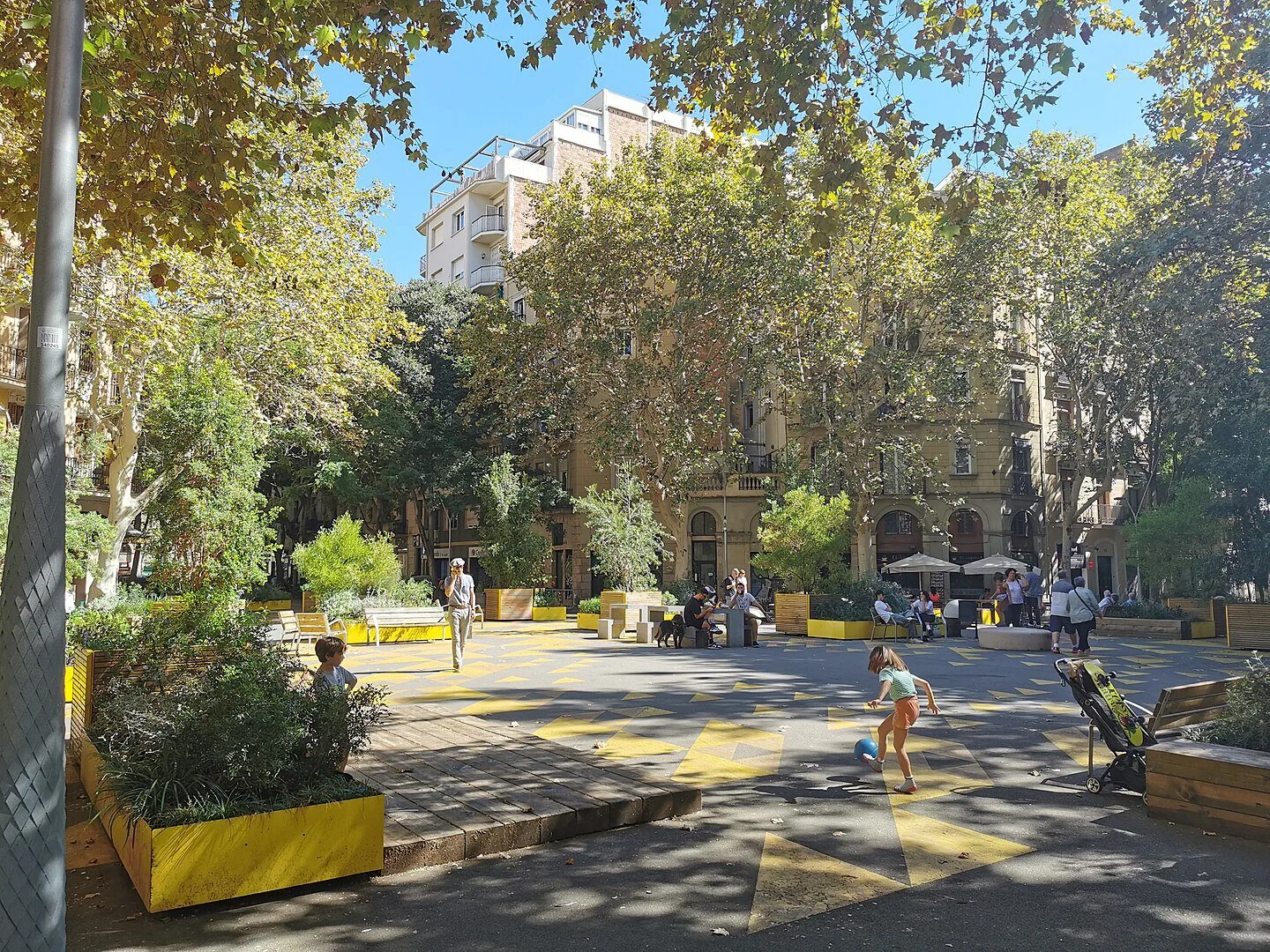
On a Thursday evening in late October, a small intersection in Barcelona is teeming with life. Half a dozen young parents are chatting in one corner, babies snug in carriers or crawling on a wooden platform on the floor. On a bench, teenagers are comparing their skates over beer, the music from their speakers drowned out by squealing children in Halloween costumes eating birthday cake at a nearby table. Two older gentlemen are sitting in companionable silence; a young girl is learning how to ride a bike without training wheels, pink streamers on her handlebars. This is Superilla de Sant Antoni, one of five “superblocks” in Barcelona: areas where traffic has been rerouted to prioritize people, community and active mobility. Superilla de Sant Antoni, Barcelona. Credit: Cataleirxs / Wikimedia Building a healthy city requires addressing five key factors: air pollution, noise, temperature, natural spaces and physical activity (or the lack thereof). Since all these factors are influenced by road traffic, superblocks, if done well, have the potential to improve them all. “Most cities are car-dominated,” says Mark Nieuwenhuijsen, director of the Urban Planning, Environment and Health Initiative at the Barcelona Institute for Global Health. “A lot of public space is given to the car, which could be used in a better way, for example for green spaces, which we know are healthy.” In Barcelona, 60 percent of the city’s public space is devoted to cars, even though people only use them for one in four trips. Air pollution from road transport has decreased dramatically in the past three decades, but dense urban traffic remains one of the primary reasons cities in Europe are unable to meet safe air quality standards. Air pollution causes cardiovascular and respiratory diseases and is the main environmental health risk in Europe, while the noise pollution from traffic can lead to hearing loss, tinnitus, sleep loss and cardiovascular and metabolic diseases. Together, the two cause 212,000 premature deaths per year in Europe. Car-centric city design also means higher temperatures, fewer green spaces and fewer opportunities for exercise, which all negatively impact health.
Like
Comment
Share
History Traveler
History Traveler
1 y

10 Major Players of the Haitian Revolution
Favicon 
www.thecollector.com

10 Major Players of the Haitian Revolution

  The Haitian Revolution was the only slave revolt in history that successfully established an independent state free of slavery and ruled by the formerly enslaved. The people of Haiti were subject to horrific treatment by the ruling white French population, and their fight for freedom crushed the widely held belief of white superiority. Numerous figures, diverse in backgrounds and beliefs, were influential in the course of one of the most important events in human history.   1. Toussaint Louverture Toussaint Louverture, leader of the Haitian Revolution, by anonymous artist (1802). Source: The Metropolitan Museum of Art   Toussaint Louverture, despite supposedly descending from African royalty, was born enslaved in Haiti in 1743. At the age of 33, he was granted his freedom and went on to amass a modest fortune. He rented a small plantation and a number of slaves, consequently profiting from the same enslavement he himself was once subjected to.   While the French Revolution spread across France, Haiti was disregarded by its imperial overlord. As a result, conditions on the island, especially for slaves, quickly deteriorated. Louverture, alongside other prominent Haitian figures, played an important role in planning a revolt against the French.   Upon the outbreak of the revolution, he forged an alliance with Spain, gained significant military experience, and became a prominent leader among Haitians. During the 1790s, Louverture’s views shifted. Previously, he had only wished to improve conditions for slaves; however, as the revolution continued, he began campaigning for abolition.   Toussaint Louverture by François-Séraphin Delpech (1840). Source: Wikimedia Commons   Following the French Revolution, the new French Republic abolished slavery. Meanwhile, Louverture’s relations with the Spanish began to deteriorate. As a result, Louverture switched allegiance to the French Republic.   By the 1800s, Louverture controlled significant territory in the south of Haiti. However, when Napoleon rose to power, concerns spread that slavery would be reimposed. In response, Louverture drafted a constitution in 1801 that declared almost absolute power for himself over the entire island of Hispaniola.   Outraged, Napoleon sent a force of 40,000 men to reestablish control of Haiti. Louverture was captured in 1802 and sent to France. He died in a French prison a year later.   2. Dutty Boukman The Revolt of the Slaves, a mural in Haiti depicting the Vodou Ceremony at Bois Caïman. Source: Oldjy Francois / The Haitian Times   On August 21, 1971, a Vodou ceremony was held at Bois Caïman that was attended by hundreds of enslaved people. Vodou, also known as voodoo, is a Haitian religion that blends numerous African traditions and beliefs.   The ceremony was led by Dutty Boukman, who was a male Vodou priest known as a Houngan. Little is known of Boukam’s origins, though it is speculated that he was born in West Africa, likely in Senegal, and was first taken as a slave to Jamaica. It is believed he was literate and taught other slaves to read, hence the origin of his name, “Boukman.” Supposedly, Boukman was caught plotting a revolt in Jamaica, so he was sold to a slave owner in Haiti.   At the ceremony, Boukman declared the beginning of the revolution and led the attendees in prayer. The Haitian Revolution began the following day. Boukman was killed during the fighting just one month later. French forces displayed Boukman’s severed head in hopes of deterring further rebellion.   3. Cecile Fatiman A modern-day Vodou priestess. Source: Visit Haiti   Cecile Fatiman led the Vodou ceremony at Bois Caïman alongside Dutty Boukman. Fatiman’s early life is heavily speculated. Some believe she was the daughter of a Corsican Prince, the son of King Theodore I of Corsica, and an enslaved African woman.   At a young age, Fatiman trained to become a Vodou priestess and participated in prayers and animal sacrifice. She became a Mambo, the title of a Vodou Priestess.   Fatiman went on to marry Jean-Louis Pierrot, who would later become the fifth President of Haiti, though the couple divorced years prior to his election.  She reportedly died at the age of 112.   Together, Fatiman and Boukman played a critical role in the outbreak of the Haitian Revolution. They inspired the enslaved people of Haiti to rise up against their oppressors and used their affinity to the Vodou religion to instill a sense of higher purpose in the cause.   4. Jean-Jacques Dessalines Jean-Jacques Dessalines holding the decapitated head of a white woman settler by Manuel Lopez Lopez (1806). Source: Wikimedia Commons   Jean-Jacques Dessalines was one of Toussaint Louverture’s most important lieutenants during the revolution. When French forces invaded Haiti under Napoleon’s orders, Dessalines won a decisive victory against French General Charles Leclerc at the Battle of Crête-à-Pierrot. However, following the battle, Dessalines abandoned Louverture and sided with the French. Some historians even suggest that Dessalines played a role in helping France capture Louverture.   When it was realized that the French intended to reimpose slavery in Haiti, Dessalines once again opposed the French. Following Louverture’s capture, Dessalines became the leader of the revolution and led Haitian forces against the French invasion.   The Coronation of Jean-Jacques Dessalines as Emperor of Haiti by Francisco Moscardo Yedra (1806). Source: Wikimedia Commons   On November 18, 1803, Dessalines won another decisive victory against the remaining French forces at the Battle of Vertières. French forces officially departed the following month, signifying Haitian Independence.   Dessalines proclaimed himself Emperor of Haiti, styling himself Jacques I. Modeling himself on Napoleon, Dessalines’ rule was heavily autocratic. In 1804, he orchestrated a massacre against the remaining French settlers in Haiti, which led to the deaths of approximately 5,000 people. Dessalines was murdered in 1806 by political rivals. Though his rule was tyrannical, he is still recognized as one of the founding fathers of Haiti.   5. Georges Biassou Haitian leader Georges Biassou by Manuel Lopez Lopez. Source: University of Florida   Georges Biassou was one of the early leaders of the revolution upon its onset in 1791. Like many of Haiti’s leaders, such as Louverture, Biassou allied with the Spanish to fight against the French. However, while Louverture switched allegiance back to the French, Biassou remained loyal to Spain.   Spain and France were at war with each other as part of the French Revolutionary War and the War of the Pyrenees. During this period, the island of Hispaniola was divided, with France controlling the west of the island, which they called Saint-Domingue (Haiti), and the Spanish controlling the east, called Santo Domingo (Dominican Republic). As a result, the island of Hispaniola and the ongoing Haitian Revolution became a battleground of this wider conflict.   Commemorative plaque outside Georges Biassou’s house in St. Augustine, Florida. Source: The Historical Marker Database   Thus, Biassou now fought against not only the French but also his former Haitian allies, such as Louverture. Biassou was one of the leaders of Spain’s Black Auxiliaries, and he received weapons, supplies, and money to fight against the French.   In 1795, at the Peace of Basel, Spain and France agreed to end the War of the Pyrenees. As part of the peace, Spain agreed to cede their control of Santo Domingo to France.   With the war over, Spain disbanded the Black Auxiliaries, and as a reward for his service, Biassou was given Spanish citizenship. He and his family left Haiti and relocated to St. Augustine, Florida, which was then under Spanish control. He was made leader of the Black Militia of St. Augustine and would defend Floridian territory from attacks by Seminole Indians.   6. Andre Rigaud Andre Rigaud during the Haitian Revolution. Source: Manioc   Andre Rigaud was born to a rich French father and a Black mother who was a former slave. Recognized by his father as his legitimate mixed-race son, known at the time as a “mulatto,” he was sent to Bordeaux, France to train as a goldsmith. However, Riguad joined the French Army and fought in the American War of Independence, serving alongside French-Haitian troops stationed in Savannah, Georgia.   With his newly gained military experience, he returned to Haiti to fight in the revolution. He fought against British forces that attempted to invade Haiti in 1794. By 1796, Rigaud controlled much of the south of Haiti, with Louverture controlling the north. Tensions quickly arose between the two leaders. Rigaud was a proponent of Haiti’s race-based social hierarchy and that it should be maintained, with whites at the top, mixed race-mulattos below them, and Black Haitians at the bottom.   The Emperor Napoleon in his study at the Tuileries by Jacques-Louis David (1812). Source: Wikimedia Commons   In contrast, Louverture wanted the eradication of this hierarchy. With the two now ideologically opposed, they fought against one another for control of Haiti. Known as the War of Knives, Haiti’s civil war, lasting for one year between 1799 and 1800, was won by Louverture. Rigaud fled to France.   Rigaud returned to France with Charles Leclerc’s expedition, which Napoleon sent. When the French incursion was defeated, Rigaud once again returned to France. At one point, he was arrested and held in the same prison in which Louverture had died. However, Rigaud was released. In 1810, he returned to Haiti yet again and attempted to establish himself as President of the south, though he was unsuccessful. He died the following year at the age of 50.   Andre Rigaud is a complex figure in Haitian history. While he fought for Haiti against its enemies, he remained observantly loyal to the racial status quo.   7. Alexandre Petion Alexandre Petion, Haitian leader and President of the Southern Republic of Haiti (c. 1807-1818). Source: Wikimedia Commons   Born in 1770 to a white Frenchman and a free mixed-race woman, Alexandre Petion was sent to France to study at the Military Academy in Paris when he was 18. He returned to Haiti upon the outbreak of the revolution and fought against the British invasion in the north in 1794.   As a mixed-race man, he allied with Andre Rigaud and fought against Louverture during the War of Knives. Alongside Rigaud, he went into exile in France after their defeat. He returned to Haiti in 1802 alongside Leclerc’s expedition. After Louverture was captured, however, Petion left the French and joined the nationalist forces, becoming a vocal supporter of Jean-Jacques Dessalines.   Henri Christophe, King of Haiti by Richard Evans (1816). Source: Wikimedia Commons   Petion supported Dessalines for the continuation of the war.  Following Dessaline’s murder in 1806, he began advocating for the introduction of democracy to Haiti. This led him to clash with fellow revolutionary Henri Christophe. Petion was elected President of the Southern Republic of Haiti in 1807. Over the next few years, he struggled for control against Christophe. Eventually, a peace treaty was signed in 1811, which split Haiti into two parts, with Henri Christophe becoming King of Haiti in the north.   Despite his advocacy of democracy, Petion made himself “President for Life” in 1816 because he felt constrained by Haiti’s Senate. He died of yellow fever in 1818 and is recognized as one of Haiti’s founding fathers.   8. Sanité Bélair Sanité Bélair featured on the Haitian 10 Gourdes banknote celebrating the 200th anniversary of Haitian Independence. Source: Numis Collection   Bélair was born a free woman of color. At the age of just 15, she married Charles Bélair, the nephew of Louverture, who would serve as a general during the revolution. Alongside her husband, Bélair would play an active role in the fighting. First, she became a sergeant and later rose to the rank of lieutenant during Leclerc’s expedition.   During the French invasion, Bélair and her husband were captured. On October 5, 1802, they were sentenced to be executed—Charles via firing squad and Sanité via decapitation, as custom for a woman. Sanité, however, demanded she be executed by firing squad like her husband. In an act of defiance, she refused to be blindfolded at her execution. While being walked past the gathered crowd, she reportedly shouted, “Liberty, no to slavery!”   Described by Jean-Jacques Dessalines as a tigress, Bélair remains an enduring figure of the Haitian Revolution. Her contributions to Haiti’s freedom were recognized in 2004 when she was featured on Haiti’s Ten Gourdes banknote.   9. Léger-Félicité Sonthonax Léger-Félicité Sonthonax, French abolitionist and politician. Source: Wikimedia Commons   A French native, Sonthonax worked as a lawyer in the Parliament of Paris during the outbreak of the French Revolution and was well-known for his views in support of abolition. In 1792, the new French Republic sent him as a member of a civil commission to Haiti, where he was tasked with granting full French citizenship to all free people of color, reasserting French authority, and reinforcing the rule of law.   However, upon his arrival, he allied himself closely with Haiti’s freed slave population. Controversially, he closed Haiti’s colonial assembly, which was entirely comprised of white members, and even exiled white settlers who refused to accept the new equality measures he imposed.   A year later, the Governor of Haiti, who was a loyalist to the deposed French Monarchy, incited riots led by white settlers. In response, Sonthonax promised freedom to any Black slaves who would fight on behalf of the French Republic.   The proclamation issued by Sonthonax and Polverel, which abolished slavery in Haiti (1793). Source: Library of Congress   When the Governor was forced into exile, Sonthonax decreed the abolition of slavery in Haiti’s northern province. A few months later, his ally and fellow commissioner, Étienne Polverel, abolished slavery in the west and south. Sonthonax also opened negotiations with Louverture, which resulted in the Haitian general realigning with the French Republic.   Sonthonax and Polverel’s actions were deeply controversial to the white settlers in Haiti, and many sent petitions to the French National Convention, which indicted the two commissioners. Sonthonax and Polverel left Haiti in 1974.   After successfully defending himself in front of a commission, Sonthonax returned to Haiti two years later. By this time, Louverture was consolidating his power and did not wish Sonthonax to interfere. Louverture had Sonthonax elected Deputy of Saint-Domingue at the Council of Five Hundred, which convened in Paris, thus keeping Sonthonax away from Haiti.   When Napoleon seized power in 1799, Sonthonax was exiled from Paris. He returned to his hometown, where he died in 1813. Léger-Félicité Sonthonax played a crucial role in the abolition of slavery in Haiti, as well as the shaping of its political landscape during the revolution.   10.  Charles Leclerc General Charles Leclerc, brother-in-law of Napoleon by François Kinson (1804). Source: Wikimedia Commons   Charles Leclerc was famous for being Napoleon’s brother-in-law after marrying his sister Pauline. An accomplished General, Leclerc had extensive experience fighting in the French Revolution.   When Louverture announced his constitution in 1801, Napoleon sent Leclerc to Haiti to restore French control. Leclerc arrived in Haiti with approximately 40,000 troops under his command. Quickly, he gained the alliance of numerous Haitian leaders, including Jean-Jacques Dessalines and Alexandre Petion.   Invasion of Haiti by French forces under the command of General Charles Leclerc by Thomas Charles Naudet (19th Century). Source: Wikimedia Commons   Leclerc won several conclusive victories against the Haitian forces and successfully regained control of much of Haiti. This forced Louverture to enter negotiations with Leclerc, which resulted in the Haitian general being placed under house arrest before he was eventually sent to France as a prisoner.   Despite being seemingly victorious over Louverture, Leclerc failed to impose his authority over Haiti, and the violence continued. Leclerc petitioned Napoleon requesting permission to conduct a “war of annihilation” against Haiti, even suggesting killing all Black Haitians over the age of 12 to ensure submission to France.   Haitians who had agreed to fight under Leclerc mutinied en masse, which eventually led to Leclerc executing 1,000 black Haitian troops under his command. Before Leclerc could inflict further bloodshed on the Haitian people, he died of yellow fever in 1802.   The attack and take of Crête-à-Pierrot in 1802 by Auguste Raffet (1839). Source: Wikimedia Commons   The people who influenced the Haitian Revolution were diverse in their motivations. Some fought purely for their liberty and freedom, some fought to reimpose bondage and authority, while others fought solely for their own ambition. The Haitian Revolution was a complex conflict, with a near-constant shifting in alliances on top of an ever-evolving political landscape. From the indomitable figure of Toussaint Louverture to the ruthless Charles Leclerc, these figures have ingrained themselves into the history of Haiti and the struggle for emancipation.

Like
Comment
Share
History Traveler
History Traveler
1 y

Rigoberta Menchú: Fighting for Indigenous Rights in Guatemala
Favicon 
www.thecollector.com

Rigoberta Menchú: Fighting for Indigenous Rights in Guatemala

  Rigoberta Menchú is one of the few voices to speak out regarding what happened in Guatemala during its civil war, as well as the ongoing mistreatment of the country’s Indigenous peoples. Her story is one of struggle and resistance—of how a child who faced poverty, discrimination, and violence generated by armed conflict became an international voice for peace and Indigenous rights. Her history is one shared by many Indigenous communities that continue to struggle against oppression, exploitation, and prejudice.    Rigoberta Menchú’s Childhood: Poverty and Exploitation Coffee harvesting by Indigenous people in Las Nubes, Guatemala, 1875, Eadweard Muybridge. Source: The Met Museum   Like so many of the women who transformed Latin America, Rigoberta Menchú came from very humble beginnings. She was born in 1959 in the mountainous village of Chimel, within the municipality of San Miguel Uspantán, Department of El Quiché, Guatemala. She comes from an Indigenous peasant family; her mother was a midwife—a tradition passed down from generation to generation in rural areas where there are no medical services. From a very young age, she survived in precarious living conditions, surrounded by violence, racial discrimination, and poverty.   From the age of five, she began working on coffee plantations with her family, a common practice in which Indigenous people would spend eight months of the year on plantations working for Guatemalans of Spanish descent. Most workers were exploited and lived in very poor conditions, crowded together without bathrooms or running water, with meager wages and almost no food. Such conditions, similar to those of a typical colonial system, persist in remote corners of the world like this.   One of her brothers died from exposure to pesticides, and subsequently, another died from malnutrition at the age of eight while her family still worked on the plantation. Their loss was heartbreaking for the family. Rigoberta was only ten years old at the time. She recounts that while mourning, they missed a full day of work; on that very night, the overseer came to tell them that they were being fired for skipping work that day. Devastated, they were forced to leave—without being paid for the months they were owed.   Rigoberta Menchú accompanied by the Pope John Paul II, 1992. Source: AFP   Rigoberta didn’t attend school because her father was afraid she would abandon her Mayan heritage. Paradoxically, her father was deeply involved in Catholic Action from a young age and worked in the community as a lay catechist and religious leader, involving his family as well. From the age of 12, Rigoberta taught the Bible to younger children in her village. She couldn’t read or write, but she memorized everything.   She didn’t see conflicts between her Mayan identity and her Catholic faith; rather, she saw parallels, as she expressed:   “Many of the images of Catholic Action are similar to ours, although ours are not written down … For example, we believe we have ancestors, and that these ancestors are important because they are good people who obeyed the laws of our people. The Bible talks about forefathers too. So it is not something unfamiliar to us. We accept these Biblical forefathers as if they were our own ancestors, while still keeping within our own culture and our own customs … the Bible tells us that there were kings who beat Christ. We drew a parallel with our king, Tecuin Uman, who was defeated and persecuted by the Spaniards, and we take that as our own reality. In this way, we adjusted to the Catholic religion and our duties as Christians, and made it part of our culture.”   During her adolescence, she worked as a domestic employee in the capital. During this period, she learned to speak Spanish entirely on her own.   Civil War: Guatemala’s Armed Conflict Guatemalan army soldiers direct a suspected leftist guerrilla into a building for interrogation in the military compound in Santa Cruz del Quiché, Guatemala, 1982, by Robert Nickelsberg. Source: American University Digital Research Archive   Much of what Rigoberta experienced in her life was the result of the Guatemalan Civil War, a complex conflict deeply rooted in the confrontation between the government and a guerrilla movement advocating for social justice. To understand the context, it’s important to note that the Guatemalan economy was primarily based on exports of coffee and sugar while heavily relying on the exploitation of Indigenous labor and land. A democratic regime and the uprisings and guerrilla movements posed a direct threat to the political and economic elite as well as their main trading partner: the United States. To combat these popular organizations, the government pursued a path of increased violence: exaggerating the threat these groups posed to political stability, they carried out bombings, massacres, and other violent acts. They killed anyone who might sympathize with the guerrilla movement.   The Commission for Historical Clarification, sponsored by the UN, documented that at least 200,000 people died, and more than 42,000 were victims of human rights violations, of which 83% were Maya. There were forced disappearances and executions of Maya authorities, but also of spiritual leaders and people not involved in politics. The aim was not only to destroy the social base of the guerrillas but also to annihilate the social and cultural fabric of the Maya people, the values that fostered cohesion and collective action within Maya communities.   A young Maya Ixil girl wearing a traditional headdress, left, sits for a picture with her brother and sister in Nebaj, 1984, by Robert Nickelsberg. Source: American University Digital Research Archive   As Rigoberta grew up, much of her family fell victim to the armed conflict. Her father led a peasant organization opposing the government, the Committee for Campesino Unity (CUC), which, along with a group of students from the Robin García Student Front (FERG), took over the Spanish Embassy to draw attention to the massacres of entire communities in the Guatemalan highlands. The Guatemalan government stormed the embassy and set it on fire with the peasants, students, Spanish diplomats, and other embassy staff locked inside, pleading to be let out while they were burned alive with white phosphorus. Her younger brother was kidnapped, tortured, and murdered by a military group; a year later, her mother was also kidnapped, raped, mutilated, and killed.   Finding Solace in the Fight for Indigenous Rights   Rigoberta Menchú standing at a podium wearing a traditional Mayan dress and a shawl, Hugo Ortiz, 2015. Source: Asamblea Nacional del Ecuador   After what happened to her family, her community, and her people, Rigoberta began to get involved in various social causes. Her brothers chose the path of guerrilla warfare, but she took a different track: a peaceful campaign denouncing the regime and its systematic violation of Indigenous peoples’ rights. She began to participate in international forums, condemning the inequalities and violence in her country.   In 1977, she began to be active in the Peasant Unity Committee, but during this period, the national army was conducting a campaign against anyone suspected of belonging to any armed group, so she exiled herself to Mexico. From there, she dedicated herself to denouncing the situation of Guatemala’s Indigenous peoples, publishing her autobiography, and traveling the world to make her complaints heard. She also participated in important events, such as the drafting of the United Nations Declaration on the Rights of Indigenous Peoples.   Nobel Committee Chairman Francis Sejersted presenting the Nobel Prize medal and diploma to Rigoberta Menchú Tum at the Nobel Peace Prize awards ceremony at the Oslo City Hall in Norway, December 10, 1992. Source: The Nobel Prize.   In 1982, Rigoberta was awarded the Nobel Peace Prize in recognition of her social activism. Before receiving this award, few people knew of her, so it served to make both Rigoberta’s work and the situation in Guatemala, from the terrible conditions for Indigenous peoples to the ravages of the civil war, better known.   Shared History: Rigoberta Menchú’s Legacy Source: Foundation Rigoberta Menchú Tum   It is important to highlight that Rigoberta’s story is not simply the story of her life. Her experience was not rare; rather, it was and is the reality for thousands of people in Guatemala—and beyond. It is a story quite universal in places of extreme poverty or among Indigenous populations in colonized countries.   In her autobiography, she says, “The important thing is that what has happened to me has happened to many other people, too: My story is the story of all poor Guatemalans. My personal experience is the reality of a whole people.”   Rigoberta’s Nobel Prize signifies a kind of recognition of all people living in desperate conditions who are ignored in official narratives. It is also a recognition of the victims of a conflict of great dimensions, one that has even been called genocide, and yet is not well known in the rest of the world. As she acknowledged in her Nobel acceptance speech: “I consider this Prize, not as an award to me personally, but as one of the greatest achievements of the struggle for peace, for human rights, and for the rights of Indigenous peoples, who over these 500 years have been divided and fragmented and have suffered genocide, repression, and discrimination.”   Bibliography/ Further reading   Menchú, R. (1983). I, Rigoberta Menchú: An Indian woman in Guatemala. Verso.
Like
Comment
Share
History Traveler
History Traveler
1 y

Haile Selassie: Divinity or Despot?
Favicon 
www.thecollector.com

Haile Selassie: Divinity or Despot?

  An iconic figure in African history, Haile Selassie is remembered as a powerful and progressive politician who modernized Ethiopia. His policies earned him much reverence and the attention of Black leadership outside the country. Not only was he an emperor, but for some, he is considered a god.   Yet his rule was anything but peaceful. His legacy is one of many paradoxes and contradictions.   Early Life of Haile Selassie Old map of Ethiopia. Source: martinplaut.com   Born on July 23, 1892 in the village of Ejersa Gora in Ethiopia, Lij (child) Tafari Makonnen could trace his lineage back to Menelik I, who was, according to legend, the son of King Solomon and the Queen of Sheba.   Tafari’s mother, Woizero (lady) Yeshimebet Ali Abba Jifar, was the daughter of a chief from Wollo province. His father, Ras (duke/prince) Makonnen Wolde Mikael Wolde Melekot, was of royal lineage, a military leader, and the governor of Harar.   Tafari’s claim to the throne was through his paternal grandmother, Tenagnework Sahle Selassie, who was an aunt of Emperor Menelik II and the daughter of King Sahle Selassie, the Solomonic Amhara King of Shewa. When Tafari’s father died in 1906, Tafari was raised in the court of Menelik II, who did not have a direct male heir. His only son had died at the age of 15.   Growing up in the imperial court, Tafari was given a good education, and he learned about the subtleties and intrigue of political life. Tafari was hardworking and attentive and gained much recognition from Menelik II. By the age of 14, Tafari had been promoted to governor of Gara Muleta in the Harar province, and by the age of 20, he was appointed commander of the province of Sidamo.   Tafari and his father Makonnen Woldemikael. Source: Wikimedia Commons   Although the exact date is unknown, at some point during his teenage years, Tafari was alleged to have married Woizero Altayech. The couple had a daughter, Princess Romanework. This episode of Tafari’s life is shrouded in mystery; the English translation of his autobiography makes no mention of it.   Tafari had a half-brother, Yelma, who was made governor of Harar. When Yelma died in 1907, this position was left vacant, and the region’s administration fell under the authority of military commander Dejazmach Balcha Safo, who proved ineffective. Balcha Safo was removed from his post, and Tafari was named the new governor.   On August 3, 1911, Tafari married Menen Asfaw of Ambassel, the niece of Lij Iyasu, who ruled as emperor from 1913 to 1916. Tafari was 19 at the time, while his wife was 22. Lij Iyasu’s rule would prove to be highly unpopular.   Selassie’s Path to the Throne Lij Iyasu wearing a Muslim turban, c. 1916. Source: Wikimedia Commons   Lij Iyasu was Emperor Menelik II’s grandson, and upon the death of the latter on December 12, 1913, Lij Iyasu assumed the crown. He did not adhere himself to those he ruled over. His scandalous behavior and disrespectful attitude towards other nobles earned him enemies. In addition to this, there were allegations that he had converted to Islam, which proved problematic with a devoutly Christian populace and earned him enemies in the Church.   As a candidate for the throne, Tafari garnered much support from both the progressive and conservative factions. Ultimately, using the accusation of Lij Iyasu’s conversion to Islam, an alliance of nobles was able to depose the emperor. Menelik II’s daughter became Empress Zewditu, while Tafari was elevated to the rank of Ras. He was also named regent and heir apparent to the throne.   Lij Iyasu fled to the Ogaden Desert, where he was aided by his father, Negus Mikael of Wollo. With an army of 80,000 soldiers, Mikael of Wollo engaged an army of 120,000 soldiers loyal to Zewditu. Wollo was defeated at the Battle of Segale on October 27, 1916, and Lij Iyasu went into hiding. His hope of regaining the throne evaporated, and after five years, he was captured and imprisoned.   Photograph of Haile Selassie, c. 1923. Source: Library of Congress   Thus, Ras Tafari became the de facto ruler of Ethiopia for the next thirteen years, during which time he set about modernizing the country. During the 1920s, Tafari also presided over the expansion of Ethiopia’s education system, building schools and universities.   In 1923, Tafari abolished slavery and admitted Ethiopia into the League of Nations, furthering the country’s standing in the Western world and garnering positive attention. He was the first Ethiopian ruler to leave the country, visiting Jerusalem, Paris, Rome, and London.   Empress Zewditu and one of her priests. Source: Wikimedia Commons   Zewditu, however, grew jealous of Tafari’s popularity. She felt obliged to name him Negus (king) on September 7, 1928. This further entrenched Tafari’s power, and a desperate Zewditu sent her husband’s army against Tafari. The ensuing battle saw this army crushed by Tafari. Zewditu died two days later, and on November 2, 1930, Negus Tafari was crowned emperor.   Upon his coronation, Tafari took the name Haile Selassie (Might of the Trinity). The coronation was a glamorous affair that drew widespread international attention. Dignitaries from all over the world were in attendance.   Haile Selassie: The Emperor 100 birr banknote from 1932. Source: Wikimedia Commons   One of Haile Selassie’s first actions as emperor was to provide Ethiopia with a new constitution. The constitution, adopted on July 16, 1931, kept power in the hands of the nobles, but it established democratic standards. It was envisioned that the constitution would be the guiding force behind Ethiopia’s slow transition towards more far-reaching democratic reform.   In the same year, Haile Selassie established the Bank of Ethiopia. A new currency, the Ethiopian birr, replaced the Abyssinian birr but was essentially just a name change. Selassie requested that the international community stop referring to Ethiopia as Abyssinia, as it was a name coined by foreigners rather than native Ethiopians.   The birr, however, would be withdrawn in 1936 and replaced with the Italian lira.   Italian Control Italian artillery in 1936, operated by Askari troops. Source: Public Domain, Narodowe Archiwum Cyfrowe Poland via picryl.com   On October 3, 1935, Italy invaded Ethiopia without any formal warning. Despite efforts at modernization, Ethiopia’s army was severely lacking. With only 13 aircraft and the number of tanks and armored cars in the single digits, Ethiopia’s forces were woefully ill-equipped to deal with the invasion, especially since the Italians also used chemical weapons.   By May 2, 1936, Haile Selassie and his family were forced into exile in the United Kingdom, where he appealed to the League of Nations for assistance. The Western nations offered sympathy for the Ethiopian people but did not come to their aid. The Ethiopians continued to resist the Italians by launching a guerilla war, hitting Italian targets wherever they could.   It was not until the Second World War when Britain found itself at war with Italy, that Ethiopia’s fortunes changed. In 1941, Allied forces liberated Ethiopia, and Haile Selassie returned home and began rebuilding an administration that had been destroyed during the years of Italian occupation.   Rebuilding Portrait photograph of Haile Selassie. Source: Fair use image via blackpast.com   After his return to Ethiopia and the expulsion of the Italians, Haile Selassie made great strides in continuing the modernization of Ethiopia. The country’s infrastructure was improved, and the expansion of the reach of education and healthcare was continued by building schools and hospitals.   In 1948, Ethiopia joined the United Nations. Issues to resolve territorial disputes left by the administration of colonial powers in neighboring areas resulted in Eritrea, a former Italian colony, being absorbed into Ethiopia. However, this happened with guarantees of Eritrea establishing its own constitution to protect the ethnic, linguistic, and cultural balance while Ethiopia took over the financial, defensive, and foreign policy aspects.   Haile Selassie: The Tyrant Harari region in eastern Ethiopia. Source: Wikimedia Commons   Haile Selassie came to be seen as a great reformer, yet his rule also drew negative attention as it was authoritarian. Far from the depictions of Haile Selassie as a benevolent dictator, messiah, and even a god, Haile Selassie is reviled by many as a tyrannical dictator who presided over countless deaths.   A prime example is in 1943 when the Tigray region of Ethiopia rose up in revolt. The rebellion was put down with military actions conducted by the British. Civilian areas were bombed, and thousands of innocents lost their lives.   Another incident in 1948 solidified Selassie’s willingness to use violent force as a means of oppression. When the Harari Muslims rose up, demanding the autonomy that had been promised to them by Menelik II, Selassie’s response was brutal. The entire town of Harar was put under house arrest, and assets belonging to the Harari were seized.   Flag of the Organisation of African Unity, 1970 to 2002. Source: Wikimedia Commons   Other areas, however, were subject to Selassie’s benevolence, and several provinces that were difficult to control were given more autonomy. Herein lies certain irony in Selassie’s actions in that they did not seem uniformly implemented.   Ultimately, Haile Selassie was a client of the West and ruled with an iron fist, similar to examples like Shah Reza Pahlavi of Iran or Mobutu Sese Seko of Zaire.   Those outside the control of the Ethiopian government, such as those who had fought against the Italians as partisans, became the target of the suspicions of an increasingly paranoid Selassie. He became wary of those he perceived to be brave enough to challenge his power, and he surrounded himself with people who could be easily controlled. This included politicians who had colluded with the Italian government during the period of occupation.   Selassie centralized the government around his authority and issued a new constitution in 1955, which granted him the same authority as the previous constitution. By the 1960s, overt resistance within Ethiopia to his rule began to grow significantly. In December 1960, a significant element within the army rose up and seized control of the Ethiopian capital, Addis Ababa. The coup was crushed, but it would help generate widespread anti-Selassie sentiment from the academic sector.   In 1963, Haile Selassie played a prominent role in the formation of the Organisation of African Unity.   Haile Selassie: The God Rastafarian graffiti. Source: Wikimedia Commons   The idea that Haile Selassie was a god stems from prophetic words by Marcus Garvey, who stated, “Look to Africa, when a Black king shall be crowned, for the day of deliverance is at hand.”   This statement generated mass interest in an Abrahamic religious movement in Jamaica that rebranded itself as Rastafarianism—literally named after Haile Selassie, who was known as Ras Tafari at the time.   The emergence of Selassie and his crowning as emperor, coupled with the prophetic words of Garvey, generated a spiritual belief that led to the idea of Selassie being of the divine.   The movement eventually moved toward philosophical sensibilities, and Haile Selassie became an icon of solidarity, freedom, and power among people of African descent.   Later Life & Death The sarcophagus of Haile Selassie in Holy Trinity Cathedral, Addis Ababa. Source: Wikimedia Commons   Hailey Selassie’s rule continued until 1974. For many, his leadership during the 1960s and 1970s was characterized by war. Not only was Eritrea fighting for independence, but a revolt in Baler in the south led to a terrorist insurgency that lasted for six years before it was finally defeated.   Dissidents were imprisoned, but Selassie also became widely known for granting pardons to prisoners during this time.   The oil crisis in 1973 hit Ethiopia hard, and inflation soared, causing socio-economic problems throughout the country. This led to economic failures, which in turn led to widespread famine that is estimated to have killed 40,000 to 80,000 people.   In February 1974, discontent over unemployment, famine, and a stagnant political situation led to strikes and the eventual removal of Haile Selassie from power. His concessions were not enough to pacify the military, which launched a coup and had the emperor removed.   His leadership was replaced with the Marxist-Leninist Derg regime, and Haile Selassie was confined to his palace, where he spent the last days of his life. In late August, the government announced that Haile Selassie had died due to respiratory failure, but later investigations proved that he had been assassinated on governmental orders. The frail 83-year-old man had been smothered with a pillow.   Legacy Bust of Haile Selassie in London. Source: Wikimedia Commons   From a modern perspective, Haile Selassie can be considered a controversial figure. While some Rastafarians consider him a god, his legacy seems to have been one of being more popular outside his country than within it.   While he tried to institute progressive reforms, the application of these reforms was hampered by Selassie’s bid to adhere himself to traditionalist nobles, and much of the country did not benefit from any policies that could have lifted them out of a feudal state of affairs.   By the end of the 1970s, Haile Selassie’s policies had left Ethiopia with an extremely underdeveloped economy. It had the lowest GNP per capita in Africa and a life expectancy of just 30 years. Sixty percent of infants died before their first birthday.   Under his leadership, the people of Ethiopia experienced the leap from feudalism to modernization with better healthcare and education. They also, however, experienced war and famine. Eritrea was hit particularly hard and suffered greatly during its fight for independence from Ethiopia.   The flag of the Ethiopian Empire. Source: Wikimedia Commons   Haile Selassie is a paradox of a ruler. He is seen as a great reformer in certain aspects, but his rule was marked by difficulties in placating both nobles and commoners, and brought him into conflict with both.   From an outside perspective, however, Haile Selassie enjoys a prominent position as an icon for independence and respect linked to the struggle for recognition of African success.
Like
Comment
Share
History Traveler
History Traveler
1 y

11 Facts About Glenn Miller: The Musician Who Disappeared
Favicon 
www.thecollector.com

11 Facts About Glenn Miller: The Musician Who Disappeared

  Glenn Miller is perhaps best known for his mysterious disappearance during World War II. However, there was much more to the legendary musician. Born of humble beginnings, he became a musical sensation and pioneer. Leaving his success and family behind, Miller served his country during the war without hesitation. It turned out he left his life in America behind permanently when he vanished. This truly fascinating man left a legacy that is often overlooked among the likes of Elvis and other legends of the era but that made a true impact on the future of music.   1. Glenn Was Not Actually Miller’s First Name Glenn Miller holds his trombone in 1942. Source: Billboard Magazine   Alton Glenn Miller was born in 1904 in Clarinda, Iowa. He was the second of four children born to Mattie and Lewis Elmer Miller. Young Alton always despised his first name and, from a young age, preferred to be addressed by his middle name, “Glenn.” Glenn would be the name he was known by to the world, as he not only used it for himself but also for his most acclaimed musical act, the Glenn Miller Orchestra.   2. Miller’s Famous Trombone Was Not His First Instrument Although it wasn’t his first instrument, Miller would become famous for his trombone. Source: Alena Jarrett via Unsplash   Miller grew up in a very musical family, with his mother an organist and older brother Deane playing the cornet. Glenn started out playing the mandolin but was most interested in pursuing a different instrument: the trombone. He purchased a beat-up used horn and began devoting most of his time to practice. A local businessman offered to buy Glenn a newer trombone so he could join Deane in the community band, and Glenn eagerly accepted, working off his new instrument in exchange for the support. The trombone became Glenn’s choice instrument, one he would play for the rest of his life.   3. Clarinets Gave His Orchestra the Competitive Edge A clarinet gave Miller’s Orchestra the sound they needed. Source: Carlos Araujo via Pexels   Miller was once quoted as saying, “a band ought to have a sound all its own. It ought to have a personality.”   He truly believed this and, as a result, realized his band would need a signature sound in order to be successful. After struggling for a few years and disbanding his first orchestra, Miller set out to try again, this time with a new sound to engage listeners and set his band apart. He decided to make the reed section the lead, with a clarinet playing the melodic line of a song. The clarinet was backed by saxophones playing harmony, and the remainder of the band, including trumpets and Miller’s trombone, rounded out the sound. The melodies were instant hits, and the aura is sometimes still referred to today as “the Miller sound.”   4. Miller Didn’t Attend His High School Graduation Miller had other plans on graduation day. Source: RUT MIIT via Unsplash   Glenn Miller was a popular student known for his prowess on the football field and participation in multiple student bands. However, academics were not his priority during his high school years. In fact, Miller did not even attend his high school graduation, skipping the event to play in a band concert in Wyoming. Instead, his mother accepted his diploma for him.   The school principal lamented that it was appropriate for Mattie Lou Miller to receive the certificate instead of her son, remarking, “You’re the one who should get it anyway; you probably worked harder on it than he did!” Despite failing to attend the ceremonies, Miller is still known today as Fort Morgan High School’s “most famous graduate.”   5. Benny Goodman Helped Miller Pay for His Wedding Benny Goodman in 1942 by James J. Kriegsmann. Source: Wikipedia   Benny Goodman, an American musician known as the “King of Swing,” was one of Miller’s contemporaries. He was hired by Ben Pollack, a jazz great, when he was only sixteen. It was in Ben Pollack’s band that Goodman met another bespectacled musician, Miller. Though they would often be framed as competitors during their future successful careers, the two men became lifelong friends.   Goodman actually lent Miller the money he needed to marry his sweetheart, Helen Burger. Miller met Helen in college when they were both students at the University of Colorado, which Miller attended briefly. The pair were married in 1928 and settled in New York as Miller began expanding his career. Helen stuck by her husband’s side throughout his early failures as a musician and later his successes and was left an assumed widow after his disappearance. She refused to give up on her husband’s memory, though, and was instrumental in ensuring that the Glenn Miller Orchestra returned to performing after the war. She raised the couple’s two children on her own after the loss of Miller and took pains to keep them out of the limelight and in a life of normalcy.   6. Miller Wasn’t a One Hit Wonder Glenn Miller in 1943. Source: Wikimedia Commons   Though his career was cut short by his disappearance, Glenn Miller and his Orchestra were anything but one-hit wonders. The group released a rapid succession of hits, many of which were granted various accolades. “Chattanooga Choo Choo” made twenty-one appearances on the Billboard Top 10. “Moonlight Cocktail” spent the most time at #1, charting for ten weeks in the top position. The group had seven Billboard number-one records and ten Your Hit Parade number-one albums. His final number-one record was “That Old Black Magic,” which spent 14 weeks at the top of the charts in 1943 after Miler had joined the armed forces and ceased his civilian career.   7. Even Though He Wasn’t Drafted, He Joined the Army in Wartime A compilation of work from the Glenn Miller Army Air Force Band. Source: RCA   World War II greatly impacted the music scene, as many up-and-coming musicians were swept up in the draft and sent to fight for their country instead of pursuing their musical dreams. Glenn Miller did his part to support the armed forces, starting a radio program in 1941 that allowed different military installations to participate in song selections and contests. He paid for this program, “Glenn Miller Sunset Serenade,” out of his own pocket, costing him an estimated one thousand dollars a week.   Miller was considered too old for the draft in 1942 and decided to volunteer his services to the US military instead. He applied for a Navy commission that summer, but it was refused. He applied to the Army and was accepted and awarded the rank of captain.   Captain Alton Glenn Miller reported for duty on October 7th, 1942, and was soon transferred to the US Army Air Forces. In 1943, he was named Director of Bands for the Army Air Forces Technical Training Command. He spent time working in Alabama, New York, and New Jersey, recruiting and training musicians in an effort to improve military morale. Eventually, his work moved overseas to the European theater.   Troops in Europe missed all aspects of being home, including enjoying American entertainment and music. He organized bands, made Office of War Information recordings, and created radio programs for soldiers. Many men Miller had played with in a civilian capacity before the war were happy to join his new unit in uniform.   8. Glenn Miller Was Posthumously Awarded the Bronze Star A plaque dedicated to Miller at the Mt. Soledad National Veterans Memorial. Source: Mt. Soledad National Veterans Memorial   During his time in the service, Glenn Miller was the recipient of multiple awards. Posthumously, he was awarded the Bronze Star, which is awarded to individuals who distinguish themselves by “heroic or meritorious achievement or service” in a combat situation. His medal citation states that Miller’s military band made a “noteworthy contribution to the morale of the armed forces.” General Jimmy Doolittle is quoted as saying, “Next to a letter from home, the Glenn Miller Band was the greatest morale builder in the European Theater of War.” Helen accepted the award in her late husband’s honor at a ceremony in 1945.   9. Glenn Miller May Have Disappeared, but His Orchestra Didn’t A 2021 advertisement for the Glenn Miller Orchestra. Source: The Levoy Theater   With the blessing of Glenn Miller’s family and efforts made by his wife, Helen, and his manager, his band and their signature sound continued after his death. Helen approached saxophonist Tex Beneke about reviving the band in 1946, and he became the first bandleader of the group following Miller.   The Glenn Miller Orchestra began touring again not long after Miller’s disappearance and continues to do so today, over eighty years after Miller’s presumed death. The band comprises over a dozen members who perform not only in the United States but globally.   10. He Worked in Radio Advertising and Propaganda Using His Music Miller preparing to record a radio broadcast. Source: US Air Force   Miller’s military band made regular radio broadcasts, including over a London broadcasting station operated by the Office of War Information. In addition to his work in military radio, Glenn Miller had already made a splash in American radio before the war. In 1944, Miller became part of a special military propaganda project called “Music for the Wehrmacht,” an Allied effort to encourage German soldiers to surrender. This program was rediscovered and issued in a 2 CD collection by RCA Records in 1996 called “Glenn Miller-The Lost Recordings.” The recordings contain music and also conversations with a German-speaking cohost in which Miller lauds America as a “symbol of unity.” Despite attempted jamming by Nazi forces, most of Miller’s work was successfully broadcast.   11. Miller Has More Hits Than Elvis and The Beatles Like Miller, Elvis joined the military at the height of his career. This photo was taken around the time Elvis joined the army in 1958. Source: Wikimedia Commons   During the four-year period in which they were most popular, the Glenn Miller Orchestra put out hit after hit to wildly receptive audiences. From 1939 to 1942, the group made sixteen number 1 records, on which there were 69 top-ten hits. This bests some of the most successful musical acts of all time, including Elvis and the Beatles. Elvis had 40 top-ten hits in his 22-year performing career. The Beatles fell short, with 34 top-tens credited to the Fab Four.
Like
Comment
Share
BlabberBuzz Feed
BlabberBuzz Feed
1 y

Elon's Mom Has A Message To Politicians And The Media
Favicon 
www.blabber.buzz

Elon's Mom Has A Message To Politicians And The Media

Like
Comment
Share
Fun Facts And Interesting Bits
1 y

10 Terrifying Human Encounters with Swarming Animals
Favicon 
listverse.com

10 Terrifying Human Encounters with Swarming Animals

Swarming is a fascinating yet unnerving phenomenon where animals move together en masse, often causing unintentional chaos for humans. Whether it’s birds, bees, or marine predators, swarming is typically a natural behavior tied to survival, such as migration, mating, or finding food. However, when these mass movements clash with human activities, the results can range […] The post 10 Terrifying Human Encounters with Swarming Animals appeared first on Listverse.
Like
Comment
Share
Homesteaders Haven
Homesteaders Haven
1 y

How To Make A Macrame Lawn Chair | Homesteading Skills
Favicon 
homesteading.com

How To Make A Macrame Lawn Chair | Homesteading Skills

Want to make a personalized macrame lawn chair? Decide on the color and add a personal touch to your very own lawn chair by revamping an old one with this DIY macrame lawn chair guide! Make A Macrame Lawn Chair For A Comfy Lounge – This post was originally by diyprojects.com and shared with permission – I've been noticing a lot more macrame furniture out there lately. I love macrame, and a macrame lawn chair is one of those DIY projects that I have always wanted to try! In the spirit of getting my place cleaned up and organized, I decided to upcycle some of my lawn chairs that have seen one too many summers. The chairs have perfectly good metal frames and just need new webbing, making them perfect macrame lawn chair candidates! As I searched for macrame pattern inspiration, I noticed there's a major lack of detailed instructions. So I decided to experiment and create my own pattern. I went ahead and mocked it up so you won't have to go through the same exhaustive search I did. You can download it HERE (for free) to get started on your macrame lawn chair!   Supplies Needed: 200 yards of 6mm macrame craft cord (I did 100 yds of each color) 2  19.00mm crochet hooks Metal lawn chair frame scissors lighter pattern (download mine here)   Step 1. Remove Old Webbing Using scissors, remove the webbing or fabric from your chair. Clean the frame.   Step 2. Start Weaving Process To start your chair, you'll want to place your roll of cord on the ground inside the chair frame. This is the easiest placement of the cord for the entire weaving process. Starting on the seat bottom frame, make a double square knot, leaving about 6″ of a slack at the end. Keep in mind that you are only going to weave on the straight parts of the chair frame, leaving the rounded edges bare.   Step 3. Under The Bridge And Through The Loop Now take your cord up, below the center bar and up over the top of the frame. (See pictures below) Then, loop the cord over the top of the chair frame and pull it around to the outside. Push your crochet hook through the loop you just made. Be sure to pull the cord tight so the hook doesn't fall out. Also, in order to make sure you will be able to get your hook through the next time around, make sure the loop is resting on the fattest part of the hook. Trust me, this will make your life much easier as you continue! Step 4. In Comes The Hook Bring the cord back down, underneath the center bar, and over the front of the seat frame. Wrap the loop over the frame and pull it under to the outside of the first couple of cords.  Just as you did before, push the crochet hook through the loop, having it rest on the flat part of the hook. Pull the loose cord tight and continue. Want to see the full details of this DIY macrame lawn chair? Check it out here on diyprojects.com! Didn't you find this personalized macrame lawn chair project engaging? I'm sure you've got visions now about how your own macrame lawn chair will be designed, the color you will choose and how it will sit in your garden landscape. Enjoy weaving your own macrame lawn chair! Let us know in the comments below how making your own macrame lawn chair went!  With a new lawn chair, learn how to care for your outdoor furniture here so your personalized chair can last long.   Follow us on Instagram, Twitter, Pinterest, and Facebook! This post was originally published in April 2017 and has been updated for quality and relevancy.
Like
Comment
Share
NewsBusters Feed
NewsBusters Feed
1 y

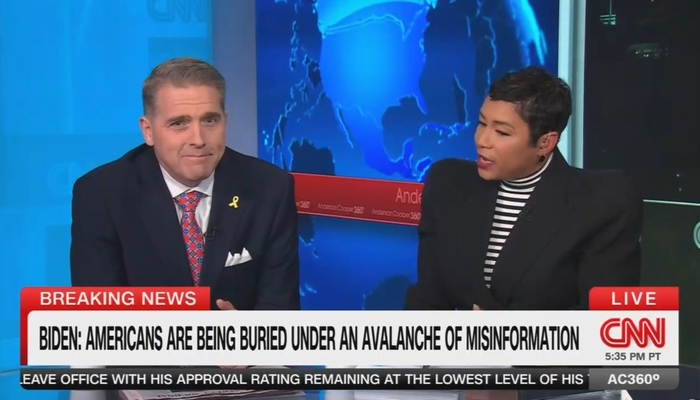
CNN’s Scott Jennings DESTROYS Biden’s Farewell Speech
Favicon 
www.newsbusters.org

CNN’s Scott Jennings DESTROYS Biden’s Farewell Speech

CNN’s post-Biden speech analysis was decidedly much less sycophantic than MSNBC’s, by virtue of the fact that they had an actual conservative on the panel: Scott Jennings, who wasted absolutely no time laying waste both to Biden’s speech, and to his legacy. Watch as Jake Tapper asks Jennings whether there was anything in the speech he liked, and get an earful: .@ScottJenningsKY BURIES the Biden farewell: "When I watch this tonight, I remain astonished that (Biden), his family, and other people around him thought he could ever run for another term." pic.twitter.com/gBfXuNVZip — Jorge Bonilla (@BonillaJL) January 16, 2025 JAKE TAPPER: And, Scott, you've been rather unrelenting in your criticism of outgoing President Biden. What did you think of the speech? Was there anything you liked? SCOTT JENNINGS: No. Not really. I think the way he’s leaving office has been, frankly, pretty terrible. He’s going to be remembered for a few things, but politically, it’s mostly for, when he was Vice President, he and Obama sort of ushering in the Trump era initially and then, as he’s leaving office as President, bringing back Trump and Trumpism stronger and more popular than ever. Today, Biden has, like, a 61% disapproval, and Trump is over a 50% approval and more popular in his ideology, is more popular than it’s ever been. If everything you say is true, the Democrats should have had no trouble getting reelected in this election. And yet, they were…they were… ASHLEY ETIENNE: (CROSSTALK)...I think it’s an issue of a communications failure… (CROSSTALK) JENNINGS: I know. And for Democrats, it’s always been about communication and no introspection about the policies that led to him leaving office as one of the most unpopular presidents. When I watched this tonight, I remain astonished that he, his family, and other people around him thought he could ever run for another term. I mean, there’s no way he could serve another six months, let alone another four years. The fact that they pursued that farce for as long as they did to me, remains one of the most astonishing things about this term. This was a brutal recap in the midst of a fawning (mostly by former Kamala Harris aide Ashley Etienne) attempt to rewrite history. The frame of Biden’s legacy as having twice paved the way for Trump and Trumpism is one we won’t often hear in the media. Instead, viewers will mostly be treated to the Resistance-y “oligarchy” narrative. A bit later on, Etienne got wrecked for trying to frame Biden’s lamentation about the decline of trust in the media by saying Trump lies: CNN’s @ScottJenningsKY schools former Kamala aide Ashley Etienne for praising Biden lamenting the decline of trust in the media and then hurling disproven lies about Donald Trump: “Has Joe Biden, Kamala Harris or Karine Jean-Pierre ever lied?...Your speech is about the truth and… pic.twitter.com/pgspP7JK7w — Curtis Houck (@CurtisHouck) January 16, 2025 JENNINGS: Has Joe Biden, Kamala Harris or Karine Jean-Pierre ever lied? ETIENNE: I don’t know. What are you talking about? I know where you’re going with this, but that’s not the point. You know, Donald Trump stands at the podium every day and delivers lies. JENNINGS: Your speech is- your speech is about the truth and one thing about Biden that has always vexed Republicans is that he spends a lot of time talking about him being the center of truth and the restoration of the soul of the nation and yet, he and his people spend a heck of a lot of time undermining that very talking point up to and including this year with the massive cover up of his own condition. And so, I just- I just… ETIENNE: Scott, how about Trump lied to the American people during covid? JENNINGS: About what? ETIENNE: How about… I mean- drink bleach, right? I can go on and on… JENNNINGS: Debunked. Didn’t happen. ETIENNE: That it’s not as bad as the flu.  JENNINGS: Debunked.  ETIENNE: I mean, all of those things and the reality is… JENNINGS: You’re doing it right now. ETIENNE:  500,000 people lost their lives because the president wasn’t honest with the country about the dangers of covid. JENNINGS: I don’t understand. Are you saying the virus was listening to Donald Trump? ETIENNE: My point is- my point is that lies have consequences. And that is- JENNINGS: I just want to make sure I understand that your position is, is that Donald Trump's words induced the virus to kill people? ETIENNE: No. What Donald Trump’s words did was prevented people from protecting themselves… JENNINGS: C’mon. ETIENNE: And their neighbors and 500,000 people lost their lives. That was my point. More importantly, because of his lies, he didn’t create an infrastructure from the governors all the way down… JENNINGS: He gave you the vaccine. ETIENNE: …to get shots in arms… JENNINGS: He gave you the vaccine. ETIENNE: To get the economy open again, so he lied. So lies have consequences and that’s what Biden’s talking about today. You have to be aware of that.  JENNINGS: Jake. This is crazy. I’m sorry, this is insane. It is ironic that the person accusing Trump of lies and disinformation imputed twice as many covid deaths to his administration as what the actual record reflects. The rest happened under Biden. As is the case with his cognitive decline, it doesn’t get talked about much. Etienne’s frantic spinning at the end of that exchange is demonstrative of the lengths the media will go to burnish Biden’s legacy. But as Jennings demonstrates, it isn’t that hard to cut through the spin and demonstrate there isn’t much of a legacy to begin with.  
Like
Comment
Share
Showing 63019 out of 120624
  • 63015
  • 63016
  • 63017
  • 63018
  • 63019
  • 63020
  • 63021
  • 63022
  • 63023
  • 63024
  • 63025
  • 63026
  • 63027
  • 63028
  • 63029
  • 63030
  • 63031
  • 63032
  • 63033
  • 63034
Advertisement
Stop Seeing These Ads

Edit Offer

Add tier


Select an image
Delete your tier
Are you sure you want to delete this tier?

Reviews

In order to sell your content and posts, start by creating a few packages. Monetization

Pay By Wallet

Payment Alert

You are about to purchase the items, do you want to proceed?

Request a Refund