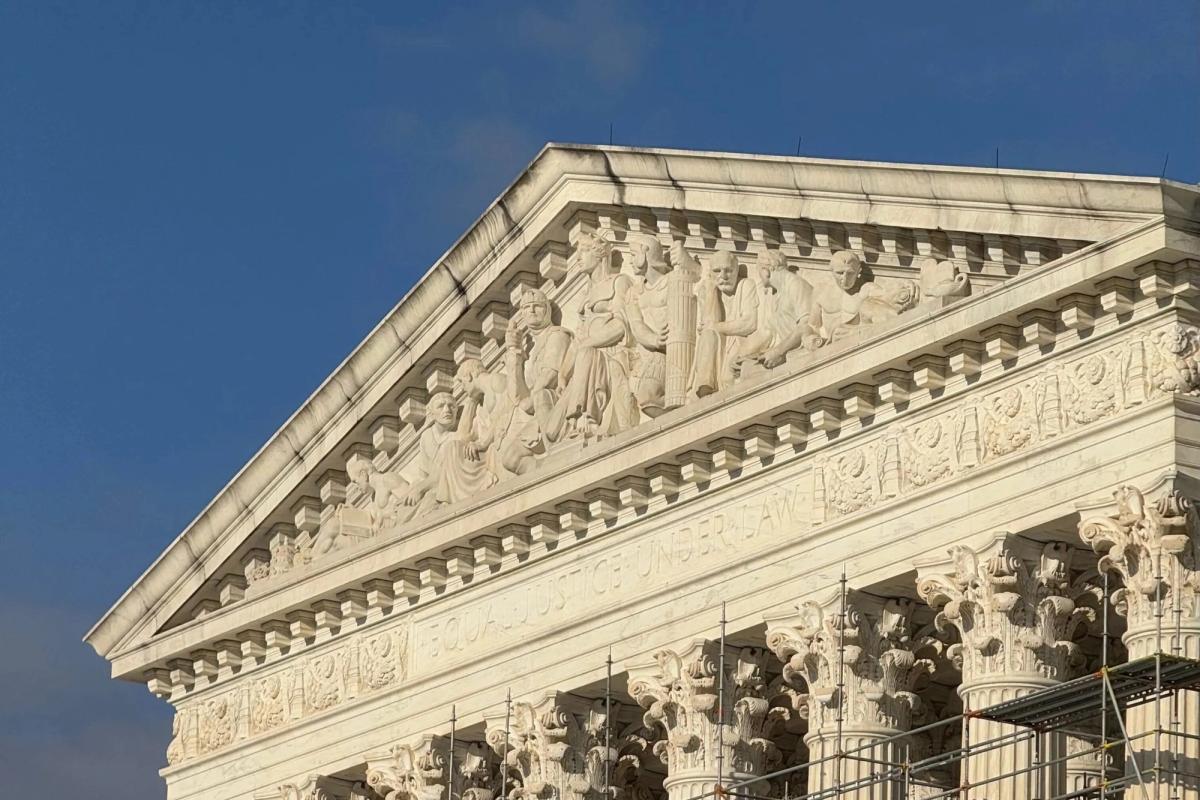
www.scotusblog.com
The ripple effects of SCOTUS’ mail-in voting decision
Yesterday was National Dog Day, and we celebrated by updating the SCOTUSblog merch store to include a stainless steel bowl and a very distinguished “SCOTUSdog” bandana. Supplies are limited, so don’t miss getting one of these unique gifts for your attorney-at-paw.Plus, if you’d like to attend The SCOTUSblog Summit: 2026 Term Preview on Wednesday, Sept. 16, remember to register your interest here.At the CourtOn Friday, Chief Justice John Roberts issued a temporary order, known as an administrative stay, allowing construction on the new White House ballroom to continue for now. The court could release its decision in the interim docket case at any time.Morning ReadsFederal judge lifts final block on Trump mail-in voting order, clearing way for midterm restrictionsLuke Fountain, CNBCOn Monday, the Supreme Court sided with the Trump administration in an interim docket dispute on President Donald Trump’s executive order on mail-in voting, determining that it was too soon for courts to consider a challenge to the order from a group of states. On Wednesday, U.S. District Judge Indira Talwani cited that decision to explain why she was vacating her nationwide injunction in a separate case that had also blocked implementation of the order, including enforcement of a new U.S. Postal Service rule requiring “states to provide lists of mail voters and use federally reviewed ballot envelopes with unique barcodes,” according to CNBC. Talwani’s “decision came as the policy faced a fresh wave of litigation. Democratic-led states filed a new lawsuit earlier Wednesday, while voting-rights groups amended their existing complaint to challenge the finalized U.S. Postal Service rule – the third legal challenge targeting it.” The new lawsuit, filed by “23 states, Washington, D.C., and Pennsylvania Gov. Josh Shapiro, a Democrat,” contends that USPS lacks the authority to impose the new rule for mail-in voting and that the rule “violates the Voting Rights Act and intrudes on states’ constitutional power to administer elections.”Supreme Court Ruling on Mail-In Voting Could Add to Election ConfusionEmily Cochrane, David W. Chen, and Anna Griffin, The New York Times (paywalled)After the Supreme Court on Monday “allow[ed] the Trump administration to move ahead with its plans to restrict mail-in voting,” states were left “grappl[ing] with how to respond,” according to The New York Times. It remains unclear whether the administration will be able to implement new restrictions before this year’s midterm elections, because there are several ongoing legal challenges. “Some states have already designed and printed ballots, a costly endeavor, and the first absentee ballots will be sent starting Sept. 4.” If proposed changes to mail-in voting go into effect, states may need to change, among other things, the envelopes used for ballots to “meet a different federal standard.” “It’s a huge issue,” said Stuart Holmes, Washington state’s elections director, to the Times. “It’s not just the logistical challenges of implementing this. It’s the tax dollars that would be wasted to throw all these envelopes away.”Iowa and Montana Ask Supreme Court to Block ‘Politicized’ Paramount-Warner Bros. Antitrust Suit Filed by California and 11 Other StatesTodd Spangler, VarietyIn a Tuesday filing, Iowa and Montana asked the Supreme Court “to stop the antitrust lawsuit brought by 12 Democratic state AGs seeking to block Paramount’s takeover of Warner Bros. Discovery,” describing the lawsuit as “politicized” and contending that the other states’ interference with the deal will harm them economically, according to Variety. “Iowa and Montana argue in their lawsuit that they have no venue other than the Supreme Court to sue California and the 11 other states to resolve ‘a controversy between sovereigns.’” “Twelve states have effectively vetoed a transaction that the other thirty-eight, and the United States, declined to challenge,” the motion from Iowa and Montana says. “No other forum can resolve that controversy. Congress made this Court’s jurisdiction over controversies between two or more states exclusive.”Federal court deals potential blow to Republicans over TV advertising ratesAndrew Howard and Jessica Piper, Politico (paywalled)On Tuesday, the U.S. Court of Appeals for the 4th Circuit “ruled that political parties – recently allowed by the Supreme Court to spend unlimited amounts in consultation with campaigns – aren’t entitled to the significantly lower candidate advertising rate when they do so,” according to Politico. The 2-1 ruling stated that the lower rate – called the lowest unit charge, or LUC – “requirement and campaign finance statutes are clear that neither political parties nor joint fundraising committees with non-candidate members can be entitled to the LUC.” Politico noted that “Republicans are almost guaranteed to appeal the Tuesday decision. The GOP had hoped to use their cash advantage and the lower rate to flood the airwaves against Democrats as both parties battle for control of Congress.”Arrest follows sighting of guillotine parked next to the Supreme CourtBen Conarck, The Washington PostOn Tuesday, “U.S. Capitol Police seized a guillotine and arrested a man it says transported it in the bed of his pickup truck before illegally parking it alongside the U.S. Supreme Court building,” according to The Washington Post. Philan-Tam-Duy Le, who drove with the guillotine “to Washington from California, was charged with carrying a dangerous weapon.” In a press release, the police department shared that it is still working “to learn more about why he came to Washington.”On SiteFrom the SCOTUSblog TeamAlcohol at the Supreme CourtIn the term ahead, the Supreme Court may take up a case on a 19th-century law prohibiting at-home production of distilled spirits. If it does, it will be far from the first time the court has considered alcohol restrictions. In her article, Kelsey went through some of the court’s most notable alcohol-related rulings.Contributor CornerThe many layers of LandorFor his Rights and Responsibilities column, Richard Garnett revisited Landor v. Louisiana Department of Corrections, in which the court held that state employees may not be held liable in their personal capacities under the Religious Land Use and Institutionalized Persons Act. The ruling “points toward still unresolved questions about the respective roles of courts and legislatures in our crucial, contested experiment in religious freedom,” Garnett wrote. Contributor CornerThe orders docket, why it matters, and this term’s criminal law ordersIn his SCOTUSCrim column, Rory Little explored the orders docket, also known as the emergency, interim, or shadow docket. Specifically, he highlighted criminal law orders that landed on this docket during the 2025-26 term. PodcastsAmarica's ConstitutionAn Amendment Like Some Others - Special Guest Vikram D. AmarVoting rights are in the news. State and federal governments have sought to weigh in and intervene on election laws, including rules for mail-in or absentee voting. Akhil Amar and Andy Lipka bring in the expert on such things: Professor Vik Amar.A Closer LookU.S. DOGE Service v. U.S. District Court for the District of ColumbiaThis Closer Look expands on the case description Kelsey wrote for her article on what the Trump administration wants from the Supreme Court next.When Trump returned to the White House in January 2025, he launched the U.S. Department of Government Efficiency (DOGE), and empowered it to “maximize governmental efficiency and productivity” by promoting technological advancements and reducing waste. DOGE’s work sparked controversy and legal battles, as watchdog groups questioned its access to Americans’ personal data and the mass layoffs that it championed.Less than a week after DOGE was created, one such watchdog group, Citizens for Responsibility and Ethics in Washington, filed a Freedom of Information Act request seeking internal DOGE communications, as well as messages exchanged between DOGE and federal agencies. In February 2025, the group filed a lawsuit aimed at forcing disclosure of these documents. DOGE countered that it did not qualify as a federal agency under FOIA and was therefore exempt from its requirements. In considering whether DOGE is subject to FOIA, a federal district judge in Washington granted many of CREW’s discovery requests, ordering DOGE to provide it with details about staff members and its communications with government agencies as both sides prepared their arguments about FOIA’s scope.The federal government appealed to the U.S. Court of Appeals for the District of Columbia Circuit, which declined to pause the judge’s order, and then to the Supreme Court on its interim docket, asking the justices to block the discovery order. U.S. Solicitor General D. John Sauer asserted that the order essentially forced DOGE to comply with the FOIA request. On June 6, 2025, the Supreme Court, in a 6-3 vote along ideological lines, granted a stay, holding that “separation of powers concerns counsel judicial deference and restraint in the context of discovery regarding internal Executive Branch communications.” The court sent the dispute back to the D.C. Circuit for another look.Over the past year, both the district court and the D.C. Circuit have reconsidered the case – after CREW narrowed its discovery request – and ruled that DOGE must provide “detailed information” on current and former DOGE employees, “directives” sent by the DOGE administrator to staff members, and efforts to gain access to data held by federal agencies, among other documents.In its petition for review in U.S. DOGE Service v. U.S. District Court for the District of Columbia, the Trump administration argues that the lower courts have “departed” from the Supreme Court’s June 2025 order, failing to address the separation of powers issues. It urges the justices to take up the case and address what types of discovery orders are appropriate in disputes over access to government information, contending that such legal battles are becoming more common. “[A]llowing the decision below to stand and far-reaching discovery to proceed would sow mischief in countless future cases seeking discovery against high-ranking officials,” Sauer wrote.In its response to the petition for review, CREW asserts that the D.C. Circuit followed the Supreme Court’s June order “to the letter” when reviewing the narrower discovery request and further argues that DOGE has complied with similar discovery requests in other cases over the past year. “As a result, the government cannot claim any meaningful concerns with reproducing modest information about USDS’s structure and authority,” CREW’s brief says. The organization also contends that there is no need for the justices to address the use of discovery orders in disputes over FOIA’s scope at this time. “The government points to no conflict in the courts of appeals on the question of whether discovery is sometimes permissible,” CREW wrote.U.S. DOGE Service v. U.S. District Court for the District of Columbia is scheduled to be considered by the justices during their “long conference” on Sept. 28.SCOTUS QuoteMR. MITCHELL: “Well, if States are allowed to waive (c)(3), it will open opportunities for gamesmanship. For example, a State's lawyers could decide whether to invoke (c)(3) based on the strength of opposing counsel. I see my time has expired. Thank you.”CHIEF JUSTICE ROBERTS: “Do you want to finish your sentence?”MR. MITCHELL: “We ask the Court to vacate and remand or, in the alternative, affirm. Thank you.”CHIEF JUSTICE ROBERTS: “That's a different sentence.”— Gonzalez v. Thaler (2011)











 Bitchute
 New Posts (Home)
 ChatBox
 Popular Posts
  Game Zone
 Top PodCasts