reactormag.com
Primer: A Film for People Who Would Use Time Travel for Day Trading
Column
Science Fiction Film Club
Primer: A Film for People Who Would Use Time Travel for Day Trading
Time travel meets grubby realism in this mind-bending cult classic…
By Kali Wallace
|
Published on January 22, 2025
Credit: THINKFilm
Comment
0
Share New
Share
Credit: THINKFilm
Primer (2004) Directed by Shane Carruth. Written by Shane Carruth. Starring Shane Carruth and David Sullivan.
Let’s begin with a brief wander through a bit of film history.
Following World War II, the whole world was making movies. In the United States that included some of the most iconic films to ever come out of the Hollywood studio system, such as Singin’ in the Rain (1952), The Searchers (1956), Some Like It Hot (1959), and Ben-Hur (1959). But it was also the beginning of the end of the studio system that had defined the industry for decades.
The 1948 Supreme Court ruling in the antitrust case United States v. Paramount Pictures, Inc. and the growing popularity of home televisions both lessened the stranglehold the major Hollywood studios had on the film industry. Through the ’50s and ’60s, it became easier for actors, directors, and producers to work outside the major studios, for theaters to show whatever movies they wanted, and for filmmakers to ignore the self-censorship of the Hays Code and the economic requirements of making a profit for a large studio.
Filmmakers around the world were already making very un-Hollywood movies, the type that that would come to define the styles and aesthetics of the post-studio era. While Hollywood studio movies of the time tended to be lavish, expensive, and glossy, filmmakers elsewhere, particularly in places directly impacted by the devastation of WWII, were taking an entirely different approach. Italian directors such as Roberto Rossellini and Vittorio De Sica were making what were called neorealist films, which often used amateur actors to show the gritty, difficult lives of ordinary people during and after the war, without a trace of glitz or glam. In France the New Wave filmmakers embraced the approach of using very little equipment, very little planning, and very little editing to tell disjointed, unpolished stories using a sort of skewed documentary style. And in Japan, while Akira Kurosawa was making Seven Samurai (1954) and Ishiro Honda was making Godzilla (1954)—bold, dramatic movies made in bold, dramatic styles—there was also the counterpoint of Yasujirō Ozu’s Tokyo Story (1953), a slow, measured film about an elderly couple visiting their children, which has little by the way of plot and is filmed with such minimalist cinematography that the audience is made to feel like they are sitting quietly in a room while the characters converse.
I promise this history lesson is going somewhere. Bear with me!
So what happened is that American filmmakers who grew up watching the studio system falter, watching television news about war and its aftermath, and watching neorealist or experimental foreign films in independent cinemas or film studies classes—well, naturally they started making their own movies.
Those movies were often gritty, deliberately rough, and devoted to a kind of cynical realism about people and society. It’s not that hard to recognize an American movie made during the start of the so-called “New Hollywood” time period that stretches roughly from Dennis Hopper’s indie biker film Easy Rider (1969) up until things changed again with the advent of the blockbuster era with Jaws (1975) and Star Wars (1977). Those ’70s movies have a very particular look and feel. The unpolished dialogue, the quasi-documentarian cinematography, the embrace of that realistic tone—it’s all a pretty recognizable cinematic style.
Which brings me to my point: Shane Carruth’s Primer (2004) is a ’70s movie that just happens to have been made in the early 2000s.
I had never seen Primer before watching it last week. I’d heard a lot about it, because people who talk about sci fi movies talk about it a lot, but none of that chatter had made me terribly interested in it. I am not inclined to go looking for films that motivate people on Reddit to make elaborate flow charts trying to “solve” the plot. I understand why that appeals to others; it’s just not really my thing.
So all I knew going in was that Primer is a super low-budget indie film about some guys who build a time machine. I was a bit surprise to find the thing I found most interesting as I was watching is that very familiar arthouse style, because it’s not generally what we see in high-concept American sci fi movies. I think that curious juxtaposition is part of what garnered the film so much attention and praise upon its release—that, combined with the buzz that comes along with being a super low-budget film that wins the right awards at the right time. There was a second resurgence in American indie film during the 1990s—that was the decade that brought us the Coen brothers (though they’d debuted a bit earlier), Quentin Tarantino, Richard Linklater, Kevin Smith, and so on—which culminated in the breakout success of The Blair Witch Project (1999), so in the early 2000s both critics and audiences were, er, primed (pun absolutely intended) for a film that came along with the lore that some nerd in Texas made the entire movie in his parents’ garage.
An important note: If you find yourself wondering, as many people have over the years, “Whatever happened to the guy who made this movie, anyway?” Carruth did make another well-received movie, 2013’s Upstream Color, and has worked on a number of other projects that all fell apart. But for the most part his filmmaking career has been pretty effectively derailed by his own bad choices: a series of professional conflicts and very serious legal problems, the latter of which included two women making allegations of domestic abuse and assault against him.
So the answer to the question of what happened to him seems to be, well, he turned out to be an enormous asshole who nobody wants to finance or work with. The history of cinema is all too often also the history of men being abusers and creeps. This is a rare case where there seems to have been actual professional consequences. There are rumors on the internet that Carruth is back working in software development, but I have no idea if that’s true.
Let’s talk about the movie.
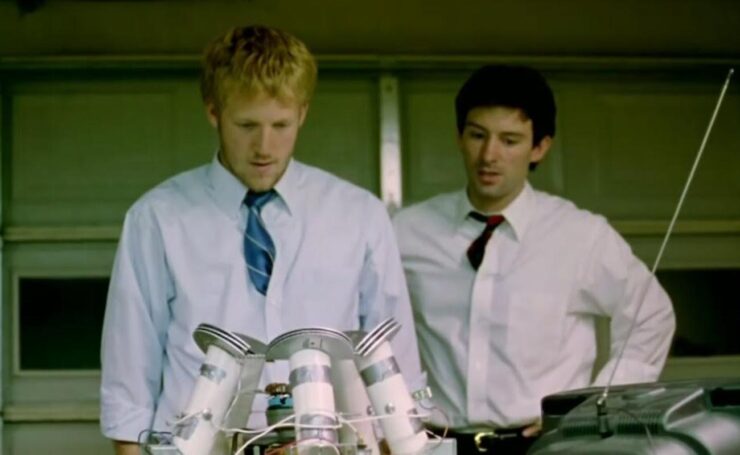
Primer really was filmed largely in Carruth’s parents’ house in suburban Dallas. The lack of funds meant each scene was carefully storyboarded ahead of time so that the actual filming only needed one or two takes for most scenes. The ’70s look of the movie is enhanced by the way the movie was filmed on Super 16mm film, with many scenes in extant fluorescent light, and subsequently overexposed in processing to give it that flat, washed-out visual style.
Likewise, the dialogue—which is sometimes inaudible and sometimes impenetrable—is purposefully naturalistic, with characters talking over each other, interrupting each other, not always listening properly, with a lot of technical talk that is unexplained but convincing enough. The audience is dropped into conversations and scenes in media res, and there is often ordinary life happening around them while they talk about the presumably world-changing event of having accidentally discovered time travel.
All of this is deliberate. In interviews Carruth specifically mentioned films like Francis Ford Coppola’s The Conversation (1974), Martin Ritt’s Norma Rae (1979), and Alan J. Pakula’s All the President’s Men (1976) as stylistic inspiration, calling on that very ’70s movie style of putting a lens of grubby realism on even the most heightened and dramatic scenarios.
Primer is about two corporate tech bros who hate their jobs and accidentally invent a time machine. Aaron (Carruth) and Abe (David Sullivan) are working with some friends of theirs to invent a device that will make them a lot of money. They do the work in Aaron’s garage, using parts they steal from their day jobs or scavenge from cars and household appliances. What they are aiming for is a sort of superconductor-adjacent device for reducing the weight of objects, but at some point Abe notices that the machine actually creates a time loop. He tells Aaron, and the two immediately decide to use it to accomplish their original goal: making a lot of money.
There is something grimly hilarious about this and what it says about the characters. They don’t care that they don’t understand the machine they’ve built; they’re more concerned about the number of stock shares they trade while time traveling. They try very hard to ignore signs that time travel is giving them brain damage—bleeding from their ears, developing tremors so severe they can’t write—and focus instead on how they will steal their own passports to leave the country. They’ve created something strange and incredible, and they devote a lot of time and effort to working out the fiddly details of how to make the time loops work, but they have very little broader curiosity or awe about what they are doing.
This self-absorbed approach to redefining the laws of physics persists even when they do use the time loops for something other than making money. There is a subplot about gun violence at a party, another about somebody else possibly using their time machine, and some brief mentions of different versions of Aaron interacting with his wife, but none of it is explored in any depth. I think there are some flimsy parts of the storytelling there, as I would have liked for the audience to see some of the repercussions in their network of relationships, even if the characters didn’t notice them. What we do see is the breakdown of their friendship and, along with that, the breakdown in their relationship with their own invention, the invention that was supposed to change their lives for the better.
In a 2005 interview Carruth explained, “I saw these guys as scientifically accomplished but ethically, morons.” Their fundamental self-centeredness is very much the point. This is a time loop story in which the characters actively choose to put themselves in a time loop over and over again, but never learn anything from it. It’s an interesting counterpoint to other time loop films, the majority of which have characters falling into time loops by accident.
It also fits with the storytelling structure of Primer, which has an iceberg sort of structure in which a series of apparently linear scenes imply a lot of unseen complexity. The deliberate deployment of point-of-view is an important aspect of any time loop story; we have to know that what the POV characters are experiencing looks very different to them than it does to everybody else. We don’t necessarily have to see in great detail what it looks like for everybody else. Hints are enough, especially in a film like this, where the consequences of the main characters’ choices are quickly spiraling well beyond the careful, logical limits they believed they had set for themselves. But we do need to know that their experience is rapidly diverging from previous sequences of events.
I think my favorite example of this in Primer is when Aaron and Abe spot Thomas Granger (Chip Carruth) in a car at night. It comes out of nowhere, they have no idea what’s going on, they draw a lot of conclusions that are neither proven nor disproven, and it ends without us ever learning the full story of what happened. The nature of the time loop Aaron and Abe are creating is that things can happen in one loop that never happen again, and they can’t ever know exactly what is happening that they aren’t around to see, and they don’t know what other versions of themselves are doing, and it’s all coming from a time machine that’s kept in a U-haul storage unit that anybody could witness them entering and leaving—and can, apparently, be made portable, which we and Abe only learn at the very end.
One reason Primer has gained cult classic status among sci fi fans is that it cleverly gives us just enough information that we can try to sort out the tangled puzzle of the many overlapping time loops—but holds back from giving us an answer key.
I think that’s why I’m so interested in the cinematic style of the film. The darker American sci fi movies of the ’80s and ’90s might go for quite a lot of cynicism and grit, but they usually do it in a hyper-stylized way. Think Blade Runner (1982), RoboCop (1987) (which we will watch at some point!), or The Matrix (1999), all of which use their chosen tone and atmosphere as part of their science fictional worldbuilding. It’s a bit less common, I think, for a movie that sits firmly in the realm of “hard” sci fi to employ an extremely mundane tone and atmosphere in the same way. That carefully curated realism, the effect that comes from dropping us into scenes and conversation as though we are silent spectators, is a key component of making this work. We watch the story unfold in the garage, in the kitchen, in the public library, always knowing there is more going on than we’re seeing on screen, with the tacit acknowledgement that even what we do see isn’t the whole story.
Whether or not there actually is anything to be “solved” in the movie, it succeeds in making enough of the audience feel like digging into it. Some people find that fun, others find it frustrating; some people adore it, while others think it’s pretentious. My personal opinion is that the movie sort of falls somewhere in the middle of all that, but that’s fine, because it’s an enjoyable film to watch, and there are good reasons why people still talk about this no-budget first film from a previously unknown and now-disgraced filmmaker some twenty years later.
What do you think of Primer? Have your thoughts on it evolved over time? What would you do if you accidentally invented a time machine in your garage?
Next week: I watched Run Lola Run approximately one thousand times when I was in college and grad school, but I haven’t seen it since the early 2000s. How will it hold up? We shall see. Watch it on Criterion, Amazon, Apple, Fandango.[end-mark]
The post <i>Primer</i>: A Film for People Who Would Use Time Travel for Day Trading appeared first on Reactor.








 New Posts (Home)
 ChatBox
 Popular Posts
  Game Zone
 Top PodCasts