YubNub Social YubNub Social
    #astronomy #police #nightsky #law #racism #electionfraud #voterfraud #civilrights #ai #funny #jupiter #venus #fourthamendment #utah #cops
    Advanced Search
  • Login
  • Register

  • Night mode
  • © 2026 YubNub Social
    About • Directory • Contact Us • Developers • Privacy Policy • Terms of Use • shareasale • FB Webview Detected • Android • Apple iOS • Get Our App

    Select Language

  • English
Community
New Posts (Home) ChatBox Popular Posts Reels Game Zone Top PodCasts
Explore
Explore
© 2026 YubNub Social
  • English
About • Directory • Contact Us • Developers • Privacy Policy • Terms of Use • shareasale • FB Webview Detected • Android • Apple iOS • Get Our App
Advertisement
Stop Seeing These Ads

Discover posts

Posts

Users

Pages

Blog

Market

Events

Games

Forum

SciFi and Fantasy
SciFi and Fantasy  
1 y

If You’ve Been Waiting for Pixar’s Elio, Your Wait is Almost Over
Favicon 
reactormag.com

If You’ve Been Waiting for Pixar’s Elio, Your Wait is Almost Over

News Elio If You’ve Been Waiting for Pixar’s Elio, Your Wait is Almost Over Don’t forget to let people know if you’re not fireproof! By Molly Templeton | Published on March 19, 2025 Screenshot: Pixar Comment 0 Share New Share Screenshot: Pixar You may feel like you’ve been hearing about Pixar’s mistaken-identity comedy Elio for along time, and there’s a reason for that: You have. The first teaser for the animated film came out in June of 2023. That’s almost two years ago! And it will be almost exactly two years to the date when Elio arrives in theaters later this year. Elio is the story of a kid who really wants to be abducted by aliens—and an alien who would like a friend less warmongering than his dad. This new look at the film is considerably more charming than the previous ones were, if still a bit on the heavy-handed side. Here’s the synopsis: For centuries, people have called out to the universe looking for answers—in Disney and Pixar’s all-new feature film Elio, the universe calls back! The cosmic misadventure introduces Elio, a space fanatic with an active imagination and a huge alien obsession. So, when he’s beamed up to the Communiverse, an interplanetary organization with representatives from galaxies far and wide, Elio’s all in for the epic undertaking. Mistakenly identified as Earth’s leader, Elio must form new bonds with eccentric alien lifeforms, navigate a crisis of intergalactic proportions, and somehow discover who and where he is truly meant to be. Yonas Kibreab voices Elio; Zoe Saldaña is Aunt Olga; Remy Edgerly is the adorable Glordon; Brad Garrett the grim Lord Grigon; Jameela Jamil is Ambassador Questa; and the incredible Shirley Henderson lends her wondrous voice to a character called OOOOO. Elio is directed by Madeline Sharafian (head of story on Turning Red), Domee Shi (“Bao”), and Adrian Molina (Coco); Molina also wrote the screenplay. It’s in theaters June 20th.[end-mark] The post If You’ve Been Waiting for Pixar’s <i>Elio</i>, Your Wait is Almost Over appeared first on Reactor.
Like
Comment
Share
SciFi and Fantasy
SciFi and Fantasy  
1 y

Alison Brie and Dave Franco Get Really, Really Close in Together
Favicon 
reactormag.com

Alison Brie and Dave Franco Get Really, Really Close in Together

News Together Alison Brie and Dave Franco Get Really, Really Close in Together Closer. Closer. No, not that close! By Molly Templeton | Published on March 19, 2025 Screenshot: Neon Comment 0 Share New Share Screenshot: Neon Would you like to watch a minute and change of uncomfortable scenes that hint at something super gruesome and never quite show it? Boy, have we got a trailer for you. Together, the feature debut of writer-director Michael Shanks, stars real-life couple Dave Franco and Alison Brie in what looks like a story of, um, coming together. Literally. And not in a sexy way. There’s no synopsis for this film, but reviews describe a story about a longstanding couple who are sorta taking a new step in their relationship—one that involves maybe getting married, but definitely moving to the country where there are strange things in the woods and in the water, and also in a cave that seems like a really bad place to get temporarily trapped. Variety’s Owen Gleiberman called it “a body-horror movie about a serious thing—love—that never takes itself too seriously.” And while this trailer is mostly vibes—an eerily still pair of dogs, a grotesquely long hair—without body-horror details, they’re in there. Brian Tallerico, reviewing the film at Sundance, wrote, “With echoes of The Substance and the work of David Cronenberg, it is the rare body horror flick that actually delivers, turning viewers into squirming participants in the chaos.” Together isn’t in theaters until August 1st, so it’s likely we’ll get a closer look before then—whether we’re up for it or not.[end-mark] The post Alison Brie and Dave Franco Get Really, Really Close in <i>Together</i> appeared first on Reactor.
Like
Comment
Share
SciFi and Fantasy
SciFi and Fantasy  
1 y

No Messages on Wire Two: H.F. Arnold’s “The Night Wire”
Favicon 
reactormag.com

No Messages on Wire Two: H.F. Arnold’s “The Night Wire”

Books Reading the Weird No Messages on Wire Two: H.F. Arnold’s “The Night Wire” By Ruthanna Emrys, Anne M. Pillsworth | Published on March 19, 2025 Comment 0 Share New Share Welcome back to Reading the Weird, in which we get girl cooties all over weird fiction, cosmic horror, and Lovecraftiana—from its historical roots through its most recent branches. This week, we cover H.F. Arnold’s “The Night Wire,” first published in the September 1926 issue of Weird Tales and collected in Ann & Jeff VanderMeer’s anthology, The Weird. Spoilers ahead! Jim is the night manager of a wire office in a western seaport city. “There’s something uncanny about these night wire jobs,” he writes. You listen “to the whispers of a civilization. New York, London, Calcutta, Bombay, Singapore—they’re your next-door neighbors after the street lights go dim and the world has gone to sleep.” The night wire man takes down the news of every disaster “almost in his sleep, picking it off on his typewriter with one finger.” Queer things do happen sometimes. Jim wishes he could get over one particular instance, but he hasn’t yet. There is—no, was—only one night operator on Jim’s staff. John Morgan was a man in his forties, sober and hardworking. Morgan was one of only three “double men” Jim’s ever met. He could take down stories from two wires at the same time, typing them up on two different typewriters, hour after hour, making no mistakes. “He was a wizard, a mechanical automatic wizard which functioned marvelously but was without imagination.” On the night in question, Morgan mentions that he’s tired and finds the room “close,” but he settles into his work as usual. Only one wire is transmitting as three a.m. rolls around. Every ten minutes or so, Jim collects Morgan’s copy for sorting and review. It’s the usual stuff until, oddly, Morgan opens the second wire. His copy from the first wire remains the usual stuff. But the copy from the second wire catches Jim’s attention because it’s from a town he’s never heard of: Xebico. Jim has saved a duplicate of the Xebico dispatches, and can put them down verbatim. Wherever this city is, it’s experiencing unprecedented weather. A heavy fog that has descended on the city, defying lights to pierce it, stopping traffic, steadily growing denser. By evening, Xebico is pitch dark. Still stranger, the fog is accompanied by an unfamiliar “sickly odor.” Morgan, Jim notices, has slumped in his chair and directed his work lamp so it illuminates only the tops of his typewriters. His fingers, however, are as deft as ever. From Xebico: A village sexton arrives at the local wire office in hysterics, claiming that the fog originated in his churchyard. It billows into queer forms that writhe in anguish. Something else moves in the fog, but the sexton fled without seeing it clearly, driven by screams from the neighboring houses. He’s admitted to a hospital, unconscious. Two search parties go to the church. Neither return. The fog invades homes through every crack, bringing with it an oppressive odor of dead things. Terrified townspeople gather in the main church as, from the outskirts, cries come like wind whistling through a tunnel. Yet there is no wind. Jim has never been so unnerved in a dozen years of listening to the wire news. He looks out a window and wonders if he sees a faint trace of fog in the city canyons far below—no, just his imagination. Morgan, head sunk between his shoulders, looks asleep but continues to type. Jim stands behind his chair and reads the Xebico dispatches word by word. The wire operator in that cursed city writes that his office has stopped receiving bulletins from outside. He will stay with the wire, however, until the end. From his window, he can look down into a thick blanket of blackness and hear wails. He fears these are death cries, and they’re coming closer to the city center. The fog swirls in contortions “of almost human agony.” Occasionally it parts to give him a glimpse of the streets where people run screaming amid the “immense whistling of unseen and unfelt winds.” Then, directly below the Xebico operator, a break reveals that the fog is not mere vapor but alive. Beside each human is a “companion figure, an aura of strange and vari-colored hues” that clings and caresses. They are—but the operator dares not say. But the writhing human bodies are being stripped. Are being consumed “piecemeal.” Hot vapors obscure the horrific sight, but there’s a new wonder. The fog begins to change colors, not of its own accord but reflecting an overarching sky that has burst into flames. The fires burn the operator’s eyes and twist into “a kaleidoscope of unearthly brilliance.” He feels that these lights radiate “force and friendliness, almost cheeriness. But by their very strength, they hurt.” The lights descend a million miles at a leap. The fog melts beneath them. Again he sees the streets, which are full of people. Then the lights are all around him, enveloping, and— The wire to Xebico goes dead. Jim looks at Morgan, whose hands have dropped to his side and whose body hunches peculiarly. Jim directs the work lamp toward Morgan’s face and sees that his eyes are fixed, staring. Jim calls the Chicago office that has been transmitting to the second wire, but they say Wire Two hasn’t been used all night. Jim shouts to Morgan that the Xebico horror isn’t true, they’ve been hoaxed. But Morgan is cold, dead for hours. Could “his sensitized brain and automatic fingers [have] continued to record impressions even after the end?” Jim has searched world atlases for Xebico, and found no town of that name. Whatever killed John Morgan will remain a mystery, but he knows he’ll never work the night shift again. What’s Cyclopean: The fog originates as a “subterranean breeze” from the graveyard. The voices within echo in “queer uncadenced minor keys.” Libronomicon: We never do learn whether these wire reports end up in the paper the next day. I’m guessing not. Madness Takes Its Toll: The Xebico church sexton arrives in hysteria, reporting unbelievable stories of the fog’s origins. Eventually he works himself into a swoon—or maybe a coma, as one doubts he survives long enough to distinguish the two. Ruthanna’s Commentary VanderMeer’s introduction to “The Night Wire” is oddly apologetic about the “dated aspects” of the story. I assume this refers to the central role of a news wire. But while I’ve heard of kids unable to relate to characters who lack smartphones, that’s far from universal. (My own can handle The Wizard of Oz and Goosebumps books with equal aplomb.) And the readers of a 102-year retrospective anthology presumably have some mental flexibility about these things. I, personally, find older news technologies comforting—the idea of some linear set of developments, watched over by responsible typists and reported in due course, is a warming bit of nostalgia in these days when media itself is eldritch. (I dare you not to be stirred by this scene from The Post—and if I were going to apologize for anything, it would not be the tech but the dude-ful-ness of it all.) Which makes the intrusion of the eldritch into that controlled process all the more disturbing. In 1926, it would’ve been an all-too-familiar intrusion. The technology may have been more linear, the routes of communication more tailored to the bounds of human attention, but the events were no more comforting than those that come at us from a thousand directions now. The news from Xebico was everywhere. The fog that first hides, and then reveals, the fate of the town, might be the fog of chemical weapons in the trenches of Europe. Or it might be London’s pervasive smog, with its regular and often deadly surges. It might also be the precursor to weird fiction’s own periodic mists; it’s certainly the earliest I’ve seen. Though I imagine that fog has always frightened, and this one doubtless has its own ancestors. It’s an excellent and disturbing example of its kind, odiferous as well as visual, and full of… something. Monsters? Demons? Avenging angels? Ghouls? The latter seems all too plausible, and the influence on Lovecraft clear—not only in the upwelling anthropovores, or in the danger heralded by “colors as yet unseen by man or demon,” but in the ending. The lights that approach through the fog are painful in their strength, and yet “radiate force and friendliness,” containing “nothing harmful” even as they harm. Is this not wonder and glory? Indeed, I think Arnold does a better job than Lovecraft of persuading that this last-minute change of heart is an ultimate horror, rather than a revelation of truth. But then I would think that, wouldn’t I? (Anne below reads the “harmless” lights and the fog as in conflict, whereas I read them as different aspects of the same apocalypse. The resolution of this ambiguity will have to be left for some future interdimensional explorer.) I am also a complete sucker for stories of people sticking to their posts, even as deadly force overwhelms them, to make sure the word gets out. Vince Coleman, urging an incoming train to avoid the Halifax Explosion. Reporters staying in war zones, because getting the story out is more important than personal survival. The unknown operator in Xebico fits this profile, making for a more plausible source of last-minute apocalyptic detail than any terrified scrawler of “The window! The window!” or “Aaaaaaahhhhh!” Perhaps the stolid Morgan is a similar hero, literally dying to share the news from somewhere otherwise lost to the world. Anyway, if you like this story, you can now follow the local Xebico news on X, YouTube, Bluesky, Facebook, Google News, TikTok, Reddit, and many other sites. If you don’t want to follow the local Xebico news… sorry. I’m afraid you’ve got no choice. Anne’s Commentary According to The Weird’s introduction to “Night Wire,” Lovecraft “is said to have loved this story.” So did many other Weird Tales readers. In these days of online magazines, readers can instantly express their opinions. Not so in the days of the pulps, when editors had to rely on posted letters to figure out which offerings were winners and which were duds. I dug into the musty PDF files of WT and found that Farnsworth Wright had a closing column called “The Eyrie,” in which he published reader comments, albeit a couple of months after the issue in question. He encouraged comments by including a “coupon” that readers could cut out and mail to “The Eyrie.” It gave space for one’s favorite stories in that issue, plus remarks. Ditto space for the stories one didn’t like, and why. “Night Wire” appeared in the September 1926 issue. In the November 1926 issue, Wright singled out praise from Albert Elmo Morgareidge of St. Louis, who “as a printer by trade, and a newspaper man,” voted for Arnold’s story as the best of September 1926. Wright adds his own opinion: “The showing made by The Night Wire, by H. F. Arnold, in the voting was one of the agreeable surprizes in the balloting for favorite story in the September issue. This story was only a four-page ‘filler’ story, buried in the magazine without even an illustration, yet it drew so many votes that it ranks right behind the three leaders in popularity with the readers. The Night Wire is the type of utterly ‘different’ story that we are always looking for, the type that causes the editor to chortle with glee when he gets one in the day’s mail. And such utterly bizarre and ‘different’ stories are as nectar and ambrosia to the reader who is sated with the humdrum magazine fare of today.” In several sites I searched, Arnold is identified as Henry Ferris Arnold, Jr. (b. 1902 – d. 1963.) In his excellent blog Tellers of Weird Tales, Terence E. Hanley profiled the author as Henry Ferris Arnold, Jr., but later struck out the material related to that person, adding he’s not sure he has the right H. F. Arnold.  Stephen Graham Jones has written a story based on “Night Wire” called “Xebico”, which delves into the mystery of the author’s identity. Whoever H. F. Arnold was, I hope that they basked in Wright’s comment. Weird lit praise don’t get much finer. To return to Lovecraft, and why he would have loved “Night Wire.” Farnsworth Wright’s verdict that it’s utterly bizarre and different may be explanation enough. More specifically, its bizarreness hinges on the way news from “nonexistent” Xebico arrives in a wire office on Earth. The normal way such news arrived in the 1920s was via telegraph wire, with the content in Morse code. Jim doesn’t exaggerate when he calls John Morgan a “wizard”—the man’s capable of real-time translation from Morse code to English text of not one but two wire transmissions—simultaneously! Jim adds that Morgan’s superpower is of a “mechanical automatic” nature, and that the man himself is “without imagination.” There may be envy there, but if Morgan has never said a word about himself in three years, I can understand Jim’s assessment. Extreme focus and facility in one task combined with a certain disconnection, a certain limited outlook, might make Morgan a perfect receptacle for an invading alien mind. I think of the “degenerate” Joe Slater in Lovecraft’s “Beyond the Wall of Sleep,” whose “harmless stupidity” and “bovine, half-amiable normality” made him easy prey for a possessing “cosmic entity.” The title character of Lovecraft’s “Music of Erich Zann” is another victim (?) of an outside intellect that uses him as an expressive conduit. Tellingly, Morgan’s only personal communication to Jim is that he’s “feeling tired” that night. Shortly afterwards, he asks Jim if it doesn’t feel “close” in the office. His fatigue and breathlessness could be symptoms of a pending heart attack or stroke. When the cardiac or cerebral accident hits Morgan, he may die at once, leaving his “mortal coil” open for an operator from beyond—perhaps the Xebico operator, who’s lost connection with his usual channels but must report his world’s apocalypse to someone. And Xebico is in the grip of catastrophic conflict between the death-stinking fog and some celestial “quintessence of all light” that sears yet feels friendly. When the light melts the fog, the Xebiconians to whom strange-hued devourers clung moments before look restored to the Xebico operator, who is himself enveloped in light. End of transmission. So, a happy ending for Xebico, with the forces of light defeating the forces of obscuration? I don’t know. “Night Wire” feels too short to chronicle the ultimate confrontation of Good versus Evil. The increasingly eerie atmosphere and rising tension in Jim’s two-man office, high above the sleeping western seaport, is the story’s strength, undeniable. There’s no happy ending in Jim’s office, with Morgan dead and Jim psychically scarred into taking the day shift, which just doesn’t have the journalistic romance of the night wire so compellingly conveyed in the story’s opening. All those exotic locations hovering close in the darkness. Calcutta, Bombay, Singapore. Xebico. Maybe day shift’s not so bad. The doughnuts are freshest then. Next week, is Louis going to wake up? Is Rachel going to get home? Is Jud going to miss the whole thing? Find out with us in Chapters 58-60 of Pet Sematary.[end-mark] The post No Messages on Wire Two: H.F. Arnold’s “The Night Wire” appeared first on Reactor.

Like
Comment
Share
Daily Signal Feed
Daily Signal Feed
1 y

Want to Fix the Birth Dearth? Make Marriage Matter
Favicon 
www.dailysignal.com

Want to Fix the Birth Dearth? Make Marriage Matter

A new report from the Centers for Disease Control and Prevention about birth data for 2023 is out. For everyone concerned about the long-term decline in America’s birth rate, the report doesn’t show strong signs that much has changed. Why should we care about declining birth rates, and what’s driving the trend? As a recent Heritage Foundation report warns, U.S. fertility is now below replacement. Fewer births and our historic low fertility rate will affect the future economy. It will affect programs like Social Security. Don’t forget the military. What about caregiving as the elderly age? A declining population will affect our nation’s future in more ways than we can count. If you ask 10 people why the number of births keeps going down, you’ll probably get 10 different answers, from housing and child care costs to economic anxiety to student loan debt. While there’s not one sole reason (and therefore not one single policy solution,) at the heart of the issue is marriage—fewer marriages, specifically. Fewer Americans are getting married, and those who do are getting married later, which in turn delays having kids (and how many they eventually have). My colleagues recently published a Special Report analyzing trends in marriage, childbearing, and other important factors of American family life. In it, they note: Today, married couples make up less than half (47 percent) of U.S. households, 40 percent of children are born outside marriage, and the birth rate has reached its lowest recorded level. The age of first marriage has increased by about seven years for both sexes. More adults ages 18 to 44 have cohabited (59 percent) than have been married (50 percent). Marriage itself has been legally redefined nationwide with the Supreme Court’s Obergefell v. Hodges decision in a way that rejects the fundamental link between marriage and childbearing. In fact, for a growing and influential segment of the country, even defining ‘man’ and ‘woman’ seems to be an impossible task. Healthy marriages help establish stable families and a thriving civil society. (And no, cohabitation does not provide the same stability and benefits for adults and children as marriage.) Separating marriage + having children has changed the structure of family formation for the worse. For all the attention that solving the “birth dearth” gets, pronatalism is not enough. It is not enough to look for policies and technology (some with serious ethical concerns) that encourages or assists people to reproduce. Addressing healthy marriages has to be front and center of policy proposals. There’s no one-size policy to help people enter a healthy marriage and keep it that way. One way to help is using (and building on) existing funding and programing at the state and federal level. But government programs can’t fix decades of cultural forces that have minimized or dismissed the importance of coupling sex, marriage, and childbearing together. The decline in marriage rates didn’t happen overnight just as the decline in births didn’t happen overnight. Put frankly, it took a long time to make the mess we’re in and it’ll take time to clean it up, too. We can debate the merits of things like student loan “forgiveness,” housing benefits, child care subsidies, and tax credits. But the most meaningful, effective way to address declining births is to reorient society to value family formation within stable, healthy marriages. Want to address the birth dearth? Let’s show our fellow Americans that marriage matters. The post Want to Fix the Birth Dearth? Make Marriage Matter appeared first on The Daily Signal.
Like
Comment
Share
Daily Signal Feed
Daily Signal Feed
1 y

Trump’s Military Transgender Ban Blocked by Federal Judge Facing Misconduct Complaint
Favicon 
www.dailysignal.com

Trump’s Military Transgender Ban Blocked by Federal Judge Facing Misconduct Complaint

A preliminary injunction issued by U.S. District Judge Ana Reyes on Tuesday blocked President Donald Trump’s executive order banning transgender-identifying individuals from serving in the U.S. armed forces.  Executive Order 14183, Prioritizing Military Excellence and Readiness, was signed by Trump on Jan. 27. It held that “expressing a false ‘gender identity’ divergent from an individual’s sex cannot satisfy the rigorous standards necessary for military service.” According to the order, “adoption of a gender identity inconsistent with an individual’s sex conflicts with a soldier’s commitment to an honorable, truthful, and disciplined lifestyle, even in one’s personal life.” The ban had not taken effect yet.  The executive order reinstates a long-standing Department of Defense policy that was changed during President Barack Obama’s second term. Trump reinstated the policy during his first term, and the Supreme Court permitted it to take effect. The transgender ban was reversed by President Joe Biden after he took office in 2021.  Reyes, who was appointed to the U.S. District Court for the District of Columbia by Biden in 2023, in the hearing about the executive order derided it as “illogical judgments based on conjecture.”  The Justice Department filed a complaint to the chief judge of the U.S. Court of Appeals for the District of Columbia on Feb. 21 against Reyes for misconduct that occurred during the hearing about the president’s ban on transgender troops. The author of the complaint, Chad Mizelle, chief of staff to Attorney General Pam Bondi, wrote that despite the case being about simply the “ripeness and success on the merits,” Reyes took issue with a variety of the government’s positions, including whether there are only two sexes. The judge contended that the government’s position on two biological sexes was incorrect: “[T]his executive order is premised on an assertion that’s not biologically correct. There are anywhere near about 30 different intersex examples. So, someone who does not have just an XX or XY chromosome is not just male or female; they’re intersex. And there are over 30 potential different intersex examples.” Reyes also accused the president of “literally erasing transgender people” and began questioning one of the DOJ attorneys about his religious views. “What do you think Jesus would say to telling a group of people that they are so worthless, so worthless that we’re not going to allow them into homeless shelters? Do you think Jesus would be, ‘Sounds right to me’? Or do you think Jesus would say, ‘WTF? Of course, let them in?” Reyes said, according to the transcript of the hearing.  The complaint argues that such a hypothetical put the attorney “in an untenable position,” in which he either appeared unresponsive or was speculating about “how an incoherent hypothetical aligns with Judge Reyes’ personal religious beliefs.” The attorney ended up replying that the government was not going to speculate about what Jesus would have said about anything. The complaint also questioned the judge’s use of the acronym “WTF,” which it contends “sheds light on the severity of the judge’s lack of professional decorum.” The complaint also argued that Reyes attempted to embarrass the government counsel by making him sit down and derided his alma mater, the University of Virginia Law School. According to the transcript, after she had the DOJ lawyer sit down, she claimed all University of Virginia Law grads were “liars and lack integrity.” The complaint held that this violated the code of conduct for federal district judges, specifically Canon 3A(4), which instructs judges to “accord to every person who has a legal interest in a proceeding, and that person’s lawyer, the full right to be heard, according to law.” The complaint holds that the judge also violated Canon 2A, which holds judges to “act at all times in a manner that promotes public confidence in the integrity and impartiality of the judiciary,” as well as Canon 3A(3) that says judges should “be patient, dignified, respectful, and courteous.” The complaint calls for an investigation to establish whether there is a pattern of alleged misconduct that would warrant “more significant remedial measures.” It notes that ”[w]hen judges demonstrate apparent bias or treat counsel disrespectfully, public confidence in the judicial system is undermined.” The post Trump’s Military Transgender Ban Blocked by Federal Judge Facing Misconduct Complaint appeared first on The Daily Signal.
Like
Comment
Share
Daily Signal Feed
Daily Signal Feed
1 y

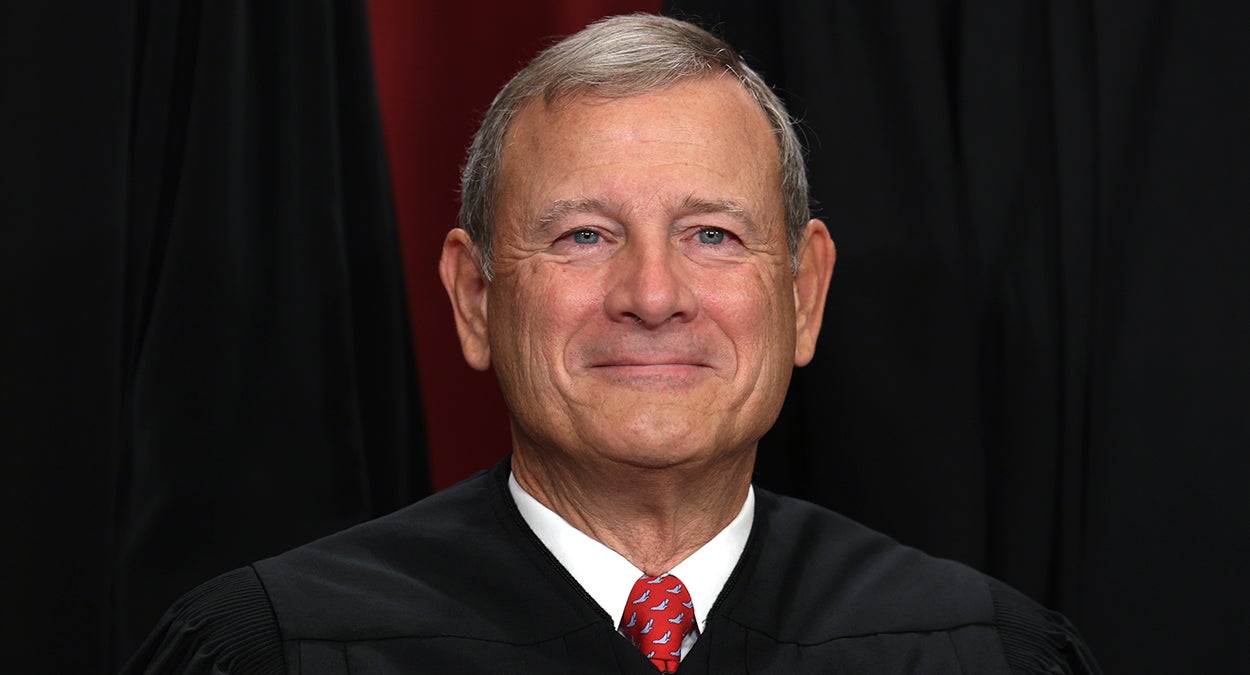
BETRAYAL: Chief Justice John Roberts Takes the Side of Deep State Swamp Creatures Against Trump
Favicon 
www.dailysignal.com

BETRAYAL: Chief Justice John Roberts Takes the Side of Deep State Swamp Creatures Against Trump

The deep state and its allies have launched a torrent of lawsuits, teaming up with activist judges to try to tie President Donald Trump’s hands on policy, and when the chief justice of the Supreme Court finally intervened, he did so on behalf of the lawless aggressors. Make no mistake: He sided with the revolt from within, the woke bureaucrats and their close allies in leftist groups who have weaponized the legal system against the people’s elected president, Donald Trump. Why? John Roberts is an institutionalist’s institutionalist. He seems not to have a populist bone in his body, and that has blinded him to the true injustice of the situation. What Happened? When woke bureaucrats stared down the barrel of a second Trump term, they strategized about how best to tie the new president’s hands. Public-sector unions made new collective bargaining agreements to protect work-from-home perks. Employees changed their titles to hide “diversity, equity, and inclusion.” Perhaps most importantly, bureaucrats and their allies outside the administration geared up to sue the Trump administration, targeting friendly judges. Sure enough, the ink was barely dry on the president’s executive orders rooting woke ideology out of the government before public-sector unions (which represent federal bureaucrats) and leftist groups had taken the new administration to court. They also hand-picked jurisdictions with judges more likely to give them the injunctions they seek. Many of the unions and leftist groups filing these lawsuits also staffed and advised the Biden administration, as I expose in my book, “The Woketopus: The Dark Money Cabal Manipulating the Federal Government.” The ACLU, for instance, pushed the Biden administration to open the border, and now the ACLU is filing lawsuits to block Trump’s border policies. The judges—many of them appointed by Democrats, surprise surprise!—have taken the opportunity to issue “nationwide injunctions.” While temporary injunctions allow a judge to protect one of the parties in a case from harm while the court considers the case, judges have weaponized this power, claiming to protect people across the country who aren’t parties to the suit. Just this week, judges blocked Trump’s order removing gender ideology from the military and the State Department’s move to restructure the U.S. Agency for International Development. Judges also ordered the administration to halt its freeze on federal spending, to restore deleted websites, and more. Such moves arguably represent a grotesque abuse of the judicial power granted in Article III of the Constitution—orchestrated by woke activists and their deep state allies. The Tren de Aragua Case None of these judicial attacks on Trump’s authority inspired so much as a peep from John Roberts. That changed Tuesday, however. Over the weekend, James Boasberg, a Washington, D.C., district court judge, presumed to order the administration to return flights carrying alleged members of the Venezuelan gang Tren de Aragua. Trump had invoked the 1798 Alien Enemies Act to fast-track the removals. The act gives Trump authority in case of an attempted, ongoing, or threatened “invasion or predatory incursion” from a “foreign nation or government.” Trump cited Tren de Aragua’s ties to the government of Venezuela and gang members’ crossing into the U.S. as justification. The Left orchestrated a judicial coup against the policy. The ACLU filed a lawsuit opposing the flights. Boasberg issued an emergency order Saturday, blocking the flights for 14 days while he considered the case. “Any plane containing these folks that is going to take off or is in the air needs to be returned to the United States,” the judge stated, according to The New York Times. “This is something you need to make sure is complied with immediately.” He issued his order verbally before putting it in writing. The Justice Department has insisted that the flights, which arrived in El Salvador after the judge’s order, did not violate the order because they had already left the U.S. by the time he issued the written version. Critics say the administration should have returned the flights or prevented them from taking off after Boasberg gave his verbal order. Trump’s Response Trump has pledged to comply with the judges’ orders, though he has rightly contested them in court. He responded angrily Tuesday to Boasberg’s order, however. The president noted that he won the 2024 presidential election in part by promising to oppose illegal immigration. “I’m just doing what the VOTERS wanted me to do,” Trump wrote. “This judge, like many of the Crooked Judges’ I am forced to appear before, should be IMPEACHED!!!” Only at this point did Roberts get involved. He released a rare statement to the press, chiding Trump. “For more than two centuries, it has been established that impeachment is not an appropriate response to disagreement concerning a judicial decision,” Roberts said. “The normal appellate review process exists for that purpose.” This may not seem like a big deal, but the Supreme Court almost never weighs in on news, so it sent shock waves across Washington. Out to Lunch To call this response tone deaf would be an understatement. Rep. Eli Crane, R-Ariz., one of the lawmakers who has introduced articles of impeachment against these judges, put it well. “This isn’t a disagreement concerning a judicial decision—this is a full-on, broad-based effort of radical judges to stop President Trump and the mandate he received from the American people to carry out his agenda,” Crane said. The problem isn’t that one judge happened to rule in a way Trump didn’t like. Instead, the president is facing a deep state judicial insurrection that is actively seeking to remove his rightful authority. Rather than stepping in to address the real problem, Roberts carried water for the judicial insurrection. Why? Roberts has chided Trump before. In 2018, when Trump denounced a judge who ruled against one of his immigration policies as an “Obama judge,” Roberts issued another rare public statement. “We do not have Obama judges or Trump judges, Bush judges, or Clinton judges,” he said. “What we have is an extraordinary group of dedicated judges doing their level best to do equal right to those appearing before them.” The judiciary should be unbiased. Statues of Lady Justice wear a blindfold because true justice does not “pay respect to persons,” i.e. resolve disputes based on riches or popularity rather than the merits of a case. Yet the public-sector unions and leftist groups suing Trump know how to use the system to their advantage, and the judges in many of these cases aren’t playing fair. To be fair, Roberts often takes conservative positions on important issues, and he has defended Trump’s rightful authority in the past. He wrote the opinion in the case granting Trump legal immunity for official acts he took as president, and he wrote the opinion in Loper Bright v. Raimondo (2024), a pivotal case that enables Americans to challenge administrative agencies in court. Roberts is still a conservative, but his preference for institutions and the status quo have blinded him to the needs of the moment. For instance, he refused to join the court’s majority in striking down the abortion precedent Roe v. Wade, focusing on a technicality. Like Anthony Fauci before him, Roberts sees Trump as a threat to his sacred institution, rather than the corrective to corruption within that institution. Trump may not always be right, but Roberts is missing the forest for the trees. When it comes to the judicial insurrection, Roberts should get his own house in order before he blames Trump. It may be right to criticize someone who yells “fire” in a crowded theater when there is no fire. In this case, however, not only is the blaze very real, but it’s licking at the robes of the chief justice himself. Rather than dousing the flames, he’s using a megaphone to shout down the man who raised the alarm—all in the name of decorum. Woe to those who cry, “Peace, peace,” when there is no peace. The post BETRAYAL: Chief Justice John Roberts Takes the Side of Deep State Swamp Creatures Against Trump appeared first on The Daily Signal.
Like
Comment
Share
Daily Signal Feed
Daily Signal Feed
1 y

Supreme Court to Decide if States Can Withhold Medicaid Funding From Planned Parenthood
Favicon 
www.dailysignal.com

Supreme Court to Decide if States Can Withhold Medicaid Funding From Planned Parenthood

The Supreme Court could soon strike a blow to America’s largest abortion provider. Amid growing concerns about the quality of care at Planned Parenthood facilities and the fact that taxpayer funding is going to facilities that provide abortions, the Supreme Court could effectively decide whether states can withhold taxpayer dollars from the organization in an upcoming case.   After South Carolina disqualified Planned Parenthood from receiving taxpayer funding under its Medicaid program, a federal district court forced the state to restore the funding. Now, attorneys from the Christian law firm Alliance Defending Freedom are representing the South Carolina Department of Health and Human Services in a case that could decide whether states can withhold such funding from providers like Planned Parenthood that fail to meet the state’s qualifications.   Oral arguments for the case, Medina v. Planned Parenthood South Atlantic, are set for April 2.  Medicaid is the taxpayer-funded, joint federal and state program that provides health insurance for low-income individuals.  “What’s at stake in this case is whether or not the American people can be forced to fund activist organizations like Planned Parenthood that perform abortions and distribute dangerous gender transition drugs to minors,” Alliance Defending Freedom senior counsel Chris Schandevel told The Daily Signal.  The narrower legal question is whether Medicaid provisions give individual beneficiaries a private right to choose a specific provider, regardless of whether that provider was disqualified for coverage by the state, and whether the individual can sue to vindicate that right. In this case, Medicaid beneficiary Julie Edwards was denied coverage after obtaining care at Planned Parenthood South Atlantic.  The Medicaid Act does not allow the state to terminate funding to a specific provider, Planned Parenthood argues, because it gives an individual the right to obtain care from any “qualified and willing provider.”  “As both courts below found and as petitioner no longer contests, South Carolina violated Ms. Edwards’ right to obtain care from the provider of her choice,” Planned Parenthood said in its brief. “The only question before this court is whether Ms. Edwards can do anything about it—in particular, whether she can sue … to vindicate this right.”  The case stems from two executive actions from South Carolina Gov. Henry McMaster, a Republican, according to a source familiar with the matter. In one order, McMaster directed in 2017 that state agencies cease providing state or local funds to any physician or professional medical practice affiliated with or operating concurrently with an abortion clinic.   The second order in 2018 directed the South Carolina Department of Health and Human Services to end Medicaid’s coverage of abortion clinics in favor of putting taxpayer dollars toward other family planning services that do not offer abortions.   Alliance Defending Freedom submitted its petition in June 2024, but the case is now coming before the court amid questions about the quality of Planned Parenthood’s care after a New York Times report in February.  The majority of the hundreds of millions of dollars Planned Parenthood receives in donations each year goes to legal and political expenses rather than improving the care provided at its clinics, the report said. As a result, The Times reported patient complaints of malpractice have landed the abortion provider in a tangle of lawsuits.  In addition to South Carolina, Arkansas, Missouri, and Texas have blocked Planned Parenthood from receiving Medicaid payments. Pending a favorable decision from the court, more states could follow suit.  “We expect Planned Parenthood to have a really difficult time identifying any language in the Medicaid Act itself to support their claim that individuals have a right to drag the state into federal court to force the state to reinstate funding for a disqualified provider like Planned Parenthood,” Schandevel said.  Planned Parenthood South Atlantic and its legal counsel did not respond to The Daily Signal’s request for comment by press time.  The post Supreme Court to Decide if States Can Withhold Medicaid Funding From Planned Parenthood appeared first on The Daily Signal.
Like
Comment
Share
Reclaim The Net Feed
1 y

India’s Election Commission Advances Voter Digital ID-Linking Initiative
Favicon 
reclaimthenet.org

India’s Election Commission Advances Voter Digital ID-Linking Initiative

If you're tired of censorship and dystopian threats against civil liberties, subscribe to Reclaim The Net. India’s Election Commission is pushing an initiative aimed at linking voter ID cards (EPICs, electoral photo identity cards) with the country’s digital biometric ID system. The system, Aadhaar, in turn, links residents’ fingerprints and iris scans to a unique 12-digit ID number. A meeting was been scheduled for this week that was expected to discuss how to speed up the process and deal with any road bumps along the way. For now, the plan is for the process of linking EPICs with Aadhaar to remain voluntary – and this is thanks to a Supreme Court ruling. The Election Commission is basing the effort on India’s Election Laws Act, the version amended in 2021, which allows officials to ask voters for their Aadhaar ID number in order to verify identity. Meanwhile, according to announcements earlier in the week, the meeting would bring together the Commission’s chief, Gyanesh Kumar, and officials from India’s Ministry of Home Affairs as well as those from the Unique Identification Authority of India (UIDAI). This last participant is credited for successful work on “biometric deduplication” (of voter registration, through Aadhaar authentication using facial recognition.) Not everyone is happy with these developments – several opposition parties have spoken about the possibility of manipulating voter lists by abusing the incoming system, as well as through duplication of EPIC numbers. The Commission did not deny this last point, but said it would solve the problem “within three months.” However, its representatives claim that duplicated voter ID card numbers “do not necessarily indicate fraudulent registration.” And the justification for this latest initiative of linking EPICs with Aadhaar is that it will improve “election integrity” – specifically around voter rolls. The initiative comes on the heels of the rollout of the electronic version of electoral photo identity cards – e-EPICs. The overall direction of all these moves is to further cement the role of digital ID in both India’s government services and the private sector. Another recent development aimed toward the same goal is the announced launch in 2025 of an updated Central KYC (“know-your-customer”) Registry (CKYCR). Before this, the country’s postal service incorporated eKYC, based on Aadhaar, for savings accounts. If you're tired of censorship and dystopian threats against civil liberties, subscribe to Reclaim The Net. The post India’s Election Commission Advances Voter Digital ID-Linking Initiative appeared first on Reclaim The Net.
Like
Comment
Share
Hot Air Feed
Hot Air Feed
1 y

Musk: A 'Fact' That Biden Rejected Astronaut Rescue 'For Political Reasons'
Favicon 
hotair.com

Musk: A 'Fact' That Biden Rejected Astronaut Rescue 'For Political Reasons'

Musk: A 'Fact' That Biden Rejected Astronaut Rescue 'For Political Reasons'
Like
Comment
Share
Science Explorer
Science Explorer
1 y

Tokyo Underground Sarin Attack At 30: Who Was The Deranged Doomsday Cult Responsible?
Favicon 
www.iflscience.com

Tokyo Underground Sarin Attack At 30: Who Was The Deranged Doomsday Cult Responsible?

The attack by Aum Shinrikyo shocked the world, but it was only one part of their short reign of terror.
Like
Comment
Share
Showing 60087 out of 126100
  • 60083
  • 60084
  • 60085
  • 60086
  • 60087
  • 60088
  • 60089
  • 60090
  • 60091
  • 60092
  • 60093
  • 60094
  • 60095
  • 60096
  • 60097
  • 60098
  • 60099
  • 60100
  • 60101
  • 60102
Advertisement
Stop Seeing These Ads

Edit Offer

Add tier


Select an image
Delete your tier
Are you sure you want to delete this tier?

Reviews

In order to sell your content and posts, start by creating a few packages. Monetization

Pay By Wallet

Payment Alert

You are about to purchase the items, do you want to proceed?

Request a Refund