YubNub Social YubNub Social
    #racism #elections #conservatives #gerrymandering
    Advanced Search
  • Login
  • Register

  • Night mode
  • © 2026 YubNub Social
    About • Directory • Contact Us • Developers • Privacy Policy • Terms of Use • shareasale • FB Webview Detected • Android • Apple iOS • Get Our App

    Select Language

  • English
Night mode toggle
Featured Content
Community
New Posts (Home) ChatBox Popular Posts Reels Game Zone Top PodCasts
Explore
Explore
© 2026 YubNub Social
  • English
About • Directory • Contact Us • Developers • Privacy Policy • Terms of Use • shareasale • FB Webview Detected • Android • Apple iOS • Get Our App
Advertisement
Stop Seeing These Ads

Discover posts

Posts

Users

Pages

Blog

Market

Events

Games

Forum

YubNub News
YubNub News
1 y

Trump Administration Directs ICE to Locate and Deport Unaccompanied Migrant Children
Favicon 
yubnub.news

Trump Administration Directs ICE to Locate and Deport Unaccompanied Migrant Children

A newly revealed internal memo outlines the Trump administration’s plan to track and deport unaccompanied migrant children, marking a significant expansion of its immigration enforcement policies. Byline:…
Like
Comment
Share
Classic Rock Lovers
Classic Rock Lovers  
1 y

The hardest Florence and the Machine song to sing, according to Florence Welch
Favicon 
faroutmagazine.co.uk

The hardest Florence and the Machine song to sing, according to Florence Welch

"I’m an idiot!” The post The hardest Florence and the Machine song to sing, according to Florence Welch first appeared on Far Out Magazine.
Like
Comment
Share
Intel Uncensored
Intel Uncensored
1 y

5 Controversial Technologies In Development That Cannot Go By Unchecked –  From Alien Technology To Head Transplant Robotic Surgeries, The Question Isn’t If They Can But Rather If They Should
Favicon 
www.sgtreport.com

5 Controversial Technologies In Development That Cannot Go By Unchecked – From Alien Technology To Head Transplant Robotic Surgeries, The Question Isn’t If They Can But Rather If They Should

by Paul A. Philips, All News Pipeline: We live in a world filled with deception and there couldn’t be more willful deceptive spin than that put out by the world’s leading technocrats. The technocratic agenda is aimed at convincing us that their new technologies are greatly beneficial. In assertive statements, they’re making outright claims that […]
Like
Comment
Share
The Lighter Side
The Lighter Side
1 y

Vienna’s Refugee-Run Hotel Is Thriving
Favicon 
reasonstobecheerful.world

Vienna’s Refugee-Run Hotel Is Thriving

Entering the lobby of Magdas Hotel around midday, the scene is one familiar from countless trendy hotels around Vienna — the cool-yet-cozy décor and quiet music in the background, locals on lunch break slowly filling the restaurant, a gaggle of tourists checking in at the reception desk, taking in their new environment with jet-lagged excitement. A neon sign behind the reception reminds them to “stay open-minded.” Most guests come to Magdas looking for nothing more than the good service, comfortable rooms and central location promised by online reviews. “With time they might notice that many of us working here aren’t Austrian, that many cultures are represented, and they ask what’s going on here,” says Ziad Rabeh, the head receptionist. “And then we tell them our story.” Magdas Hotel opened on Valentine’s Day 2015, with the purpose of helping refugees integrate into the job market by offering employment and training. The timing was excellent for all the wrong reasons: Over 1.3 million migrants applied for asylum in Europe over the course of that year, kicking off Europe’s so-called migrant crisis. As countries struggled to accommodate the new arrivals — and, in some cases, erect border fences — charities, NGOs and social businesses across Europe rallied to help them rebuild.  Magdas has been operating for 10 years. Credit: Walter Luttenberger While there is no universal definition of successful integration for refugees, work is generally considered a crucial component — but it’s not easy to come by. Finding employment in a new country without a social network, local language skills or recognized education certificates can feel like an insurmountable task. In Austria, restrictions on access to the job market during the often lengthy asylum application process further complicate matters, so that, on average, it takes refugees almost three years longer than other migrants to enter the Austrian labor market. “People spend a considerable part of their life working, and that provides a lot of functions,” says Peter Vandor, head of the Social Entrepreneurship Center at the Vienna University of Economics and Business. Reliable income is a big part of building a stable and secure life, but the social aspects of work can be just as important, providing people with the opportunity to learn the local culture and develop a public identity beyond their status as a refugee or migrant. “It allows you to feel competent and in control and exhorting mastery, which is especially important for someone who has gone through an experience where they are just reacting.” Weighed down by negative news? Our smart, bright, weekly newsletter is the uplift you’ve been looking for. [contact-form-7] “Here the people we employ are no longer guests but hosts, and can make good use of the qualities they bring with them,” says Gabriela Sonnleitner, who has been running Magdas for almost a decade. “And Austria is a tourist destination. There is always a demand for skilled workers in this sector.” Rabeh joined the Magdas team in 2016, having arrived from Syria with his family the year before. He had originally interviewed for a position in accounting, but as with other jobs, his lack of German-language skills was an issue. “In Syria I worked in the accounting department of a large hotel, so I know the industry. But it was boring, I was just working with numbers. I figured working at the reception would be better for improving my German,” he remembers.    Ziad Rabeh (left) joined the Magdas team in 2016, having arrived from Syria with his family the year before. Credit: Aleksandra Pawloff After initial training, he apprenticed as a hotel manager, eventually taking over as the head of reception in 2021. For Rabeh, Magdas’s commercial success is a point of pride: “People with asylum come from other countries, other cultures, they’re afraid, and the people aren’t very open-minded about them. But Magdas proves that it can work.” In recent years, social businesses have emerged as a powerful tool for addressing social issues worldwide. Prioritizing social impact over profit, such businesses straddle the line between NGOs and the private market. “Austria is a welfare state. There are many state-run services and NGOs, but with a social business the question becomes, ‘How can I solve a social problem with economic means?’” says Sonnleitner. While the hotel was founded by the charity Caritas, it operates independently. “This was a requirement,” says Sonnleitner. “We have to earn the money we need for this project ourselves. There is no funding, no donations.” Magdas runs apprenticeship programs for for cooks, restaurant experts and hotel managers. Credit: Severin Wurnig / BWM Architekten Financially independent social businesses can be more adaptable to the changing needs of their target groups and less vulnerable to changing political priorities. Their hybrid nature makes them an appealing option across the ideological spectrum, emphasizing both the importance of entrepreneurship and of social welfare. “It’s a multi-purpose concept,” says Vandor. “Pretty much every topic is being tackled by some social entrepreneur or social innovator. It’s attractive policy-wise because it’s fairly broad in what it tries to achieve.” Especially when working in a politically charged field like migration, the cloak of entrepreneurship can also shield social businesses in countries where governments are hostile towards NGOs. Building a self-sustaining business while serving a marginalized and often vulnerable group comes with many challenges. “We learned a lot in those first years, we were quite naïve,” Sonnleitner says with a laugh. “We had five experienced hotel employees and 20 refugees who have never worked in the service industry before. We quickly realized that this ratio doesn’t work.” Over the years, the hotel invested heavily in training and communication, which was the biggest challenge for such an international team — both in terms of language and culture. The hotel also employs a social worker who comes by once a week. “Many of the people working here have very difficult life stories and are still processing things,” says Sonnleitner. The social worker also helps them navigate the practical aspects of building a new life in Austria, like moving out of temporary accommodation, sorting out language courses and navigating bureaucracy. “She helps them feel more stable and get their lives in order so they can work well and integrate well into the workplace.” Even so, accepting the limitations of the project was an early lesson, and a hard pill to swallow. “We learned that we can’t solve all the problems in the world,” says Sonnleitner. “At the beginning it totally overwhelmed us. We can help with work integration, but all the other problems, the trauma they might still be processing, that is beyond our capacities.” In addition to offering training on the job, Magdas launched three apprenticeship programs — for cooks, restaurant experts and hotel managers — in the autumn of 2017, hosting around 10 apprentices at any given time. About 35 percent of young people in Austria pursue practical vocational training. A foundational part of the Austrian education system, this training combines a paid apprenticeship with part-time studies at a vocational school. “Afterwards you have an official education in Austria and good options going forward,” says Sonnleitner. After a completed apprenticeship many jump straight into the job market, but it’s also possible to continue training or complete the Matura examination to attend university.  In autumn 2022 the hotel to a new location that was thoroughly renovated with an eye towards circularity and sustainability. Credit: Julia Geiter Ten years in, Magdas has integrated over 100 refugees into the job market. It currently employs 43 people from all over the world, with around 20 languages spoken on the team. Magdas’s success offers proof that a social business doesn’t have to sacrifice its bottom line. In autumn 2022 the hotel moved from the former retirement home on the edge of Prater Park to a new central location, this one a former priest’s residence that was thoroughly renovated with an eye towards circularity and sustainability. Meanwhile, the original location will be renovated to a high environmental standard and reopened as a second Magdas Hotel in 2027, providing 42 additional training and employment opportunities.  This success and growth gives the social effort at its core an additional aura of legitimacy — there’s no question that it’s a sound business model. “Social entrepreneurs are perceived as more legitimate because they are so close to the market, especially in job market integration,” says Vandor.  Wait, you're not a member yet? Join the Reasons to be Cheerful community by supporting our nonprofit publication and giving what you can. Join Cancel anytime But with many work integration projects focusing on services, gastronomy, trade and industry, which are easier to access without language skills or a recognized higher education degree, there is the risk of occupational downgrading, leaving even skilled workers stranded in low-skilled jobs.  This was the case for Rabeh, but while he is by now fluent in German, has passed the Austrian accountant examination and received his Austrian citizenship last year, he is planning to continue working at the reception for the time being. “I believe in Magdas,” he says. “I might go back to accounting later, but for now I find I can support people better at the reception. Magdas gave me this chance, and I want to pay it forward.” The post Vienna’s Refugee-Run Hotel Is Thriving appeared first on Reasons to be Cheerful.

Like
Comment
Share
Living In Faith
Living In Faith
1 y

Struggling with Impatience in Motherhood? Try Fasting.
Favicon 
www.thegospelcoalition.org

Struggling with Impatience in Motherhood? Try Fasting.

I used to think of fasting as a spiritual practice for desperate situations—not for my typical struggles as a mom. But the days of caring for my two young girls at home were often punctuated by simmering impatience and anger. I enjoyed motherhood and desired to embody the heart of Christ, but self-control felt elusive in the hard moments. In Scripture, we read that God’s people fasted for several reasons—to seek God’s wisdom (Acts 13:1–3), to lament (Neh. 1:1–4), to express repentance (Lev. 23:27–28), and to fight temptation (Matt. 4:1–2). Fasting was an embodied way for God’s people to surrender their whole lives to him, which was what I needed—desperately. Maybe fasting would be good for me, after all. Initially, I wondered how not eating for a day would have any positive effect on my mothering. Wouldn’t hunger only exacerbate my poor attitude? Nevertheless, my husband and I chose a day to fast from breakfast and lunch, eating only an evening meal—and it was the most peaceful, emotionally restrained day I’d experienced in a long time. How the Lord works in our lives through fasting is still somewhat of a mystery to me. But I’ve begun to recognize how the Holy Spirit uses it to orient my hunger toward Christ and declare his sufficiency in the everyday work of motherhood. Fasting Cultivates Humility In Deuteronomy 8:3, Moses reflects on God’s provision during the Israelites’ 40 years of wilderness wandering: “He humbled you and let you hunger and fed you with manna, which you did not know, nor did your fathers know, that he might make you know that man does not live by bread alone, but man lives by every word that comes from the mouth of the LORD.” The Holy Spirit uses fasting to orient my hunger toward Christ and declare his sufficiency in the everyday work of motherhood. Hunger is uncomfortable. God made our bodies to need food and our souls to enjoy it. When those of us with access to an abundance of food experience hunger pains and don’t immediately satisfy them, it’s an invitation to acknowledge our felt finitude before the Lord. It’s possible to avoid the discomfort of hunger so adeptly that we rarely remember we’re dependent creatures. As I feed, dress, instruct, and encourage my kids, how quickly I forget that I don’t hold all things together. I’m tempted to believe that my strength (or energy level, time management, or disciplinary strategies) will bring peace and security to my home. While food certainly benefits our mental clarity and emotional regulation, temporarily going without it reminds us of our true source of well-being. Fasting is an opportunity to dwell on God’s sufficiency through meditating on his Word and recognizing his compassionate presence in our weakness. Fasting Reveals Deeper Longings Bodily hunger can be demanding, requiring our attention several times each day. By delaying gratification, we embody and focus our attention on the deeper desires within us that cannot be satiated apart from the Lord. What do we want most? On a standard Tuesday morning, for example, my potent desire on the surface is for my kids to stop whining. Yet even more than that, I long to grow in endurance and faithful love. In some mysterious blend of the Spirit’s strength and my obedience, the physical restraint practiced through fasting trains my heart toward self-control. I more readily respond with gentleness instead of irritability. Not every time; the flesh makes a valiant effort to challenge the Spirit’s inner workings (Gal. 5:17). But I’m convinced that regular fasting—like rhythms of prayer and Scripture meditation—slowly and repeatedly reorients my deepest hunger toward Christ and compels me to find satisfaction in him. Richard J. Foster explains, “Our human cravings and desires are like a river that tends to overflow its banks; fasting helps keep them in their proper channel.” Hunger can also guide me to intercede for others as I attend to my children. Each time my stomach groans, whether while running errands or changing a diaper, I can remember people and circumstances in need of God’s consolation and redemption: “Lord, even more than I hunger for food right now, I long for . . .” Fasting becomes a subtle but powerful way to redirect my attention to God’s desires. Fasting Develops Perseverance I’ve noticed how the Lord has grown my endurance in motherhood through a regular practice of fasting. He has increased my tolerance for the inconvenient, uncomfortable, and tedious sacrifices necessary for my kids’ well-being. He has quickened my reflex to ask for help and surrender my will, rather than worry and complain. He has provided contentment on days when I can hardly wait until naptime. The apostle Paul faced significant worldly troubles; he was stoned, shipwrecked, imprisoned, and martyred for his faith in Jesus. Yet in 2 Corinthians 4:17, he describes suffering as a “light momentary affliction” that’s “preparing for us an eternal weight of glory beyond all comparison.” My experience of suffering isn’t like his, but fasting is one way I can voluntarily undergo “light momentary affliction” to fix the eyes of my heart on eternity. I can choose to seek God’s peace amid hunger, the toddler’s fussiness, sickness, missed expectations, and dirt tracked on the floor. And when I encounter seasons of more severe suffering in the years to come, I pray my attitude will be like David’s when he declared contentedly, “I lack nothing” (Ps. 23:1, NIV). Take and Eat The purpose of any spiritual practice isn’t checking a box or mastering a skill. The goal is deeper, integrated union with Christ. Fasting, then, is an opportunity not to prove our righteousness but to grow in our belief that God is sufficient. Fasting is an opportunity not to prove our righteousness but to grow in our belief that God is sufficient. While not every mom can or should fast in every season, it’s worth asking the Lord what role fasting might play in your spiritual growth. If you’re new to fasting, consider skipping one meal and paying attention to the thoughts and emotions that surface in your hunger. You might adopt a weekly fasting rhythm or fast in accordance with specific needs in your community. Rely on the Holy Spirit and the wise counsel of fellow believers for guidance and encouragement. However gracefully or contentiously your body responds to the hunger pains, keep looking to the Lord for sustenance and satisfaction. Jesus compared his life to a loaf of bread, broken on the cross and shared so all who believe in him can take part in abundant, eternal life (John 6:35–40). Take and eat, moms—feast on his Word, ruminate on his promises, and anticipate the fullness of joy when he returns.
Like
Comment
Share
Living In Faith
Living In Faith
1 y

Be Faithful over Little: A Different Vision for a Life That Counts
Favicon 
www.thegospelcoalition.org

Be Faithful over Little: A Different Vision for a Life That Counts

I don’t remember ever being allured by the prosperity gospel. By God’s grace, I grew up in churches that spoke regularly of Christ’s sufficiency amid suffering. I never thought following Jesus would be easy. I was trained to count the cost. But, with a well-intended passion to make Jesus famous, I became convinced a life that counted for Christ was one of epic faithfulness. True cross-carrying, following the apostles’ example, meant “turn[ing] the world upside down” (Acts 17:6). As far as I was concerned, a Christian life that rose no higher than “ordinary” faithfulness in practicing spiritual disciplines, loving and providing for one’s family, and serving regularly in church was for folks who had either lost sight of the mission or had yet to truly understand that God’s glory is worth burning out for. Run-of-the-mill faithfulness hardly seemed like an appropriate offering for the glorious God who called me to put on my armor and offer my life as a living sacrifice. I wanted to change the world. My nagging fear wasn’t that I’d commit adultery or leave the faith but that I’d live a largely forgettable, quiet, “meh” life for Christ. While eternal life by grace through faith in Jesus felt like winning, a pedestrian contribution to Christ’s kingdom felt like losing. Thankfully, God used the parable of the talents (Matt. 25:14–30) to shatter and reconstruct my understanding of good and faithful service to Christ. Where Are the Extraordinary Christians? It’s embarrassing to admit in hindsight, but my distorted convictions led me to think no one God had placed in my life modeled exemplary faithfulness—not my godly parents, teachers, or coaches, or even my local church pastor. I appreciated them as great Christian folks. But as far as I could tell, they hadn’t turned anything upside down for Jesus. God used the parable of the talents to shatter and reconstruct my understanding of good and faithful service to Christ. The unwasted life was represented by missionaries, martyrs, public servants, famous pastors, and defenders of the faith; people who made real waves. True faithfulness looked like Calvin, Knox, Judson, Tyndale, Mueller, Spurgeon, Wilberforce, Whitefield, Graham, Piper, and Keller. Many weren’t prosperous by worldly standards, but their contributions in Jesus’s name were epic. That’s all I wanted. Was my desire to be a franchise player on God’s team shot through with mixed motives? Of course. I genuinely desired to make a difference for Christ and his kingdom. I just hoped that difference would look more like that of my heroes than that of my Sunday school teachers. Only after a life of epic faithfulness could I sit back at age 85 and say with a clear conscience, “My life counted for Christ. I didn’t waste it.” Parable of the Talents In Matthew 25, Jesus describes a man who entrusts his servants with his property and then goes on a journey. “To one he gave five talents, to another two, to another one, to each according to his ability. Then he went away” (v. 15). When the master returns to settle his accounts, Mr. Five-Talent and Mr. Two-Talent are found faithful. They return to their master double what they were given. Mr. One-Talent is found unfaithful, returning only the talent originally entrusted to him. As I read this parable one afternoon, my paradigm for “success” in the Christian life was vaporized by the master’s evaluation of the two faithful men. Both Mr. Five-Talent and Mr. Two-Talent received the verdict “Well done, good and faithful servant.” My initial response was “Yes! This is what motivates us to avoid living a small and ordinary life!” But what floored me was the reason the master offered his approving judgment: “You have been faithful over a little” (vv. 21, 23). That’s it. That’s why these men were deemed good and faithful servants. They were faithful over a little. Faithful with a few things. I would’ve expected “Well done, good and faithful servant” to be followed by something like “You were extraordinary” or “You changed the world!” But the master’s final analysis was “Faithful over a little.” To my ears, that commendation hardly corresponded with the magnitude of John Knox’s “Give me Scotland, or I die.” But there it was in the pages of Scripture. Jesus offers a glowing endorsement of two men’s faithfulness with a few things. On God’s authority, that’s a well-lived life. Comprehensive Faithfulness Is Jesus setting a low bar for Christian faithfulness? No. Recall that “little” describes not the intensity of the men’s devotion but rather the resources they were originally entrusted with according to their God-given abilities. “Faithful” describes what they did with those resources. Mr. Five-Talent receives the same commendation as Mr. Two-Talent even though the former returned twice as much profit, because the verdict isn’t based on the size of the return. Both men leveraged all their abilities to maximize what they were entrusted with. They both doubled what they were given. They were equally faithful. If you’re Mr. Two-Talent and Mr. Five-Talent is your neighbor, it may be difficult to feel faithful. But it’s a mistake to measure our faithfulness by our believing neighbor’s work; it’s wrong to make Mr. Five-Talent’s output the litmus test for whose life counts for Christ. Rather than thinking true faithfulness must be world-changing, we should aim to make it comprehensive. We should aim to multiply and steward all the abilities and opportunities we’ve been given, to not neglect any of the few things entrusted to us. Understood this way, faithfulness is primarily a matter of stewardship, not “impact.” It’s not seen in whether we achieve all we want for God but in how we steward the little God has given to us. Labor for the Master God’s gifting and call will lead some to have a public influence like the eloquent Apollos (Acts 18:24). But most of us will be more like the little-known Persis (Rom. 16:12), for whom the Bible’s commendation is that “[she] has worked hard in the Lord.” A shoutout like that used to feel like a participation trophy to me—commendable exertion with no impressive achievement to show for it. That’s why these men were deemed good and faithful servants. They were faithful over a little. But God hasn’t purposed for most people to be world-shapers. The vast majority of our faithfulness and work for the Lord will be exercised in the small, often boring, and monotonous rhythms of life. We’ll serve our families, churches, workplaces, and communities and do nothing particularly impressive. Among truly faithful Christians, only a fraction will have a biography written about them. If that’s disappointing to us—if a thoroughly faithful but outwardly run-of-the-mill life for Christ is unsatisfying—we’ve forgotten who we’re laboring for. We’ve become enamored with entering the joy of the wrong master. Remember John Newton’s words: If two angels were to receive at the same moment a commission from God, one to go down and rule earth’s grandest empire, the other to go and sweep the streets of its meanest village, it would be a matter of entire indifference to each which service fell to his lot . . . for the joy of the angels lies only in obedience to God’s will, and with equal joy they would lift a Lazarus in his rags to Abraham’s bosom, or be a chariot of fire to carry an Elijah home. Faithfulness Today I still want to change the world. I still pray, echoing Jim Elliot, “Lord, make me dangerous.” Those impulses are good. But I no longer conceive of true, sold-out faithfulness to Christ in terms of widespread influence. I understand “faithful over a little” to involve service that varies dramatically from person to person based on the abilities and resources God has given them. Annie Dillard insisted that “how we spend our days is, of course, how we spend our lives.” If a faithful life is the sum of faithful days, we better make the most of what God places in front of us. Don’t wait around for a giant-slaying moment that will make all the years of training with your sling feel worthwhile. Instead, steward what God has placed before you. Labor for Christ’s approval, not man’s. Be faithful over little. You may not become a hero of the faith, but you’ll be a good and faithful servant of Christ. As Jesus sees it, that’s a job well done.
Like
Comment
Share
Living In Faith
Living In Faith
1 y

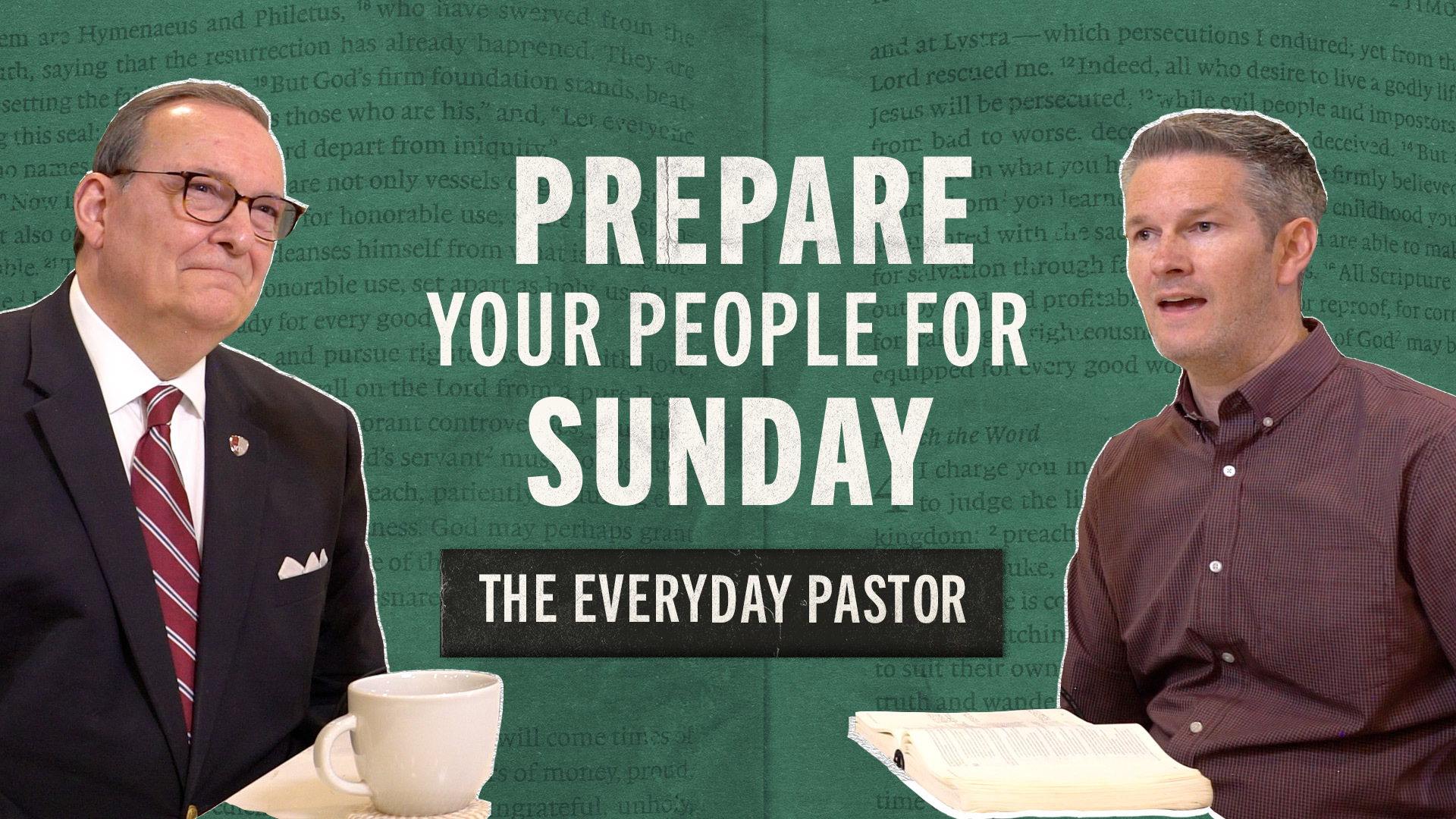
Prepare Your People for Sunday
Favicon 
www.thegospelcoalition.org

Prepare Your People for Sunday

Do your members prioritize the Lord’s Day? Are they maximizing their time at church? In a hyperbusy age, we can serve our people by preparing them to come on Sundays ready to grow, ready to serve, and ready to launch. In this episode of The Everyday Pastor, Ligon Duncan and Matt Smethurst offer practical tips for helping your congregation get the most out of corporate worship. Recommended resources: How Can I Make the Most of Sunday Services? by Erin Wheeler Listen Up: A Practical Guide to Listening to Sermons by Christopher Ash The Practical Works of Richard Baxter, Vol. 1: A Christian Directory by Richard Baxter J. I. Packer: An Evangelical Life by Leland Ryken (see Packer’s essay “A Mouthpiece for God”) Make the Most of Sunday Mornings: Two Simple Changes by Matt Smethurst 
Like
Comment
Share
Homesteaders Haven
Homesteaders Haven
1 y

Another Natural Homemade Deodorant Recipe
Favicon 
homesteading.com

Another Natural Homemade Deodorant Recipe

Make this homemade deoderant. It's easy, and your pits will thank you. How to Make Homemade Deodorant We've known for a while that store bought deodorants have chemicals that are thought to be linked with cancer cell growth, so why not skip to the toxins and learn how to make homemade deodorant for yourself? Use this homemade deodorant recipe to ward off body odors the natural way. You'll love this easy deodorant recipe so much you won't even miss big brand deodorants and wonder why you haven't been doing this all along! Ingredients: image via 1/4 cup Coconut Oil 1/4 cup Shea Butter 1/4 cup Beeswax 3 T. Baking Soda 3 T. Arrowroot Powder 15 drops OnGuard essential oil 8 drops Melaleuca oil   Step 1. Place coconut oil, shea butter, and beeswax pastilles in a glass measuring cup. Pop in the microwave for 10 seconds to melt them. image via   Step 2. Once melted, combine baking soda, arrowroot powder, and essential oil drops to the mixture. Mix until smooth. image via Add more liquids or powders until mixture has reached desired consistency (I prefer mine a little more stiff so I like to use a little more arrowroot powder).   Step 3. Pour mixture in a container. |   That’s all, fellow homesteaders! Did you enjoy our tutorial on how to make homemade deodorant? Let us know in the comments section below what you thought of our homemade deodorant. Do you have a favorite deodorant recipe that’s a staple on your homestead? Share it with us and we’ll give it a shot. We love doing DIY homesteading projects and becoming more self-reliant by learning more about how everything works around the homestead. That’s why Homesteading was created. We want all folks looking to lead a self-sufficient life, either on a homestead or in an urban environment, to come together and learn from each other! Of course, we welcome your help in creating a community of homesteaders.  Come and share your homesteading tips and ideas, recipes and expect the best advice on self-reliance and homesteading trials from our team of long-time homesteaders, self-reliant wilderness, and preparedness experts. Want to write for Homesteading? Shoot us an e mail and make sure to stay in touch on Facebook, Twitter, and Pinterest!   Adapted from Little House Living's Deodorant Recipe. Click here to read the original post.
Like
Comment
Share
Twitchy Feed
Twitchy Feed
1 y

A Come To Jesus Monument? AI-Generated 200-Foot White House Christ Statue Fools the Faithful
Favicon 
twitchy.com

A Come To Jesus Monument? AI-Generated 200-Foot White House Christ Statue Fools the Faithful

A Come To Jesus Monument? AI-Generated 200-Foot White House Christ Statue Fools the Faithful
Like
Comment
Share
YubNub News
YubNub News
1 y

Medicare Battle: Albanese Calls Dutton’s $9 Billion Plan ‘Pure Politics’
Favicon 
yubnub.news

Medicare Battle: Albanese Calls Dutton’s $9 Billion Plan ‘Pure Politics’

On Feb. 23, Dutton announced a $9 billion investment in Medicare, matching Labor’s proposed $8.5 billion plan.The Medicare debate has once again taken centre stage in the lead-up to the Australian federal…
Like
Comment
Share
Showing 58018 out of 120902
  • 58014
  • 58015
  • 58016
  • 58017
  • 58018
  • 58019
  • 58020
  • 58021
  • 58022
  • 58023
  • 58024
  • 58025
  • 58026
  • 58027
  • 58028
  • 58029
  • 58030
  • 58031
  • 58032
  • 58033
Advertisement
Stop Seeing These Ads

Edit Offer

Add tier


Select an image
Delete your tier
Are you sure you want to delete this tier?

Reviews

In order to sell your content and posts, start by creating a few packages. Monetization

Pay By Wallet

Payment Alert

You are about to purchase the items, do you want to proceed?

Request a Refund