YubNub Social YubNub Social
    #jesuschrist #christmas #christ #merrychristmas #christmas2025 #princeofpeace #achildisborn #noël #sunrise #morning
    Advanced Search
  • Login
  • Register

  • Night mode
  • © 2025 YubNub Social
    About • Directory • Contact Us • Developers • Privacy Policy • Terms of Use • shareasale • FB Webview Detected • Android • Apple iOS • Get Our App

    Select Language

  • English
Install our *FREE* WEB APP! (PWA)
Night mode toggle
Community
New Posts (Home) ChatBox Popular Posts Reels Game Zone Top PodCasts
Explore
Explore
© 2025 YubNub Social
  • English
About • Directory • Contact Us • Developers • Privacy Policy • Terms of Use • shareasale • FB Webview Detected • Android • Apple iOS • Get Our App
Advertisement
Stop Seeing These Ads

Discover posts

Posts

Users

Pages

Blog

Market

Events

Games

Forum

Daily Caller Feed
Daily Caller Feed
1 y

‘F**k You, Actually’: Tucker Apologizes For Profanity While Accurately Describing How Dystopian ‘Freedom’ Has Become
Favicon 
dailycaller.com

‘F**k You, Actually’: Tucker Apologizes For Profanity While Accurately Describing How Dystopian ‘Freedom’ Has Become

Tucker tells the audience member how backwards our system really is
Like
Comment
Share
SciFi and Fantasy
SciFi and Fantasy  
1 y

Midsummer Murder and Mayhem: Five Underrated Summer Horror Movies
Favicon 
reactormag.com

Midsummer Murder and Mayhem: Five Underrated Summer Horror Movies

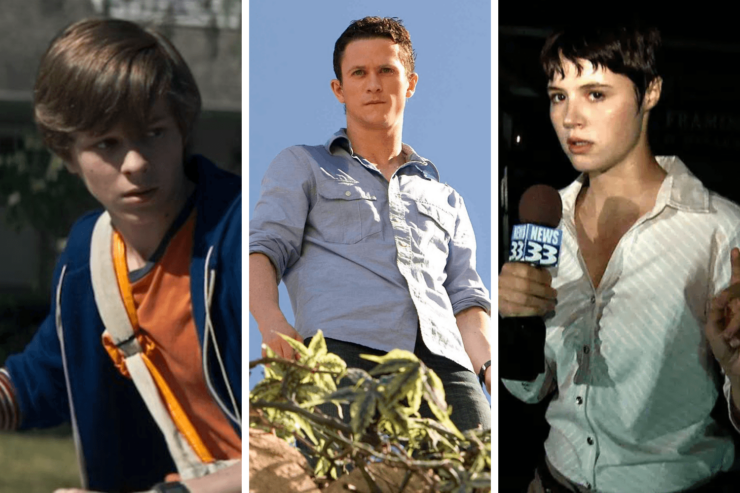
Lists Horror Midsummer Murder and Mayhem: Five Underrated Summer Horror Movies From doomed tourists to carnivorous underwater creatures, these movies offer an array of chills, thrills, and excellent jump-scares! By Lorna Wallace | Published on July 30, 2024 Comment 0 Share New Share Some people only want to watch horror movies in the run-up to Halloween, but I like onscreen spooks and scares all year round, even in the bright sunshiny months of summer. There are plenty of horror movies that are perfectly suited to the hottest months of the year, with some of the biggest horror flicks of all time being set in summer—there’s Jaws (1975), Friday the 13th (1980), and The Texas Chain Saw Massacre (1974), to name just a few! But if you’ve already sweated and screamed through those classics countless times and you’re looking for something different to watch this summer, then here are five underrated horror films to check out… The Ruins (2008) Based on Scott Smith’s 2006 novel of the same name, The Ruins follows two American couples who are on a summer vacation in Mexico. Looking for a bit of adventure to cap off their mostly poolside and booze-fueled trip, the friends decide to accompany a fellow tourist who’s going to an archaeological dig in the jungle in search of his missing brother. The group leaves all common sense back at the resort and they soon find themselves trapped on the mounded ruins of a Mayan temple. Their limited food, water, and shelter initially seem like their biggest problems—especially considering the blazing hot sun above—but it doesn’t take long for them to realize that the greatest threat is actually the strange and sinister vines blanketing the ruins. The characters themselves are paper thin, but really, we’re all watching for the plant-based carnage, which is generously delivered in huge, gory buckets of blood and viscera! 47 Meters Down: Uncaged (2019) Shark attack movies are a summer staple and my favorite underrated example has to be the oh-so-silly 47 Meters Down: Uncaged. I do also like its 2017 predecessor, 47 Meters Down—which is about cage driving with sharks going wrong—but Uncaged is a lot more playful.  The film stars a pre-Yellowjackets Sophie Nélisse as Mia, who’s being bullied at her new school and is struggling to connect with her stepsister, Sasha (Corinne Foxx). The sisters are supposed to go on a glass-bottom boat tour to view sharks, but two of Sasha’s friends tempt them away with promises of a secret swimming spot. The lagoon happens to be the dive entrance of a now-submerged ancient Mayan city and the girls decide to channel their inner Lara Croft by exploring. 47 Meters Down: Uncaged certainly has its stupid moments but it’s so much fun that I just don’t care. The lost city setting not only looks very cool, but it also provides a horrifyingly claustrophobic atmosphere. The film is a total popcorn flick, but it was never trying to be anything more grounded or serious, so just lean in and let the current take you. Summer of ’84 (2018) Set in the fictitious Cape May area of Oregon, Summer of ’84 follows four teenage boys as they while away the bright days of summer break by riding their bikes around town and hanging out in a treehouse. The summer takes a darker turn when Davey (Graham Verchere) begins to think that his police officer neighbor, masterfully played by Rich Sommer, might be the Cape May Slayer, who has been killing kids for a decade. Davey and his friends decide to become amateur sleuths in an attempt to prove their suspicions.   Summer of 84 may seem like it’s relying on clichés and playing into ’80s nostalgia—and it is, at first, right down to its synth-pop score—but then it takes the rose-tinted glasses through which we often view that decade and smashes them to pieces. Come for the classic coming-of-age tale with fun ’80s trappings, stay for the ultimately harrowing deconstruction of that subgenre. The Bay (2012) Director Barry Levinson—of Good Morning, Vietnam (1987) and Rain Man (1988) fame—has just one horror flick in his filmography: The Bay, a found footage mockumentary that has largely managed to fly under the radar. Set on the Fourth of July in the made-up town of Claridge on the Chesapeake Bay, we watch as a bizarre illness rapidly infects the population, causing people to break out in nasty lesions. The film is essentially a collection of footage pulled from security cameras, townspeople’s phones, a news camera, and police cams. Found footage films are often limited to just one or two perspectives, but The Bay offers a sweeping overview of the rapidly deteriorating situation. You might think that this is a perfect film to watch on the Fourth, but I actually recommend watching it nearer the end of summer, ideally once all of your lake and/or beach days are done, because the gruesome visuals might leave you unwilling to spend even a single second in the water. Piranha 3D (2010) Technically, Piranha 3D is set during spring break, but the sun-drenched lake setting means that it’s just as much fun to watch during summer too. Everything kicks off when a small earthquake causes a chasm to open up at the bottom of a lake in Arizona, unleashing hundreds of vicious prehistoric piranhas. This toothy situation is made even worse by the fact that hordes of spring break revelers have descended on the lake to party. Director Alexandre Aja knew exactly what kind of film he wanted to make—one filled with silly and gory fish-fueled insanity—and he certainly delivered it. Everything is over-the-top, from the self-consciously lewd humor to the gore-fest final act. As well as featuring copious amounts of blood and boobs, the cast is also great. Elisabeth Shue stars as the sheriff trying to stop the mayhem and she’s helped by a marine biologist played by Christopher Lloyd and a diver played by Adam Scott. I’ll let you discover the rest of this very fun cast for yourself! There are plenty of other hidden gem horror movies out there that are perfect to watch during summer, so feel free to leave your own favorites in the comments below! [end-mark] The post Midsummer Murder and Mayhem: Five Underrated Summer Horror Movies appeared first on Reactor.
Like
Comment
Share
Survival Prepper
Survival Prepper  
1 y

The Herbalist’s Bookshelf
Favicon 
www.theorganicprepper.com

The Herbalist’s Bookshelf

By the author of Prepper’s Natural Medicine and Prepping for a Pandemic. When I was first learning about herbs, I didn’t have a computer. Back in my day, all we had were books. The internet has been both a boon and a curse for herbalism. On one hand, there are websites with extensive collections of early medical books and herbal books, access to scientific studies on herbs, and articles on herbs and crafting herbal medicine by skilled herbalists. There are loads of YouTube videos with tutorials on herbal skills and plant ID. The best part, the vast majority of it is all free.On the flip side, we also get the clickbait sites with unsupported articles and wild claims of cure-alls. The worst are the Facebook memes. These things just won’t die- like the onion slices in a sock that cure everything from the flu to pneumonic plague and how coconut oil “cures” literally everything. Recommended Reading for Herbalists Thankfully, we have lots of wonderful, well-researched, and well-written herbal books today – many more than were available when I was learning. I have put together a list of what I consider “required reading” below. Anatomy and Physiology Holistic Anatomy: An Integrative Guide to the Human Body, by Pip Waller, is an anatomy book that resonates with many holistic practitioners. It covers Anatomy in a way that is scientifically sound but is holistic in approach. While there are many A&P textbooks on the market, most are written with the medical field in mind. This book is far more readable to the average person. Botany and Plant ID Botany in a Day: The Patterns of Plant Identification, by Thomas J. Elpel, provides a straightforward, simple way to recognize major plant groups. The title is misleading, as you cannot assimilate everything in the book in a day, but it is probably the best single book on Botany on the market. The Peterson Field Guides are always a good source of information. There are two, in particular, to consider putting on your bookshelf depending upon where you live. These are the Peterson Field Guide to Western Medicinal Plants and Herbs and the Peterson Field Guide to Medicinal Plants and Herbs of Eastern and Central North America. While some of these have good photos, there are also a lot of sketches that are less helpful. However, they have lots of great information on medicinal herbs that grow according to your region. Edible Wild Plants, A North American Field Guide to Over 200 Natural Foods, by Thomas Elias and Peter Dykeman, isn’t necessarily about herbs but is a great book for plant identification in North America. It isn’t region-specific, but it is detailed, has great pictures, is organized by season, and is an excellent start in plant foraging. Herbalism – General Prepper’s Natural Medicine: Life-Saving Herbs, Essential Oils, and Natural Remedies for When There Is No Doctor is my book, so yes, there is a bit of shameless self-promotion here. However, the book has a number of strengths going for it that separate it from the bulk of herbal books on the market. This book covers herbal skills, the therapeutic properties of 50 herbs, and has recipes for both acute and chronic conditions. It does all this from the perspective of a prepper. Unfortunately, there are no photographs of herbs. While that was not my choice, this was intended to be an herbal skills book, not a plant ID book. Still, I would have liked to have added pictures of the herbs. The Herbal Medicine-Maker’s Handbook: A Home Manual, by James Green, is an excellent book focusing on herbal skills. While I disagree with him on a few points, it is a solid book on herbal preparations. Medical Herbalism: The Science and Practice of Herbal Medicine, by David Hoffman, is one of those “must-have” books. Medical Herbalism is the best of both worlds, synthesizing holistic medicine and modern biomedicine. This book gets into the chemical composition of plants and why plants have the effects upon the body that they do. Very useful textbook for both folk herbalists and clinical herbalists alike. Principals and Practice of Phytotherapy: Modern Herbal Medicine 2e, by Kerry Bone, is an herbal textbook that means serious business. This is a well-researched, clinically-oriented book on plant medicine that covers the medicinal properties, side effects, contraindications, and scientific studies of commonly used medicinal herbs. This is an expensive book compared to many of the popular herbal paperbacks on the market. As a scientific textbook, however, the price is rather reasonable. It is worth every penny. Making Plant Medicine, by Richo Cech, is a classic. The latest edition is still available, but it can be hard to get. It goes out of stock on Amazon frequently. Great explanation of making liquid extracts and a materia medica that is loaded with information on medicinal herbs. Herbalism- Traditions The Practice of Traditional Western Herbalism: Basic Doctrine, Energetics, and Classification, by Matthew Wood, lays out the foundations of our western herbal traditions. This book looks at the energetics of herbs, tissue states, constitutions, and the classifications of plants. This book gives herbalists a language that is our own, as opposed to the terminology owned by the medical industry. I do not find the language contrary to modern biomedicine. Instead, it is more like a poetic way of describing observations about the body and how the body responds to different herbs. The Yellow Emporer’s Classic of Medicine: A New Translation of the Neijing Suwen with Commentary, by Maoshing Ni, is a perfect beginner book for understanding Traditional Chinese Medicine (TCM). Like Traditional Western Medicine, TCM is an energetic-based system with a poetic way of verbalizing observations regarding health and the actions of herbs. This energetic system is the basis for Chinese herbal practice, Acupuncture, and the flow of Chi (energy) in the body. The Way of Ayurvedic Herbs: A Contemporary Introduction and Useful Manual for the World’s Oldest Healing System, by Karta Purkh Singh Kahlsa, and Michael Tierra, presents a comprehensive look at what ayurveda, the traditional healing system of India, is all about. This book covers ayurvedic body types (doshas), ayurvedic diet, and traditional herbal remedies in the ayurvedic system. Infectious Disease Herbal Antibiotics, 2nd Edition: Natural Alternatives for Treating Drug-Resistant Bacteria, by Stephen Harrod Buhner, is another “must-have” book on your herbal shelf (along with his Herbal Antivirals book below). Antibiotic resistance is an ever-growing, real threat that goes largely ignored by the general public, in a similar way that the general public is unaware or doesn’t care about the growing threats against our power grid. We are equally unprepared for a world without antibiotics. This book lays out research and experience with herbs and bacterial diseases. Herbal Antivirals: Natural Remedies for Emerging and Resistant Viral Infections, also by Stephen Harrod Buhner, will teach you more about viruses than you could ever want to know. This is just as well-researched as his Herbal Antibiotics book and equally as important. Prepping for a Pandemic: Life-Saving Supplies, Skills, and Plans for Surviving an Outbreak is my second book. This is a unique book examining the lessons we can learn from the Ebola outbreak of 2014 (how did governments, media, medical professionals, individuals, and industries respond, plus how can we use this to be better prepared), the top contenders for the next great pandemic, and illnesses that tend to follow after a disaster. I cover both herbal and conventional approaches to treatment where such options exist, address security issues, and how to implement a Self-Imposed Reverse Quarantine (SIRQ). Our herbalist’s bookshelf is far from an exhaustive list, but it is a solid start. One last point that I want to make… While the internet is awesome in so many ways, the power grid and access to the internet is not a given. Both physical and cyber attacks on our electrical grid are a real threat. Every day North Korea gets closer to being able to pull off an EMP attack on the United States. What’s worse is that we are woefully unprepared, as Ted Koppel lays out in this book, Light’s Out. For this reason, I prefer and recommend getting physical copies of books whenever possible. What are your thoughts on the best herbal medicine books out there? Let us know in the comment section. About Cat Cat Ellis is an herbalist,  massage therapist, midwifery student, and urban homesteader from New England. She keeps bees, loves gardening and canning, and practice time at the range. She teaches herbal skills on her website, Herbal Prepper. Cat is a member of the American Herbalists Guild, and the author of The Wuhan Coronavirus Survival Manual, Prepper’s Natural Medicine and Prepping for a Pandemic. The post The Herbalist’s Bookshelf appeared first on The Organic Prepper.

Like
Comment
Share
Daily Signal Feed
Daily Signal Feed
1 y

US Ally Paraguay Stands Firmly With Israel, Taiwan
Favicon 
www.dailysignal.com

US Ally Paraguay Stands Firmly With Israel, Taiwan

Reconfirming that his country would be relocating its embassy in Israel from Tel Aviv to Jerusalem in a July 17 speech, Paraguayan President Santiago Peña underscored that “Paraguay has always been a great friend of Israel, we always say that it fills us with pride to have been the decisive vote for the creation of that State, a fact that has deeply marked our relations.”  A brave action by a great friend to Israel and America! Gracias. https://t.co/KgLIW5Ojvu— Victoria Coates (@VictoriaCoates) July 22, 2024 He added, “It is hard to believe that two countries so geographically far away can be so close in the hearts of their peoples.” Washington should make a note of that. Certainly, from the standpoint of the United States, Paraguay has been playing a notable role on the foreign policy front. For years, it has maintained constructive relationships with Israel and Taiwan, two important allies of the United States.  In 2019, Paraguay officially recognized the military wings of the Palestinian group Hamas and Lebanon’s Hezbollah as terrorist organizations. Equally noteworthy is that Paraguay is one of just 12 countries in the world—and the only nation in South America—to recognize Taiwan, whose formal diplomatic relationship with Paraguay was established in July 1957. These facts make Paraguay stands out as a unique partner of the United States, whose bilateral partnership should be further enhanced to grow the practical nexus among these three willing partners of the United States—Israel, Paraguay, and Taiwan.  More specifically regarding Paraguay’s increasingly practical relationship with Taiwan, it’s notable that bilateral trade in the past five years has grown by more than 600%, demonstrating how the two economies work together, complementing each other. Peña, who has visited Taiwan twice in less than a year, has reiterated to Taiwanese President Lai Ching-te the international support of Paraguay for the Taiwanese, demonstrated in forums such as the U.N. General Assembly, Interpol, and World Health Assembly. The vibrant Paraguay-Taiwan partnership matters to Washington in constraining China, which has been seeking trade, diplomatic, and military ties in Latin America and the Caribbean for years. From a broader geostrategic perspective, the overall challenges China poses on various policy fronts are still unnerving for the U.S. and many others, particularly given the fact that it has become unambiguous that China is the most capable adversary the United States is currently facing. The United States can and must win the geopolitical diplomatic competition with China. There is still time for America to counter China’s malign and manipulative influence with other nations, but that window is quickly closing. Washington cannot win the battle of ideas and diplomacy without being proactive on this critical front. To that critical end, Washington should pay closer attention to the ongoing interaction and the broad relationship between Paraguay and Taiwan while proactively paving a deeper and wider path of a pragmatic, strategic partnership among the three nations—the U.S., Paraguay, and Taiwan.  Indeed, it’s also encouraging that Paraguay has unambiguously shown itself to be a good partner for the United States in hemispheric relations. The country has worked closely with Washington in counternarcotics initiatives, as well as cooperating to reduce other illicit cross-border activities. Paraguay also has been an essential partner of the U.S. in countering growing malign influence of China in the Americas, which brings increasing instability while threatening U.S. regional partnerships. In introducing a bipartisan resolution commemorating the 163-year bilateral relationship between Paraguay and the United States and welcoming Peña’s visit to the United States in May this year, Sen. Bill Cassidy, R-La., noted: Paraguay is an important U.S. partner in the hemisphere. They are a vibrant democracy, an ally against the Venezuelan dictatorship, and the only country in South America that continues to recognize Taiwan. This resolution emphasizes that the United States and Paraguay are allies with common goals so that both countries benefit. In recent years, Paraguay has implemented a series of significant political and economic reforms. This ongoing transformation has earned the nation plaudits from allies and potential investors alike. Paraguay has been delivering notable economic growth. Over the past five years, despite the challenging economic environment, its economy has grown at a greater rate than many of its neighbors. The sustained push for economic liberalization and greater transparency in government has been gradually improving Paraguay’s competitive edge. The Heritage Foundation’s annual Index of Economic Freedom rates Paraguay’s economy as “moderately free,” and the country’s global ranking is ahead of its large neighbors Argentina and Brazil. Reflecting Paraguay’s economic resilience and sound economic fundamentals, on Friday, Moody’s Ratings elevated Paraguay’s credit assessment to “investment grade” in an unambiguous recognition of the notable emerging market as “one of the fastest growing economies in South America.” The credit rating agency further noted that “the upgrade of Paraguay’s rating reflects a combination of factors, including robust and sustained economic growth and [the] expectations that the economy has become more resilient to shocks.” All in all, Paraguay is becoming one of the most reliable partners of the United States. As Peña pointed out during a public event last October at The Heritage Foundation, “Paraguay offers a platform of a stable, democratic, economic environment” for the United States. More than ever, it’s in the clear interest of Washington and America’s private sector to work closely with Paraguay on a range of vital issues that advance freedom, opportunities, and prosperity for both nations. The post US Ally Paraguay Stands Firmly With Israel, Taiwan appeared first on The Daily Signal.
Like
Comment
Share
Reclaim The Net Feed
1 y

Lawmakers Request Delay on Meta’s Shutdown of “Fact-Checker” Favorite Content Surveillance Tool
Favicon 
reclaimthenet.org

Lawmakers Request Delay on Meta’s Shutdown of “Fact-Checker” Favorite Content Surveillance Tool

If you're tired of censorship and dystopian threats against civil liberties, subscribe to Reclaim The Net. Meta’s decision to shut down a content surveillance tool called CrowdTangle, announced earlier in the year and about to take effect next month, has met with opposition from a group of US lawmakers. CrowdTangle, which the giant bought in 2016, has over the years been “repurposed” by “fact-checkers,” researchers focusing on “disinformation” as well as media who flag it. Meta said it is replaced by the Meta Content Library, available to some researchers but not commercial entities (such as media outlets, a number of whom are currently running “fact-checking” operations). Now 17 lawmakers (three Republicans among them) have written to Meta asking that it reconsider this decision, referring to CrowdTangle as a “transparency tool” both for researchers and journalists. The letter, addressed to CEO Mark Zuckerberg, says CrowdTangle is being used to “view and study” content on Facebook and Instagram, but also other platforms, searching for content ranging from foreign influence, and terrorism, to mental health. We obtained a copy of the letter for you here. And these members of Congress, led by senators Bill Cassidy (R) and Chris Coons (D) assert that the new tool, Meta Content Library, has “significant limitations” compared to CrowdTangle, urging at the same time the company not to discontinue the latter for at least another six months. I.e., until after the US elections. But the lawmakers didn’t quite explain this timeframe in that way, mentioning first national security, then the children – in this case, protecting their mental health – then the perceived threat of AI, and elections in the US, but also around the world, as the reason to make sure CrowdTangle continues to be available, “while additional functionality and access is developed for the Meta Content Library.” Some of those using CrowdTangle are the agency Agence France Presse (AFP) – also a major “fact-checker” and one of Facebook’s partners in this business – which found it useful in “debunking” content around topics like Covid. AFP was searching for keywords and using Meme Search to find the targets of the debunking efforts and “report misinformation.” Poynter Institute’s PolitiFact, another of Facebook’s third-party fact-checkers, was also among those who have “for years” been using CrowdTangle to focus its “fact-checking” on content slated for censorship that was likely to reach the widest audience. If you're tired of censorship and dystopian threats against civil liberties, subscribe to Reclaim The Net. The post Lawmakers Request Delay on Meta’s Shutdown of “Fact-Checker” Favorite Content Surveillance Tool appeared first on Reclaim The Net.
Like
Comment
Share
Reclaim The Net Feed
1 y

The Biased Hidden Kingmaker of Google News
Favicon 
reclaimthenet.org

The Biased Hidden Kingmaker of Google News

If you're tired of censorship and dystopian threats against civil liberties, subscribe to Reclaim The Net. Sign Up To Keep Reading This post is for Reclaim The Net supporters. Gain access to the entire archive of features and supporters-only content. Help protect free speech, freedom from surveillance, and digital civil liberties. Join Already a supporter? Login here If you're tired of censorship and dystopian threats against civil liberties, subscribe to Reclaim The Net. The post The Biased Hidden Kingmaker of Google News appeared first on Reclaim The Net.
Like
Comment
Share
Hot Air Feed
Hot Air Feed
1 y

Three Palestinian Terror Suspects Caught at Border
Favicon 
hotair.com

Three Palestinian Terror Suspects Caught at Border

Three Palestinian Terror Suspects Caught at Border
Like
Comment
Share
Hot Air Feed
Hot Air Feed
1 y

Whoa: Trump Hits 52% in New Harvard/Harris Poll
Favicon 
hotair.com

Whoa: Trump Hits 52% in New Harvard/Harris Poll

Whoa: Trump Hits 52% in New Harvard/Harris Poll
Like
Comment
Share
Science Explorer
Science Explorer
1 y

Damascus Goats: The Bizarre-Looking Stars Of Animal Beauty Pageants
Favicon 
www.iflscience.com

Damascus Goats: The Bizarre-Looking Stars Of Animal Beauty Pageants

The internet loves a goat, whether they’re craving that mineral or screaming to Taylor Swift. There’s one breed, however, that’s repeatedly found viral fame not because of its salt-seeking escapades or musical abilities, but because, well, it’s just plain bizarre-looking.What is this unusual creature that one TikTok user described as "if you typed ‘Renaissance-era nightmare goat’ into an AI image generator"? Why the Damascus goat, of course.               IFLScience is not responsible for content shared from external sites.This particular breed first piqued wider public interest back in 2018 when a video of a “monster” goat started doing the rounds on social media, featuring a flat face, prominent overbite, and a bulging forehead. Not to mention, the goat was also absolutely enormous. But while it’s perhaps the most famous example of the breed, a lot of Damascus goats don’t actually look like that. Some of the distinguishing features are still there, but they’re far more toned-down in livestock populations.For example, they’re still a pretty large breed compared to other goats, standing at around 78 centimeters (31 inches) when fully grown, and they do usually have fairly blunt snouts – it’s just nowhere near as exaggerated. Unfortunately for them, even regular Damascus goats also bear a passing resemblance to Jar Jar Binks, being born with pendulous ears that can make up nearly half of their height.So why do some Damascus goats look so different? It’s likely the result of years of selective breeding for the traits that gave them their fame.Though native to Syria (hence the name), these goats were introduced to Cyprus around 80 years ago as a livestock breed and underwent decades of selective breeding to create an animal that could produce lots of milk and make for a popular meat. In that time, it seems people also took a fancy to the Damascus goats’ more unusual features and entered them into beauty contests. Breeders likely mated together those with the most prominent features and, after generations and generations, wound up with the kind of animal that was almost inevitably going to become internet famous, whether people love it or think it’s incredibly cursed.The creation of “designer breeds” for such a purpose is far from unusual, which isn’t a surprise when you find out how lucrative it is. The winner of a 2008 contest in Riyadh, Saudi Arabia, to find the most beautiful Damascus goat was bought by its owners for 150,000 Riyals, worth around $40,000 at the time.Whether that fame and fortune comes at a price is unclear; designer animals breeds like pugs, for example, can have all sorts of health problems.As for whether or not the Damascus goat is worthy of a beauty pageant crown – we’ll leave that up to you.
Like
Comment
Share
Science Explorer
Science Explorer
1 y

Whale Shark “Rio Lady” Tracked For Record-Breaking 4 Years In Gulf of Mexico
Favicon 
www.iflscience.com

Whale Shark “Rio Lady” Tracked For Record-Breaking 4 Years In Gulf of Mexico

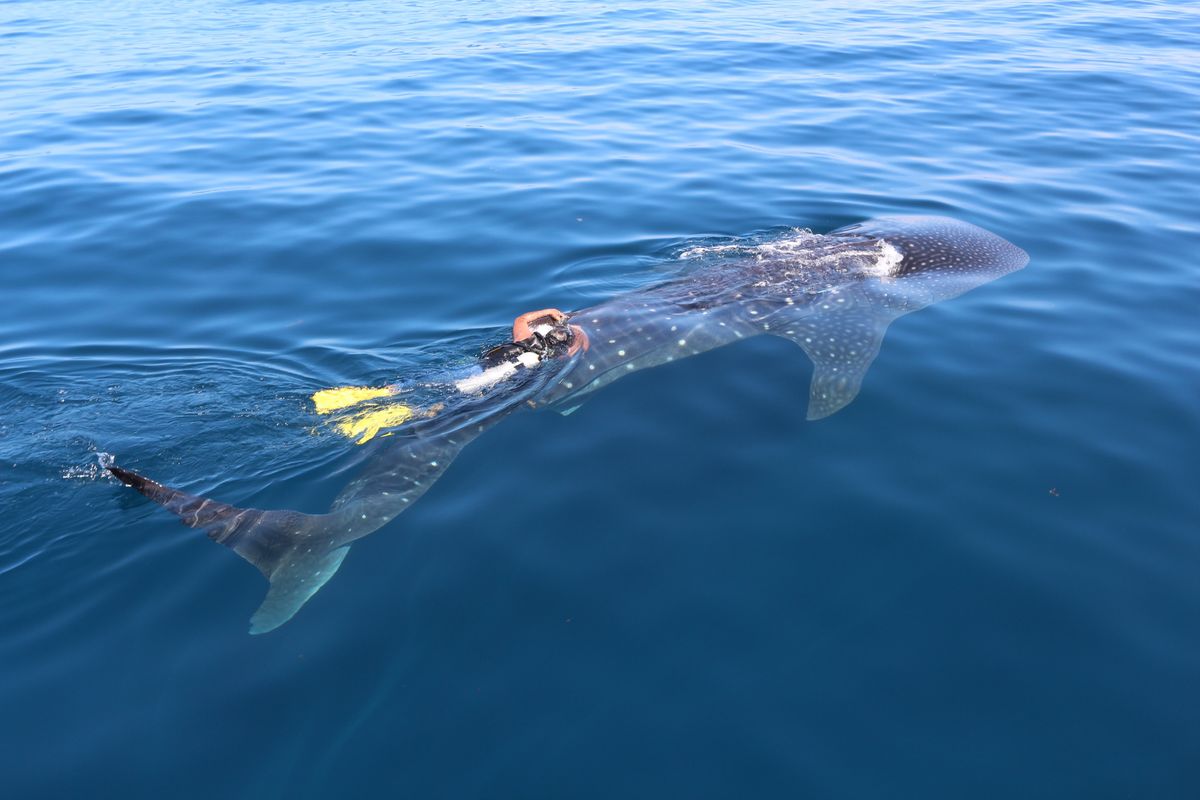
Rio Lady is a whale shark (Rhincodon typus) and a swimming superstar. By following her movements with different trackers for almost two decades, including a record-breaking four-year streak, scientists have learned a lot about whale sharks and their habits.For such big fish – Rio Lady is nearly 8 meters (26 feet) long – there is actually still a great deal that we do not know about whale sharks. “There's a lot to learn about where whale sharks go to give birth” Daniel Daye, lead author of a recent study describing Rio Lady’s movements, told IFLScience. We also know little about their social and mating behaviors.One of the things we do know, however, is that once a year, between July and August, a large whale shark gathering occurs off the coast of Isla Mujeres, across from Cancùn in the Gulf of Mexico. Up to 400 individuals have been spotted there together, and they are there to feast. The waters at that time of year are full of the freshly spawned eggs of tunny fish, a banquet for our big fish. Whale sharks are filter feeders, swimming near the water surface with their mouths agape, letting plankton, eggs, and little fish flow in.  It was here, near Isla Mujeres, that Rio Lady was most recently GPS-tagged in 2018. From there, the researchers were able to follow her slow, far-ranging movements over the course of almost four years (with the first three years giving the most consistent recordings). Between 2018 and 2021, she covered at least 44,000 kilometers (27,340 miles) in the Gulf of Mexico. That’s more than the Earth’s circumference!Her movements revealed that she not only enjoys the yearly banquet of Isla Mujeres, but consistently divides her year between three different hunting areas in the Gulf of Mexico. The other two are the area across from Veracruz and the northern region of the gulf.Interestingly, the feeding ground gatherings seem to be somewhat age and sex-specific, with the Isla Mujeres being visited predominantly by young males (Rio Lady is an exception here). It is not known yet if the other feeding grounds that Rio Lady visits are dominated by other groups. “We are working on a follow-up paper to look more at the population-level movements for [a group of 20 male] whale sharks,” said Daye.Whale sharks are slow movers, but can still cover some impressive distances.Image credit: University of Rhode IslandRio Lady’s movements during the winter months were not recorded in the current study. The type of tracker that was used was programmed to only transmit when the tracker, attached to her dorsal fin, was outside the water. This suggests that she didn’t surface in the wintertime.In the winter of 2006, using a different type of tracker, she was recorded swimming 7,772 kilometers (4892 miles) in 150 days to the mid-Atlantic, near the Brazilian Saint Peter and Saint Paul Archipelago. She might have undertaken the long journey to give birth there.In the current dataset, “the timing of movement back into the Gulf of Mexico from somewhere southern suggests that there was some similar movement pattern during this time,” explained Daye. Whether this journey happens as regularly as her movements within the Gulf is still unknown.The whale shark population has been decreasing worldwide, with a roughly 63 percent decline over the last 75 years. The cause for the decline is in part fishing, either as direct targets or as bycatch. Because they feed near the surface, they are also at risk of being struck by boats and propellers, and as filter feeders, are at risk of ingesting microplastics. As a result, whale sharks are now an endangered species and research like the current study into their movements and habits is key for informing conservation efforts.“With respect to the sharks near Isla Mujeres, the Mexican government has established two nature reserves near the area to protect whale shark habitat. Regulations surrounding the tourism industry try to prevent tourists from overwhelming the sharks and adding unnecessary stress,” Daye told IFLScience."Other studies have compared shark movements to shipping corridors and identified areas that show potential for a higher risk of collision. Speed limits, like those enacted in some areas of the US to protect whales, could be implemented to reduce risk to whale sharks too,” Daye continued. “Since we identified three regions of habitat use that occur during different times of year, this could help to determine when/where some of these regulations get implemented, and to ensure that they are implemented effectively.”You can track the movements of Rio Lady and other whale sharks here. Some tags are still active!This study is published in Marine and Freshwater Research.
Like
Comment
Share
Showing 67993 out of 104089
  • 67989
  • 67990
  • 67991
  • 67992
  • 67993
  • 67994
  • 67995
  • 67996
  • 67997
  • 67998
  • 67999
  • 68000
  • 68001
  • 68002
  • 68003
  • 68004
  • 68005
  • 68006
  • 68007
  • 68008
Advertisement
Stop Seeing These Ads

Edit Offer

Add tier


Select an image
Delete your tier
Are you sure you want to delete this tier?

Reviews

In order to sell your content and posts, start by creating a few packages. Monetization

Pay By Wallet

Payment Alert

You are about to purchase the items, do you want to proceed?

Request a Refund