www.thecollector.com
How the Roosevelt Corollary Redefined the Monroe Doctrine
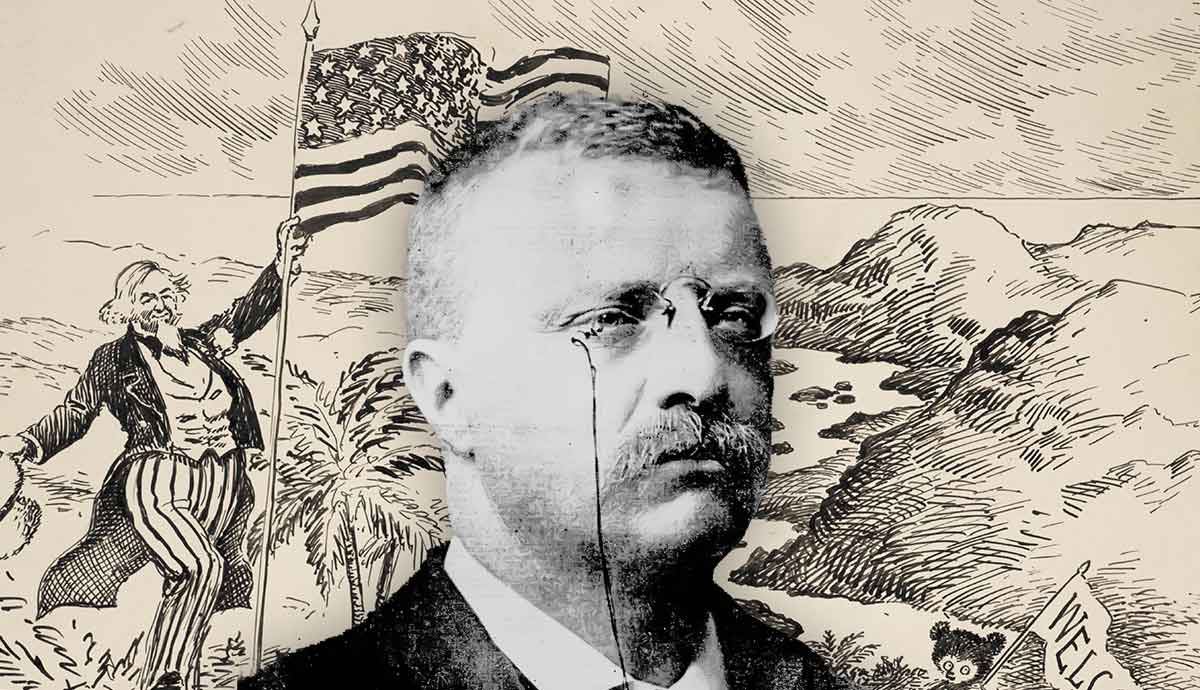
In 1904, shortly after helping Panama win its independence from Colombia, US President Theodore Roosevelt made a public announcement that the Western Hemisphere was the United States’ sphere of influence. If European powers had an issue with a country in Central or South America, they would need to come to the US for help with the situation rather than intervening directly. The proclamation set up the United States as the designated peacekeeper and enforcer for the hemisphere, leading to the phrase “talk softly and carry a big stick” to describe Roosevelt’s foreign policy. Did the Roosevelt Corollary of 1904 succeed in its goals?
Setting the Stage: Colonialism in the Western Hemisphere
An 1893 painting of Italian explorer Christopher Columbus, sailing for Spain, claiming new territory for the Spanish crown. Source: Library of Congress
In 1492, Italian explorer Christopher Columbus, sailing for Spain, landed in the Caribbean and discovered that a previously unknown land mass lay between Europe and India in the Atlantic Ocean. Quickly, European powers set out to colonize this New World. Spain took most of Central and South America, as well as southern and southwestern North America. Portugal took the northeastern quadrant of South America, which comprises modern-day Brazil. France claimed central North America, and England took the eastern coast of North America and modern-day Canada to the north.
Colonial societies were established in all these regions, varying in their levels of infrastructural development. Vast populations of Native Americans were decimated by smallpox and other diseases from the Old World, which allowed European colonizers easier access to resources and conquest. In North America, the imperial powers of France and Britain clashed over territory in the 1750s during the French and Indian War. The war also embroiled Spain, which sided with France. Britain prevailed in the war, seizing French land east of the Mississippi River and the Florida Peninsula from Spain.
Setting the Stage: Independence Movements (1770s-1820s)
A drawing of Continental Army soldiers during the 1781 Siege of Yorktown. Source: National Archives
Tensions over colonialism increased in North America after the French and Indian War, with British colonists upset over feeling that they were having to pay extra taxes. After a decade of rising tensions, the American Revolutionary War erupted, resulting in an unexpected victory for the new United States of America. The colonists’ successful independence movement was noticed by other colonies, who began pursuing their own independence. In 1791, a slave rebellion in French-controlled Haiti began the Haitian Revolution amid the backdrop of the ongoing French Revolution.
After the United States and Haiti gained independence, the viceroyalties of New Spain began to pursue their own political independence. In 1810, while Spain was occupied by France during the Napoleonic Wars, Mexico began fighting for its own sovereignty. After eleven years of conflict, Mexico became an independent nation. By January 1826, the entirety of South America had won its independence through military action. In 50 years, the Western Hemisphere south of Canada, which finally gained sovereignty over domestic affairs in 1867, had transitioned from being firmly controlled by Europe to mostly independent countries (although some islands in the Caribbean would remain colonial territories for many more years).
1823: The Monroe Doctrine
Detail of a painting of James Monroe, by Casimir Gregory Stapko, after John Vanderlyn. Source: US Department of State
While South American countries still fought for independence from Spain, the United States made a bold proclamation on the heels of its survival in the War of 1812: European powers needed to stay out of the Western Hemisphere. Made by US President James Monroe, a young veteran of the Revolutionary War, the 1823 statement declared that the United States would not tolerate further colonization of the Americas. With Spain and France waning in power, the time seemed opportune to demand an end to European colonialism, at least close to America’s spreading borders.
The Pacific Northwest was the alleged focus of the doctrine, with both Britain and Russia vying for the region’s bounty. At the time, the US did not have the military might needed to evict European powers, especially Britain, but the Monroe Doctrine set an important precedent and helped keep Russia, France, and Spain at bay. Reaction abroad was mixed, with some nations showing little response and others denouncing the United States’ perceived aggression. Diplomacy, rather than force, was later used to help secure the Oregon Territory (present-day Oregon and Washington) from British Canada.
1830s-1860s: European Intervention in the Western Hemisphere
General Antonio Lopez de Santa Anna, 1847. Source: University of Texas at Arlington
In 1823, despite having pushed Britain back from New Orleans at the end of the War of 1812, the United States lacked the power to project force across the Western Hemisphere. As a result, European powers intervened openly in Central and South America during the following decades. Much of the intervention involved debt, with new governments in Latin America borrowing heavily from British banks. Some debt was owed to France, and this sparked a brief war between France and Mexico in 1838, known as the Pastry War. Although it resulted in a Mexican victory, it cost Mexico’s commander, General Antonio López de Santa Anna, his leg.
Europeans returned to the Western Hemisphere in the early 1860s, as Britain and France were interested in the ongoing American Civil War due to their reliance on cotton exports from the newly formed (and embattled) Confederate States of America. The United States managed to prevent European recognition of the Confederacy, but France, Britain, and Spain likely took advantage of the United States’ occupied military to agree to invade Mexico in an October 1861 agreement. France took the lead, with Napoleon III deciding to set up an empire. When the American Civil War ended in 1865, France agreed to end support for the Second Mexican Empire. Two years later, the empire collapsed and its emperor, Maximilian of Austria, was executed by the new Mexican Republic.
1870s-1890s: The United States Emerges as a World Power
A map showing Russia (left) and Alaska (right) to illustrate America’s 1867 purchase of Alaska from Russia for $7.2 million. Source: Ashland University
France was wise to back out of Mexico in 1865, as the United States had emerged from its civil war as a military power. During the Gilded Age, the US underwent tremendous industrial and infrastructural expansion, including the building of the Transcontinental Railroad, which linked both coasts and generated rapid development of the West. Railroads allowed the growing nation unprecedented access to natural resources like timber and minerals, which were eagerly mined. Within 20 years of the railroad’s completion, the United States had become the world’s largest industrial producer.
Manifest Destiny had been achieved with victory in the Mexican-American War in 1848, and some Americans desired even further expansion. In 1867, the United States purchased Alaska from Russia for $7.2 million, which many criticized until they realized that Alaska had lots of gold (and later oil). Faced with a powerful and growing United States, European powers avoided using physical force to dominate Latin America during the 1870s and 1880s. Rather, they used economic power to control poor countries in Latin America and Asia in a practice known as “New Imperialism.” Perhaps influenced by the Monroe Doctrine, Europe turned away from Latin America when searching for colonies, instead choosing to divide up Africa in the 1880s.
1898-1903: US Becomes Foreign Policy Interventionist
A painting of the Battle of Manila Bay, by Rand McNally. Source: Library of Congress
By the 1890s, the United States was an undisputed world power, both militarily and economically. It had developed strong economic ties to Cuba, a source of sugar, and Spain had resisted multiple US attempts to buy the island. In 1898, after years of rising tensions between Spain and the US due to American sympathies toward Cuban revolutionaries in the Cuban War for Independence, war erupted between the two powers. The US swiftly defeated Spain in both the Caribbean and the Pacific, seizing Cuba, Puerto Rico, Guam, and the Philippines.
Supporters of the Spanish-American War justified aggressive American actions by referring to the Monroe Doctrine and accusing Spain of tyrannical colonial oppression in Cuba. Critics said America was violating its anti-colonial past by seeking its own colonies, including the annexation of Hawaii. Two years later, the US joined several European colonial powers in putting down the Boxer Rebellion in China, reinforcing critics’ assertion that America itself had become imperialist. In 1903, the US used the implied threat of naval intervention to help Panama break free from Colombia in exchange for rights to build a canal across the narrow isthmus and link the Atlantic and Pacific Oceans.
1904: The Roosevelt Corollary
A photograph of Theodore Roosevelt in 1901. Source: The Library of Congress
Now building the Panama Canal, the United States was expanding its military and economic power throughout Latin America. However, what if other world powers wanted to do the same? This dilemma was exemplified by European powers using gunboats to intimidate Venezuela in 1902 over unpaid debts. The United States needed to rationalize its own interventions in Latin America while simultaneously preventing European powers from being able to do the same. In December 1904, US President Theodore Roosevelt created the Roosevelt Corollary, which was an addition to the Monroe Doctrine of 1823. It stated that the US would be the enforcer of civilized law in the Western Hemisphere.
The statement positioned the United States explicitly as an “international police power” that would ensure Latin America’s security… and solvency (ability to pay its debts). If European creditors had a problem, they had to come to the United States first rather than interfering directly. Supporters of the Roosevelt Corollary argued that it promoted peace and kept European colonial powers at bay, benefiting both the United States and Latin America. Critics, including some Latin American leaders, felt it justified American imperialism and simply reserved the region for American interests.
1961-62: Cuba Tests the Roosevelt Corollary
A map showing Soviet-built missile sites in Cuba in 1962. Source: National Museum of the United States Air Force
After the Roosevelt Corollary was issued, no European power was in a position to take territory in the Western Hemisphere by force. But what if they were invited in? This question emerged in 1960 after relations broke down between the United States and the newly communist Cuba, which was only 90 miles south of Florida. As a result of an economic embargo, Cuba sought an economic alliance with the Soviet Union, inflaming Cold War tensions. In 1961, the United States tried to facilitate a popular uprising on the island by training and delivering anti-communist rebels in the infamous Bay of Pigs Invasion.
As a result of the unsuccessful US-led invasion, Cuban dictator Fidel Castro pursued a military alliance with the Soviet Union. The Soviets quickly began setting up missile sites on the island, allowing them to strike the United States with almost zero warning. Tensions soared as the Cuban Missile Crisis grabbed the world’s attention. The US blockaded the island, demanding the removal of the missiles. It symbolically referred to the Monroe Doctrine by insinuating that the Soviets were attempting to dominate Latin America and force communism on people. Ultimately, US President John F. Kennedy prevailed in the crisis, while Soviet Premier Nikita Khrushchev was removed from power in 1964.
1982-83: Falklands War and Grenada
A photograph of British troops navigating the rocky terrain of the Falkland Islands during the brief Falklands War of 1982. Source: National Army Museum (UK)
Although the Soviets removed their missile bases after the autumn 1962 crisis, a strong Cuban-Soviet alliance remained. Two decades later, another foreign policy crisis rocked Latin America: the Argentine invasion of the Falkland Islands, tiny island territories of Britain near the coast of Argentina. In April 1982, Argentine forces occupied the Falklands, sparking United Nations condemnation. British subjects on the islands were deported, imprisoned, or subjected to harsh measures, angering Britain. For the first time since World War II, the British military was put on full operation and sailed toward the South Atlantic.
The United States faced a political dilemma: support World War and Cold War ally Britain, and allegedly back a colonial power, or support Argentina and condone alleged violence? Ultimately, the US chose to assist the British and allowed their military to swiftly retake the islands. A year later, the US chose to intervene similarly on the Caribbean island of Grenada, which had undergone a violent communist revolution that reportedly threatened the safety of American medical students. The new revolutionary regime, which replaced a more moderate socialist government, was seen as potentially establishing a new Soviet weapons base.
Summary: Roosevelt Corollary Successful
A drawing praising the completion of the Panama Canal in 1914. Source: Digital Public Library of America (DPLA)
The Roosevelt Corollary can be considered highly successful, as no world power has recolonized any territory in the Western Hemisphere since it was issued. Since 1904, the United States has had an undisputed sphere of influence in the region. It successfully completed the Panama Canal in 1914, allowing it to transfer its naval forces quickly between the Pacific and the Caribbean. In 1962, the US was able to retain the world’s political support during the Missile Crisis, likely due to its ability to portray the Soviets as interlopers in America’s metaphorical backyard.
Although the Roosevelt Corollary established the United States as the military enforcer of the Western Hemisphere, the US voluntarily limited its own power by agreeing to cede ownership of the Panama Canal back to Panama with the 1977 Panama Canal Treaty. However, the US also showed that it was unwilling to tolerate radicalism: it invaded Panama in 1989 to depose dictator Manuel Noriega. Despite this conflict, the US did not alter the timeline of turning the canal back over to Panamanian control in 1999. Proponents of the Roosevelt Corollary also frequently point out that, unique among the continents, Central and South America have not had a major international war since Roosevelt’s Corollary was made.








 New Posts (Home)
 ChatBox
 Popular Posts
  Game Zone
 Top PodCasts






![Why Lee Brice, 'Country Nowadays' Lyrics Caused Division [LISTEN]](https://townsquare.media/site/204/files/2026/02/attachment-lee-brice-country-nowadays.jpg?w=1200&q=75&format=natural)