www.thecollector.com
How Themistocles Interpreted a Riddle and Saved Athens From the Persians
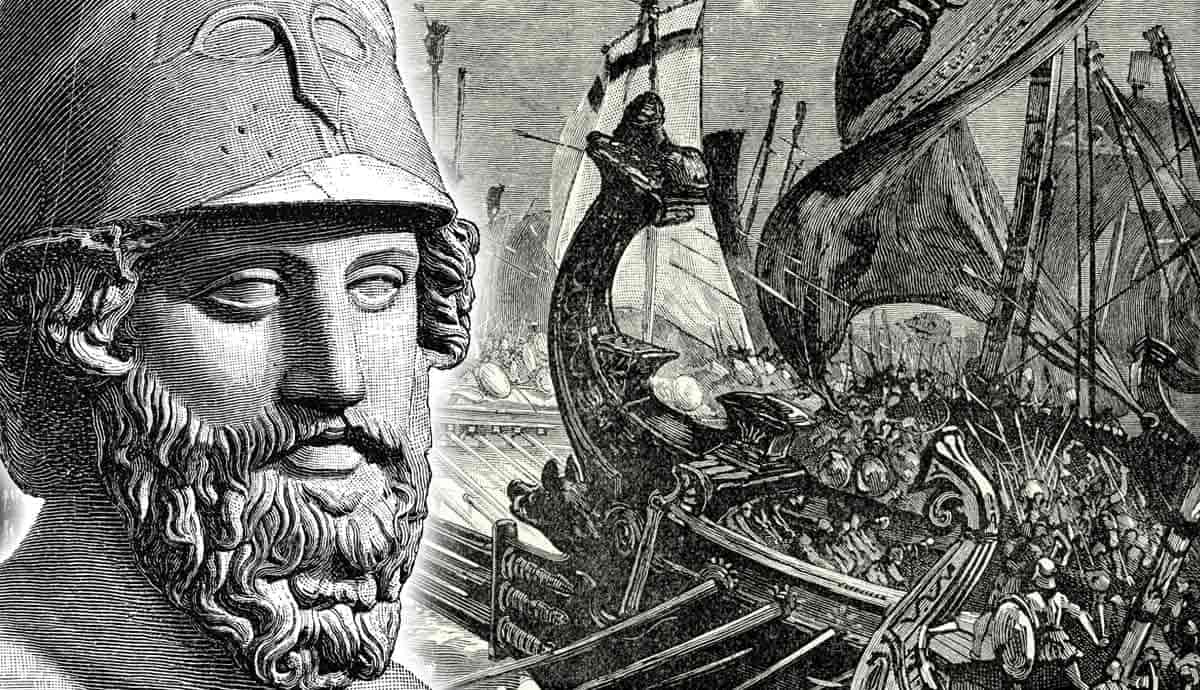
In 480 BCE, a colossal Persian army crossed the Hellespont. Led by the power-hungry King Xerxes I, hundreds of thousands of troops traveled towards Greece’s heartland in search of vengeance for a disastrous defeat ten years prior. As their customs demanded, the Athenians sought counsel at Delphi, where the Pythian oracle told them that a “bulwark of wood” would save them. Confusion ensued about the prophecy. When most people thought they should reinforce the city’s palisades, their general Themistocles proposed a radical alternative: to build a massive fleet and turn Athens into a sea-faring city. Themistocles’s bold leadership saved Athens from destruction.
The First Persian Invasion
Frieze of Persian soldiers from Susa, c. 510 BCE. Source: Louvre, Paris
In the 5th century BCE, Athens produced world-shaping art, literature, and philosophy. Yet, Greece’s “golden age” was far from a peaceful and prosperous era. It began partially as a response to the destabilizing effects of war, which loomed large across the century.
As Herodotus reminded his contemporaries, one of the period’s defining events was the ongoing conflict between independent Greek city states and the expansionist Persian Empire. Open conflict between Greeks and Persians began in 499 BCE. Xerxes’s father, Darius the Great, had managed to conquer virtually all Greek-speaking regions in Ionia, off the coast of modern-day Turkey. His plan was to expand Persian rule across the Mediterranean.
United by sports, language, and religion despite their political autonomy, the Greek city states grew frustrated with Persian rule. Their first rebellion unfolded at the behest of Aristagoras, a Greek tyrant who incited the Ionians to revolt against their sovereign’s hegemony. Athens sent money and troops in support of this and later rebellions, upsetting Darius and earning Persia’s long-lasting enmity.
Map of the Persian Empire in the era of Darius I, 1717. Source: Aikaterini Laskaridis Foundation
To avert future Athenian interventions, Darius decided to invade Greece. Like his son ten years later, he set off with a sizable militia: tens of thousands of infantry troops and hundreds of ships. On his way to Athens, he conquered cities in Macedon and Thrace, until his fleet landed at Marathon. Under the leadership of Miltiades, the Greeks rallied to try to obstruct Darius’s advance. Despite a large numerical advantage, the Persian troops could not prevail. They fled by ship and attempted to seize Athens, which lay largely unprotected. Spurred by the threat of extinction, the Greek army made it home just in time to repel Darius. But their victory did not end the war.
Darius never witnessed the decisive match between his empire and the Greeks. His son did, in 480 BCE, at the battle of Salamis. The commander of the Greek army was Themistocles, who had risen to prominence as a skilled politician and ambitious commander.
Themistocles’s Rise to Power
Bust of Themistocles, c. 470 BCE. Source: Museo Ostiense, Ostia
Themistocles was born around 524 BCE in the deme of Phrearrhii, on Athens’s coastal area. The Greeks divided their cities by demes to allot land and, in democratic regions, monitor citizen participation in assemblies and other such activities.
Unlike most of his famous contemporaries, Themistocles did not come from a privileged family. His mother was probably a foreigner from Thrace. One anecdote from Plutarch suggests that his family lived in an immigrant district outside the city walls and were thus perceived as outsiders. Themistocles, whose name means “famed in law and right,” allegedly persuaded the children of influential aristocrats to play and exercise with him. True or not, he was certainly intelligent and ambitious. As soon as he could, he pursued a public career.
Panathenia Procession, an important festival under the Pisistratids, c. 5th century BCE. Source: Acropolis Museum
When Themistocles was born, Athens was a few decades away from its golden age. The tyrant Peisistratus died in 527 BCE, and his two sons, Hippias and Hipparchus, succeeded him as Athens’s rulers. After a tumultuous decade of internal strife and war, Athens abandoned tyranny in favor of democracy. The people chose Cleisthenes as their first leader in this new government where citizens could participate directly in state affairs.
Democracy opened the way for Themistocles, whose background would have otherwise kept him from any position of power. If decision-making once depended on birthright, now it hinged on public speaking and networking, two skills Themistocles studied and learned better than most of his contemporaries. He focused his energy on courting new citizens. He moved to one of Athens’s market areas, often interacted with ordinary people, and even litigated cases on their behalf.
In 494 BCE, he was elected Athens’s highest magistrate, or “archon.” His political career revolved around Athens’s sea-power, which he sought to increase in light of Athens’s regional conflicts and the first Persian invasion. When Miltiades died in 489 BCE, Themistocles stepped up as his natural replacement, becoming Athens’s top general. This combination of political power and military authority turned him into one of the most influential figures from this period.
Themistocles and the Pythian Oracle
Red-figure drinking bowl depicting the Pythia giving a consultation at Delphi, 5th century BCE. Source: Staatliche Museum, Berlin
Although the Greeks, under Miltiades’s leadership, had repelled the Persians, the latter’s interest in conquering Greece endured. The Athenians knew that a second invasion was coming. As was custom before or during war, they sought advice from the Pythian priestess of Delphi, whose cryptic oracles offered divinely inspired answers to complicated matters. The priestess’s name was Aristonike. As reported by Herodotus, she told Athenian supplicants to flee “to the uttermost limits” and avoid “dire unavoidable evil.”
Frightened by such an ominous prophecy and reluctant to abandon their homeland, the Athenians asked Aristonike for a second oracle, which she delivered. This time it mentioned some Olympian gods: “A bulwark of wood at the last Zeus grants to the Trito-born goddess / Sole to remain unwasted, which you and your children shall profit.” The Trito-born goddess was Athens’s protectress Athena, who, according to some myths, was the daughter of the sea god Triton. But what about the “bulwark of wood”?
View of Delphi with a Procession, by Claude Lorrain, 1673. Source: Art Institute of Chicago, Chicago
The Athenians split into two camps as to the meaning of this puzzling phrase. Some offered a literal interpretation: the bulwark referred to the old wooden palisades of Athens’s acropolis, which they thought should be strengthened to withstand a likely siege. Others in this camp called for new defensive technologies, including additional physical barriers around the city’s outskirts. The second, smaller group opted for a less obvious conclusion. Instead of reinforcing land fortifications, they advocated for strengthening their fleet with triremes: sturdy, three-layered ships that later became the signature vessel of Athens’s navy.
Those who called for a bigger and better fleet were taken aback by another part of the second oracle that mentioned Salamis: “Salamis, thou the divine, thou shalt cause sons of women to perish.” They took these verses to mean that the Greek fleet would be destroyed at Salamis. A bad omen of this kind demanded caution. Fear struck, and hesitation ensued.
Pottery used to vote in an ostracism, Athens, c. 5th century BCE. Source: Agora Museum Copyright Neil Middleton
Themistocles sided with the second group, but he refused to accept a catastrophic prophecy. He proposed a subtle interpretation: if the oracle had really referred to Athens’s demise, it should have used stronger language. Describing Salamis as “divine” could only mean, he argued, that the Greeks would receive divine protection, and that the Persians were the ones with a grim fate ahead. Reassured by Themistocles’s compelling arguments, the Athenians gave him full control of pre-war preparations.
His calls for expanding the navy had already been heard a few years earlier. But this time the stakes were higher, as were the numbers Themistocles demanded. Encouraged by the discovery of a new seam of silver in a nearby mine, he asked for 200 new triremes. His political opponents decried the request, urging Athenians to distribute the currency among themselves. Foremost in the opposition was Aristides. When tensions resulted in further stasis, the people put the matter to a general vote. Themistocles’s plan received majority approval, and Aristides was ostracized. Athens eventually built more than 200 ships, just in time to ensure its survival when the time came for desperate measures.
The Second Persian Invasion
Jar with the name of Xerxes the Great in four languages (Egyptian, Old Persian, Elamite, Neo-Babylonian), c. 485-465 BCE. Source: Metropolitan Museum of Art
Much like his father Darius, Xerxes pillaged and destroyed cities across the northern part of the Greek peninsula. His army was much bigger than his father’s. According to Herodotus, Xerxes mobilized more than two and a half million soldiers, though the number is probably closer to 200,000. The Persians’s goal had not changed: subdue the Greeks.
Xerxes’s menace prompted the first large-scale alliance of Greece’s independent city states. The historical record offers no official name for this coalition, which Herodotus simply called “the Hellenes,” or “the Greeks.” Not all city states decided to unite. Many remained neutral, while others, like Argos, openly sided with the Persians, whom they deemed more likely to win. Thanks to its strategic location, economic eminence, and staunch opposition to Persia, Athens became a leader in the alliance.
Head of a Persian guard, c. 486-465 BCE. Source: Metropolitan Museum of Art
After a failed attempt at stopping the Persian army early on, the alliance opted to block the invaders at Thermopylae, in 480 BCE. The Athenians chose Themistocles as one of their spokespeople. He knew that the Persians had to cross Thermopylae’s narrow pass to reach southern Greece. When he advocated for dispatching a large defense battalion to the region, the allies agreed with little reservation. Once the armies met at Thermopylae, Xerxes launched dozens of swift attacks. Each failed. The land played in favor of the Greeks, who repelled their numerous enemies wave after wave.
The allies could have perhaps stopped Xerxes altogether, if not for a local man named Ephialtes, who told the Persians of a hidden path from which they could take the allies by surprise. After discovering the betrayal, Leonidas, a Spartan and one of the Greek generals on the battlefield, convinced most of the allied forces to retreat, while his famous 300 Spartans (and about 1,000 Greeks from other cities) tried to delay Xerxes. They were quickly slaughtered, though their fearlessness continues to fascinate.
Battle on the Sea
Acropolis, Athens, Greece, by James Robertson, early 1850s. Source: Metropolitan Museum of Art
To stop the invaders from reaching southern Greece by sea, the allies also decided to dispatch a fleet to Artemisium, a strait on the northern side of Euboea, an island near Athens. Worried that Sparta might withdraw support after recent losses, Themistocles proposed one of his most daring measures. He argued for dispatching Athens’s entire fleet. This move would imply three things. First, every able-bodied Athenian male would have to participate in the war. Ships needed rowers, even if they were not skilled soldiers. Second, dispatching the entire fleet would leave Athens totally unprotected, which led to the third conclusion: the Athenians should abandon their city.
The Athenians had rejected the oracle’s first warning, which called for evacuation. Now, they were forced to reconsider. Sending all men to war could mean losing all of them. Abandoning Athens could mean never seeing it again. Yet, they agreed. So deep was their trust in Themistocles, so great their desperation. As historian Tom Holland put it in Persian Fire, “The Athenian people, facing the gravest moment of peril in their history, committed themselves once and for all to the alien element of the sea, and put their faith in a man whose ambitions many had long profoundly dreaded.”
Themistocles ordered a smaller envoy to escort the women and children to safety in nearby regions. Some ended up on the island of Aegina, others in the Peloponnesian city of Troezen, while others were dropped off at Salamis. The remainder of the Athenian fleet was sent to Artemisium alongside allied ships.
Lenormant Trireme Relief, from the Acropolis of Athens, end of 5th century BCE. Source: Acropolis Museum
The Persian navy had been decimated by storms on its way to Greece. Once it reached Artemisium, the Persian fleet was still twice the size of that of the allies. For the first two days of the battle, the Greeks managed to withstand naval incursions, largely thanks to Athens’s numbers and experience at sea. The allies captured enemy vessels and prevented Xerxes from endangering their lines of retreat, while suffering few losses.
On the third day, Xerxes ordered a full attack. There was no clear winner, but the Greeks incurred severe losses. At least half of their fleet was debilitated. Numerically, the Persians sustained similar damage. Proportionally, their forces still posed a serious threat. Once news of Leonidas’s defeat at Thermopylae reached Artemisium, the allies retreated southward to Salamis, anxious to finally discover what the oracle meant.
Salamis: A Desperate Defense
Flemish print of Xerxes, c. 1579. Source: Harvard Art Museums, Boston
The Persians, too, advanced southward. Athens was empty. They occupied it and turned it into a supply center, finally sending their fleet to Salamis in hopes of finishing off their cornered enemies for good.
Themistocles stepped up once again. Against popular consensus, he argued for staying near Salamis, where the allies could exploit the narrow strait to overwhelm the Persians, as they had done at Artemisium. This time there would be no way out. All of Athens was in danger. It was either victory and freedom, or slavery and death.
After threatening to take his people and his navy to Sicily, Themistocles convinced the allies to stay put. He baited Xerxes with false information about a Greek retreat, luring the over-confident king into the straits. Mayhem ensued, but the battle went exactly as Themistocles had predicted. Crammed into small spaces, the Persians struggled to maneuver their cumbersome navy. They met a moving wall of swift and sturdy ships manned by soldiers with nothing to lose. Xerxes famously watched from afar, forced to accept a terrible defeat. Although Salamis was not the last battle in the second Persian invasion, it effectively ended Persia’s hopes of subduing the Greeks, ushering Athens into its golden age.
Themistocles’s Fall: Ostracism and Escape
The Naval Battle at Salamis, at Wilhelm von Kaulbach, 1858. Source: Bayerische Staatsgemäldesammlungen, Neue Pinakothek München
In the war’s aftermath, Themistocles continued to advocate naval policies. He supported the expansion of the Piraeus port, which he had started in his first wave of reforms. He also possibly introduced tax breaks for merchants to incentivize sea trade. In 478 BCE, he oversaw the creation of the Delian League, a stepping stone for what soon became the Athenian Empire.
His rise to power probably increased his arrogance, as suggested by his decision to build a sanctuary to Artemis “of good counsel” near his home. Aristides had returned from exile, and other politicians joined him to oppose Themistocles, who was ostracized around 472 BCE. After a series of accusations waged against him by Sparta because of his probable but unproven involvement in the treason of a prominent Spartan general, Themistocles fled from Greece. Thus ended his political service for a people in whose survival he had played a vital part.
Ostracon with the name “Themistocles son of Neocles,” recovered from a well near the Athenian Acropolis. Source: Museum of the Ancient Acropolis, Athens
Themistocles eventually settled in the Ionian part of the Persian Empire, at the court of Artaxerxes I, third son to the same Xerxes he had vanquished less than ten years earlier. He counseled his new sovereign on all things Greek and was appointed governor of Magnesia, a fertile and prosperous region. Much like Hippias, Alcibiades, and other influential Greek aristocrats, Themistocles began his life a patriotic Greek and ended it an exile.
Although Themistocles’s life did not end as he might have wished, it remains worthy of contemplation. His humble beginnings, his determination to excel at a public career he had always known he wanted, and his ability to win over the hearts and minds of common people made him one of the shrewdest politicians in the early years of Athens’s democracy. His charisma and his understanding of human psychology allowed him to prevail on the battlefield against all odds, as did the fearless but deliberate measures he took to preserve himself and his people. Had Themistocles abandoned any hope to accomplish the impossible, Athens would have likely perished, and with it all of Greece.










 New Posts (Home)
 ChatBox
 Popular Posts
  Game Zone
 Top PodCasts