YubNub Social YubNub Social
    #astronomy #police #nightsky #law #racism #electionfraud #voterfraud #civilrights #ai #funny #jupiter #venus #fourthamendment #utah #cops
    Advanced Search
  • Login
  • Register

  • Night mode
  • © 2026 YubNub Social
    About • Directory • Contact Us • Developers • Privacy Policy • Terms of Use • shareasale • FB Webview Detected • Android • Apple iOS • Get Our App

    Select Language

  • English
Community
New Posts (Home) ChatBox Popular Posts Reels Game Zone Top PodCasts
Explore
Explore
© 2026 YubNub Social
  • English
About • Directory • Contact Us • Developers • Privacy Policy • Terms of Use • shareasale • FB Webview Detected • Android • Apple iOS • Get Our App
Advertisement
Stop Seeing These Ads

Discover posts

Posts

Users

Pages

Blog

Market

Events

Games

Forum

Intel Uncensored
Intel Uncensored
1 y

Mark Zuckerberg: Biden Admin would ‘scream’ and ‘curse’ at Facebook execs to remove ‘true’ vaccine posts
Favicon 
www.sgtreport.com

Mark Zuckerberg: Biden Admin would ‘scream’ and ‘curse’ at Facebook execs to remove ‘true’ vaccine posts

by Doug Mainwaring, LifeSite News: Facebook founder Mark Zuckerberg slammed Biden Administration officials who would “scream” and “curse” at executives at the social media giant during the COVID-19 pandemic, demanding that even “true” posts critical of the mandated vaccine be banned.   In a wide-ranging video interview with popular podcast host Joe Rogan, Zuckerberg came down hard on […]
Like
Comment
Share
Intel Uncensored
Intel Uncensored
1 y

DELIBERATE DISASTERS are part of globalist program to depopulate and DISPLACE billions of humans
Favicon 
www.sgtreport.com

DELIBERATE DISASTERS are part of globalist program to depopulate and DISPLACE billions of humans

from Health Ranger Report:  TRUTH LIVES on at https://sgtreport.tv/
Like
Comment
Share
Conservative Voices
Conservative Voices
1 y Politics

rumbleRumble
What Christopher Nolan Got Wrong in 'Oppenheimer,' According to a Nuclear Historian
Like
Comment
Share
History Traveler
History Traveler
1 y

The Skeletons of Shanidar Cave: What Can They Tell Us About the Past?
Favicon 
www.thecollector.com

The Skeletons of Shanidar Cave: What Can They Tell Us About the Past?

  Located in the Zagros mountains in the Kurdistan region of northern Iraq, Shanidar Cave served as an important place for Neanderthals for tens (possibly even hundreds) of thousands of years.   The discoveries made there have upended our beliefs about the Neanderthals. No longer confined to pure speculation, the secrets of the skeletons of Shanidar have changed the way we look at our evolutionary cousins and the way we see ourselves.   Who and What Were the Neanderthals? Facial reconstruction of a Neanderthal named “Krijn.” Reconstruction by Kennis & Kennis. Source: Servaas Neijens / Rijksmuseum van Oudheden   Regarded as the “other us,” Neanderthals occupy a divergent space on the human evolutionary tree. While they were making their home in the Middle East and the icy regions of Europe, Homo sapiens evolved in Africa.   The two species evolved separately, with differing lifestyles and vastly contrasting demands. Homo sapiens did not, however, stay in Africa forever. Migrating beyond the confines of the continent, they spread into Europe and Asia, finally coming into contact with a branch of humanity that had been on a different evolutionary path for hundreds of thousands of years.   The two species of human beings met around 100,000 years ago (possibly more). They recognized the obvious physical differences but also their similarities, as genetic evidence proves that they interbred. Given the evolutionary distance between these two species, it is surprising that they were compatible, yet it certainly happened. Of course, compatibility wasn’t assured. Most of the offspring would likely have been infertile. Yet certain individuals (perhaps only female hybrids) were viable and continued the lineage.   Swedish geneticist Professor Svante Pääbo (right) holding a reconstructed Neanderthal skull. Source: Frank Vinken For Max-Planck-Gesellschaft/AP   This is how modern Homo sapiens ended up with Neanderthal DNA. All human beings today have up to 4% Neanderthal DNA.   Compared with modern Homo sapiens, Neanderthals were shorter and stockier. They were built for toughness rather than long distance-running as Homa sapiens were. Marked differences in skull shapes show that Neanderthals had heavy brow-ridging and bigger noses, among other features that were different from Homo sapiens. Of all the species on the human evolutionary tree, Neanderthals had the biggest brains. This, however, does not necessarily mean they were more intelligent. Debates over their mental capabilities are ongoing, but it is generally accepted that their levels of intelligence were similar to ours.   How our archaic ancestors perceived them is a subject of speculation. We know very little about the cultures that existed during the Stone Age and have little idea of how people treated their own kind, let alone how they treated those who were different. Theories range from genocide to peaceful coexistence and intermingling.   The discoveries of Shanidar do, however, give us insight into how the Neanderthals treated their own.   Shanidar Cave: Discovery and Excavation View from the inside of Shanidar Cave. Source: Cambridge University   Because of its location and the obvious advantages that such a cave might have had, Shanidar Cave presented itself as a prime example of prehistoric archeology. American anthropologist Ralph Solecki, who excavated the site in the 1950s, made the first study of Shanidar Cave.   Professor Ralph Solecki. Source: Columbia Center for Archaeology   Four seasons of excavations yielded the remains of seven Neanderthal adults and two Neanderthal children. The specimens date from 65,000 to 35,000 years ago, occupying a fairly wide period in prehistory.   Recent excavations have also yielded more discoveries. In 2018, the remains of another Neanderthal were found, dating back over 70,000 years.   Shanidar 1: Extensive Injuries The entrance to Shanidar Cave. Source: Wikimedia Commons   One of the most intriguing individuals is that of an adult male who stood 5 feet 7 inches tall. Shanidar 1 suffered terrible injuries during his life. The left side of his head had received a terrible blow, causing injuries that may have blinded him in the left eye and damage to the part of the brain that controlled the right side of the body. His right arm was withered, and his right leg was crippled. His right foot had also been fractured at some point.   Facial reconstruction of Shanidar 1 by Kathleen Gallo. Source: Penn Museum / International Museum of Surgical Science   None of these injuries killed him outright. He died between 35 and 40 years of age, which, for a Neanderthal, would have been considered old. All his injuries show signs of healing. There is no way this would have been achieved without the care of those around him. Shanidar 1 therefore spent much of his life being looked after.   The implications of this discovery were exceedingly important in that they upturned the common belief that Neanderthals were thuggish brutes. Shanidar 1 is evidence that Neanderthals cared for each other and had the skills to look after grievous injuries. This suggests a level of compassion thought to only exist in our own species.   Shanidar 2 The remains of Shanidar 2. Source: Wikipedia   Shanidar 2 was a Neanderthal male who stood 5 feet 2 inches tall, suffered from slight arthritis, and died around the age of 30. He was killed 60,000 to 45,000 years ago after being crushed by falling rocks.   Stones sharpened to points were found on top of this grave, and nearby was evidence of a large fire. These suggest some sort of funerary ceremony.   What is also interesting about the remains of Shanidar 2 is that the skull had a higher cranial vault than typical Neanderthal skulls and was more representative of a Homo sapien’s skull in this particular aspect. The relevance of this is debated. It has been suggested that the particular group of Neanderthals was very diverse and that the similarity between Neanderthals and Homo sapiens is closer than previously thought.   Shanidar 3: Interpersonal Violence The remains of Shanidar 3 in situ. Source: The Ralph S. and Rose L. Solecki papers, National Anthropological Archives, Smithsonian Institution / the Smithsonian Collections Blog   The remains of Shanidar 3 are fragmentary, and this fact led the specimen to receive little initial attention compared with some of the other discoveries. The lack of a skull also meant it was far more difficult to glean information about this individual.   The damage to Shanidar 3’s rib, caused by a sharp object. Source: Smithsonian Institution   The remains of Shanidar 3 indicate sharp force trauma to the left ninth rib, possibly from a spear tip or something similar. The bone shows signs of several weeks of healing, which indicates that Shanidar 3 did not die immediately from these wounds. It is also possible that these wounds had little to do with Shanidar 3’s death. The bones were also crushed by a cave-in, which may have been the cause of death. This may have also happened after Shanidar 3 had already died.   Forensic evidence suggests the wound was not self-inflicted. Thus, Shanidar 3 remains the oldest evidence of interpersonal violence.   Shanidar 4: “The Flower Burial” Dr. T. Dale Stewart (right) and Jacques Bordaz (left) of Ralph Solecki’s team in 1960, excavating Shanidar 4. Source: Ralph Solecki / University of Cambridge   Shanidar 4 was an adult male who died around the age of 35 to 40. He was positioned on his left side in a fetal position and was discovered in 1960. Eight years after his discovery, the soil around him was analyzed, and large clumps of pollen were discovered.   The implications of this discovery set imaginations off. It was suggested that flowers were placed by his grave in a ceremonial display. Moreover, the pollen was connected to several species of flowering plants that exhibit healing properties, fueling a theory that the individual performed the function of a shaman and that the flowers were symbolic of his ability to heal people.   More recent theories suggest that the pollen was deposited by burrowing rodents rather than any action linked to human sentiment.   Whatever the truth may be, the debate still attracts much attention.   Shanidar 5 Professor Graeme Barker in Shanidar Cave. Source: Shanidar excavation team / Cambridge University   Caught in the same rockfall that killed Shanidar 2, Shanidar 5 was a male aged between 40 and 50 years when he died. Despite the remains being fractured and scattered, archeologists were able to determine that Shanidar 5 was a particularly robust individual.   In 2015 and 2016, ongoing archeological digs at Shanidar uncovered more fragments from Shanidar 5.   A five-millimeter-long scar on the frontal bone of the cranium, along with the evidence of bone trauma on the other skeletons, adds weight to the theories that the Neanderthals lived incredibly tough lives fraught with danger.   Shanidar 6, 7, 8, & 9 Illustration showing what remains have been found of Shanidar 4, 6, 8, and 9 by E. Pomeroy. Source: Cambridge University   Shanidar 6 was an adult female who was likely between 20 and 30 years old when she died. The remains found were mostly fragments of the limbs, and along with Shanidar 8 and Shanidar 9, were found beneath Shanidar 4.   Shanidar 7 and 9 were infants. Shanidar 7 was approximately six to nine months old at the time of death. Shanidar 9 was six to 12 months old, and only a few of the upper vertebrae have been found.   Shanidar Z Shanidar Z. Source: Netflix / National Geographic   The discovery of Shanidar Z in 2018 came as a surprise to Professor Graeme Barker and his team, who currently lead the excavations at Shanidar. Shanidar Z lived around 75,000 years ago and died in her mid-to-late 40s. She stood around five feet tall.   Like some of the other specimens, care was taken when she was laid to rest. Her arm and hand were placed under her head and it seems a rock was placed behind her head as a pillow.   The remains had been severely crushed after death, and more than 200 fragments of the skull lay in a layer less than an inch thick. Years of painstaking cleaning and reassembly resulted in archeologists being able not just to piece the skull back together but to create a bust of what Shanidar Z actually looked like. When the skull had been reconstructed, it was scanned, and a 3D model was printed and sent to Dutch paleoartists Adrie and Alfons Kennis, who used their considerable talents to show us what Shanidar Z looked like.   The astounding reveal was captured in the documentary Secrets of the Neanderthals, released on Netflix in 2024.   Doctor Emma Pomeroy and the reconstruction of Shanidar Z’s face. Source: BBC / Gwyndaf Hughes   The discoveries from Shanidar Cave have changed the way we see humanity in terms of both Neanderthals and Homo sapiens. They have provoked a deeper introspection of our place in the world and what it means to be human, bringing us much closer to the part of our evolutionary family tree that left us too soon.  

Like
Comment
Share
Classic Rock Lovers
Classic Rock Lovers  
1 y

Feel old yet? These classic metal albums turn 20 in 2025
Favicon 
www.loudersound.com

Feel old yet? These classic metal albums turn 20 in 2025

Trivium’s Ascendancy, Bullet For My Valentine’s The Poison and Avenged Sevenfold’s City Of Evil are 20 years old now, and your knees aren’t what they used to be
Like
Comment
Share
Independent Sentinel News Feed
1 y

8 Years & A Day Since Tapper Planted the Seed of the Russia Hoax
Favicon 
www.independentsentinel.com

8 Years & A Day Since Tapper Planted the Seed of the Russia Hoax

On Thursday, January 12, 2017, Jake Tapper, Karl, Bernstein, Jim Sciutto, and Evan Perez dropped an article at CNN based on BuzzFeed’s report of the fake dossier, titled Intel chiefs presented Trump with claims of Russian efforts to compromise him. It began, “Classified documents presented last week to President Obama and President-elect Trump included allegations […] The post 8 Years & A Day Since Tapper Planted the Seed of the Russia Hoax appeared first on www.independentsentinel.com.
Like
Comment
Share
Daily Wire Feed
Daily Wire Feed
1 y

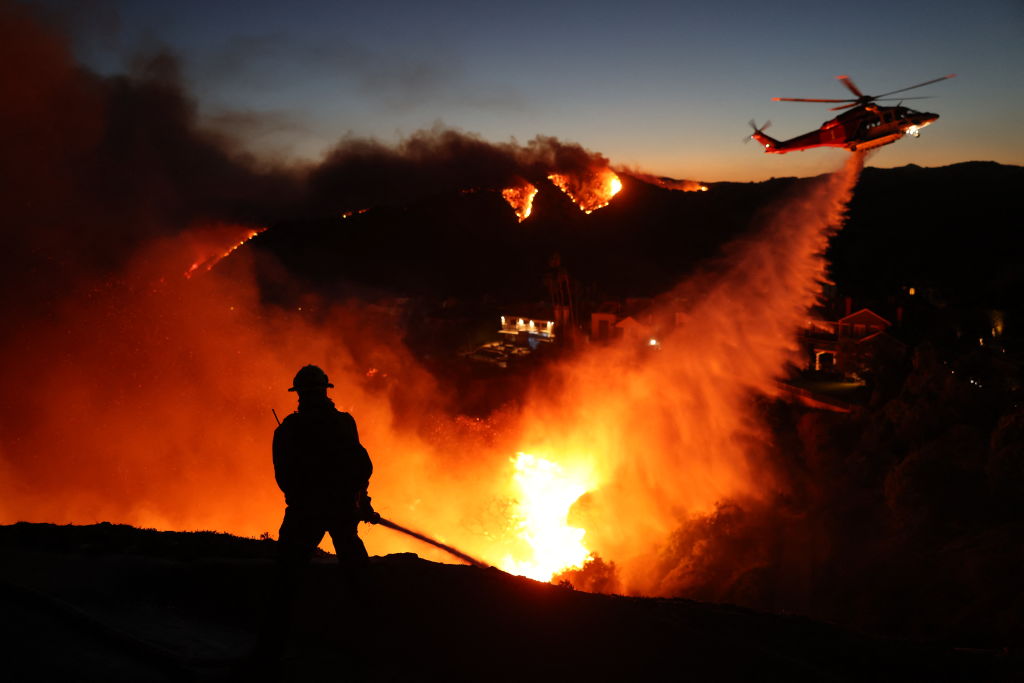
Spin Cycle: Wildfires Rage, And Politicians Fan The Blame
Favicon 
www.dailywire.com

Spin Cycle: Wildfires Rage, And Politicians Fan The Blame

For those who don’t spend their Sunday mornings glued to the television — and their Sunday afternoons attempting to dig through a week’s worth of network and cable news media spin — The Daily Wire has compiled a short summary of what you may have missed. On Sunday, as multiple wildfires still rage out of control in California, what to do about them and how to prevent such a tragedy from happening in the future was top of mind on many of the political talk shows. As one might expect, media personalities were quick to jump to the aid of Democrats — who are often only too happy to politicize natural disasters when they occurred in red states — were desperate to put a stop to the criticism being leveled at California’s leadership (or lack thereof) with regard to the fires. Deanne Criswell, head of the Federal Emergency Management Agency (FEMA), joined host Jonathan Karl on ABC News’ “This Week” to discuss the “dangerous situation” still unfolding in Southern California. “The red flag warnings have been reissued, the winds are coming back, and we still want to make sure that people are in a safe place,” Criswell said. The winds had abated enough to allow for air support to fly in water and fire retardant over the last day, but they are expected to pick up again and the situation is still extremely volatile. FEMA's Deanne Criswell tells @JonKarl that the wildfires in California are still creating a “dangerous situation.” “The red flag warnings have been reissued, the winds are coming back, and we still want to make sure that people are in a safe place.” https://t.co/DaiAqGdfIK pic.twitter.com/E6hxHKtpFs — This Week (@ThisWeekABC) January 12, 2025 Criswell, fresh off her agency’s scandalous behavior in the southeast — refusing to knock on doors and offer federal assistance where signs supporting President-elect Donald Trump were visible — assured Karl that the federal government was prepared to handle the aftermath of the devastating fires in addition to what was already on their plate. FEMA's Deanne Criswell tells @JonKarl that the agency has funding to support the wildfire response in California, as well as “recoveries from Hurricanes Helene and Milton and the other 179 declarations that we had last year alone across the United States.” https://t.co/9L2wIzgR1g pic.twitter.com/anOvr3S7Ko — This Week (@ThisWeekABC) January 12, 2025 Senator Adam Schiff (D-CA) also spoke to Karl about the fires ravaging his home state, praising firefighters and likening the devastation to that seen in war zones. “The heartbreak is just overwhelming,” he said. “The heartbreak is just overwhelming.” California Sen. Adam Schiff tells @JonKarl that the level of devastation in his home state due to the wildfires reminds him of visiting war zones, praises firefighters for the “extraordinary job they’re doing.” https://t.co/ztBCpzSppZ pic.twitter.com/XL43g6Prb4 — This Week (@ThisWeekABC) January 12, 2025 Schiff suggested that the best response to the fires would be to put forth an independent commission to review what had transpired. “What went right in our response? What went wrong in it?” Sen. Adam Schiff calls for an independent commission to review the response to the California wildfires. “What went right in our response? What went wrong in it?” https://t.co/nf9CAUZ2iH pic.twitter.com/Pj3azIxjvm — This Week (@ThisWeekABC) January 12, 2025 The new California senator, elected to fill the seat that was initially vacated when the late Sen. Dianne Feinstein (D-CA) passed away, also called on President-elect Trump to join with California in an effort to prevent future disasters. Schiff, who spent the majority of Trump’s last term attempting to either impeach him or simply smear him as a Russian asset, claimed on Sunday, “It’s going to be really important for the incoming president to work with all of us in California to make sure that we get the resources we need to put out these flames … to get the relief to get back on our feet.” “It’s going to be really important for the incoming president to work with all of us in California to make sure that we get the resources we need to put out these flames … to get the relief to get back on our feet,” California Sen. Adam Schiff says. https://t.co/ANK2epHI2F pic.twitter.com/ygCxGG6ESk — This Week (@ThisWeekABC) January 12, 2025 On CBS News’ “Face the Nation,” FEMA’s Criswell also spoke with host Margaret Brennan — and she argued that despite the growing evidence to the contrary, California had been adequately prepared to confront the massive blaze. “I think that they were very prepared,” Criswell said — despite multiple reports of budget cuts to local fire departments, empty reservoirs, and empty fire hydrants. She went on to blame the excessive winds — which are a common problem in Southern California — for the difficulties first responders have faced in battling the fires. “[They] have never seen 100 mph winds that are fueling the fire.” When asked why the Los Angeles area was so unprepared for these wildfires, @FEMA_Deanne says, "I think that they were very prepared." But she adds the firefighters "have never seen 100 mph winds that are fueling the fire." pic.twitter.com/JELhORdFoE — Face The Nation (@FaceTheNation) January 12, 2025 Rep. Judy Chu (D-CA) echoed Schiff’s sentiments in calling for bipartisan efforts in helping California to rebuild. “These wildfires don’t have any political affiliation,” she told Brennan. “They don’t belong to any political party. This devastation has affected thousands upon thousands of people who just ran out of their homes with nothing in their hands, and are trying to rebuild, and they need help.” She called on President-elect Trump and newly re-elected House Speaker Mike Johnson (R-LA) to visit the affected area, saying that they need to “witness the devastation for themselves.” There are plans to invite President-elect Donald Trump and House Speaker Mike Johnson to the areas of California afflicted by the wildfires and "witness the devastation for themselves," says Rep. Judy Chu (D-CA). "These wildfires don't have any political affiliation," she says.… pic.twitter.com/Lhb9U7F7M8 — Face The Nation (@FaceTheNation) January 12, 2025 Senate Majority Whip John Barrasso (R-Wyo.) also weighed in, noting that if the federal government was going to assist California after obvious failures in preparation, that there would be “strings attached” to any funding provided. “It has to do with being ready the next time because this was a gross failure this time,” he said. "There will be strings attached" to any disaster and recovery aid Congress will "ultimately" approve for the California wildfires, says Senate Majority Whip @SenJohnBarrasso. "It has to do with being ready the next time because this was a gross failure this time," he tells… pic.twitter.com/ym9WvXaDoa — Face The Nation (@FaceTheNation) January 12, 2025 Meanwhile, Governor Gavin Newsom joined NBC News’ “Meet the Press” — where he said that Trump had not yet responded to an invitation to tour the damaged areas of his state. Trump has not responded to invitation to survey L.A. wildfire damage, Gov. Newsom says https://t.co/OP9KQebWTM — Meet the Press (@MeetThePress) January 12, 2025 Saying that the fires would be viewed as one of the worst natural disasters to be recorded in American history, Newsom also claimed that he still had complete confidence in the leadership in place — including L.A.’s Democratic Mayor Karen Bass, who was on a taxpayer-funded trip to Africa when the fires began. Gov. Newsom says he has ‘faith in our leaders’ as L.A. Mayor Karen Bass faces scrutiny https://t.co/l6WlHoYtdP — Meet the Press (@MeetThePress) January 12, 2025
Like
Comment
Share
The Lighter Side
The Lighter Side
1 y

A Bird With Purple Eyes?! Australian Bowerbird Shows Off Its Unique Peepers
Favicon 
www.inspiremore.com

A Bird With Purple Eyes?! Australian Bowerbird Shows Off Its Unique Peepers

Bowerbirds are named for the elaborate bowers a male will build to attract a female. The bower has no other purpose. Once a pair mates, the male will often kick the female out, tidy up, and wait for a new female. There are 20 species of bowerbirds, ten living in Australia, with plumages in every color. One striking feature of the Satin bowerbird species is their bright purple eye color. @coopsbirds Those are some of the biggest purple eyes I’ve ever seen. #nature #birds #birdwatching #bowerbirds #australianbirds #birdsoftiktok ♬ original sound – Coop Juvenile bowerbirds are a satiny olive drab color. As the males mature, their feathers change to a deep midnight blue/black color, while females maintain the greenish hue. Both males and females have striking purple eyes. Male bowerbirds build elaborate bowers to attract mates. The more lackluster their plumage, the more intricate their structures are. Once the bower is complete, the male searches for decor, primarily blue. To enhance attraction, they may place flowers, plastic, and other items around the bower. Image from Wikimedia Commons. Males also perform an elaborate mating ritual when females are near. The bower serves one purpose: to attract female bowerbirds. Once mating is complete, the male stays near his bower while the female flies off to build a nest. Males may mate with several females during a season. @coopsbirds Volume up! This spectacular dance is a male Satin Bowerbird. You can hear him calling and mimicking in an attempt to attract a mate. You can even hear a #kookaburra laughing in the background at the end. #nature #australianbirds #birds #bowerbird #birdsoftiktok #australianwildlife ♬ original sound – Coop When they are not actively courting and mating, male birds constantly prowl for shiny baubles. The birds may steal decorations from other bowers. They may also destroy the bowers of other males. This action decreases the fierce competition for mates. Satin bowerbirds prefer wet rainforest, acacia, and eucalyptus forest areas. They reside predominantly along the Australian coastlines. All but one species of bowerbird builds bowers, but many others are equally beautiful and incredible. Please share the story of these fantastic architects of nature. You can find the source of this story’s featured image here and here. The post A Bird With Purple Eyes?! Australian Bowerbird Shows Off Its Unique Peepers appeared first on InspireMore.
Like
Comment
Share
Daily Caller Feed
Daily Caller Feed
1 y

Steelers’ Fanbase Beats The Living Hell Out Of Each Other After Pittsburgh’s Disastrous Playoff Loss Against Ravens
Favicon 
dailycaller.com

Steelers’ Fanbase Beats The Living Hell Out Of Each Other After Pittsburgh’s Disastrous Playoff Loss Against Ravens

Steelers fans actually thought they had a chance
Like
Comment
Share
Strange & Paranormal Files
1 y

Do Faster-than-Light Particles Exist?
Favicon 
anomalien.com

Do Faster-than-Light Particles Exist?

One of the most limiting constants of modern physics is the speed of light. It implies that we cannot transfer information to astronauts visiting the nearest star, Proxima Centauri, in less than 4.25 years. Despite wishful thinking, quantum entanglement cannot transfer messages faster than light. Indeed, a measurement of an entangled quantum system at one location would affect its measurement at another location at a speed that is faster than light, but there is no transfer of an intentional message through these two measurements. No known particles move faster than light. However, some physicists conjectured, as late as in a Physical Review paper published in July 2024, a hypothetical brand of elementary particles that could do that. These particles are called tachyons. If tachyons exist, they could be used to send signals into the past. This would violate causality according to Einstein’s Special Relativity, leading to the so-called grandfather paradox by which you could travel to the past and interact with your grandfather to prevent your own birth. The speed of tachyons increases with decreasing energy. No experimental evidence for the existence of tachyons exists. In September 2011, the OPERA experiment of CERN reported that neutrinos travel faster than light, but later updates indicated that the conclusion resulted from a faulty fiber-optic cable in the experimental timing system. Of course, laboratory constraints depend on the types of interactions that tachyons have. If a tachyon has significant interactions with Standard Model particles, we may expect it to be especially easy to find signals that are not being seen from our future. Furthermore, we may expect to have already found evidence for tachyons through precision laboratory tests at CERN or particle detectors of various kinds. On the other hand, it is possible that tachyons interact with ordinary matter weaker than neutrinos. In the limit of extremely weak interactions, this would mean that only gravitational tests could constrain tachyons, as gravity is universal for all particles and is the one interaction that cannot be avoided. This is the limiting case, where the possible theoretical problems and direct observational constraints are minimized. Nevertheless, even if the interaction is only gravitational, one could find indirect ways to constrain the existence of tachyons. A range of astrophysical observations from X-ray binaries of a star feeding a black hole to LIGO sources of gravitational waves, show that stellar-mass black holes exist and are long lived for billions of years. Tachyons must be compatible with this fact. A new paper that I just wrote with the brilliant Mark Hertzberg and Aidan Morehouse shows that the long-term existence of black holes can be used to rule out massive tachyons. The idea is simple. Black holes can be regarded as the ultimate prison, but only for particles that do not exceed the speed of light. Tachyons could escape quantum-mechanically from the vicinity of black holes and cause them to evaporate more vigorously than Stephen Hawking calculated in his famous 1974 paper. Based on Classical (non-Quantum) Physics, we can ask whether tachyons can escape a black hole. This seems plausible given that they travel faster than light. However, our paper shows that from the point of view of a distant observer, even tachyons do not escape. However, tachyons can escape quantum-mechanically from black holes. Our paper computed the Hawking radiation of tachyons, finding that for heavy tachyons — the emergent flux of energy is dramatically enhanced compared to standard Hawking radiation of photons. This leads to black holes evaporating quickly if the tachyons are sufficiently massive. We use this insight to place a direct lower bound on any tachyon’s mass. Our paper derives direct observational constraints on tachyons. We compute the Hawking radiation of tachyons from black holes, finding it to be significantly enhanced in the presence of heavy tachyons. For a black hole of mass M and tachyons of mass m, the black hole lifetime is proportional to M/m2. This implies that the observation of astrophysical black holes of a few solar masses with a lifetime of several billion years, rules out tachyons of mass m larger than a billion times the mass of the proton. In other words, there cannot be any tachyons associated with Grand Unification scales or Quantum Gravity scales within a tenth of a billionth of the Planck mass, which is 10^{19} times the proton mass. As a result, while there already are theoretical reasons to be skeptical of the existence of tachyons based on causality, our paper provides a new observational constraint based on the long lifespan of astrophysical black holes. The future discovery of primordial black holes in the asteroid mass range of 10^{17}-10^{21} grams, which could potentially constitute dark matter, would rule out tachyon masses down to 7–700 times the proton mass. Of course, if we ever encounter events from a future generation of CERN’s particle colliders or from what happened before the Big Bang, we would have to reconsider the possible existence of tachyons. The post Do Faster-than-Light Particles Exist? appeared first on Anomalien.com.
Like
Comment
Share
Showing 68961 out of 126109
  • 68957
  • 68958
  • 68959
  • 68960
  • 68961
  • 68962
  • 68963
  • 68964
  • 68965
  • 68966
  • 68967
  • 68968
  • 68969
  • 68970
  • 68971
  • 68972
  • 68973
  • 68974
  • 68975
  • 68976
Advertisement
Stop Seeing These Ads

Edit Offer

Add tier


Select an image
Delete your tier
Are you sure you want to delete this tier?

Reviews

In order to sell your content and posts, start by creating a few packages. Monetization

Pay By Wallet

Payment Alert

You are about to purchase the items, do you want to proceed?

Request a Refund