www.dailywire.com
What Democrats Aren’t Telling Voters About ‘Affordability’ Before November
Democrats aren’t stupid.
Well, at least their consultants aren’t stupid (generally speaking).
Every Democrat campaign (and Republican campaign, for that matter) has the polling and data in front of them. They know that among voters’ top concerns going into November are the cost of living, affordability, and the economy.
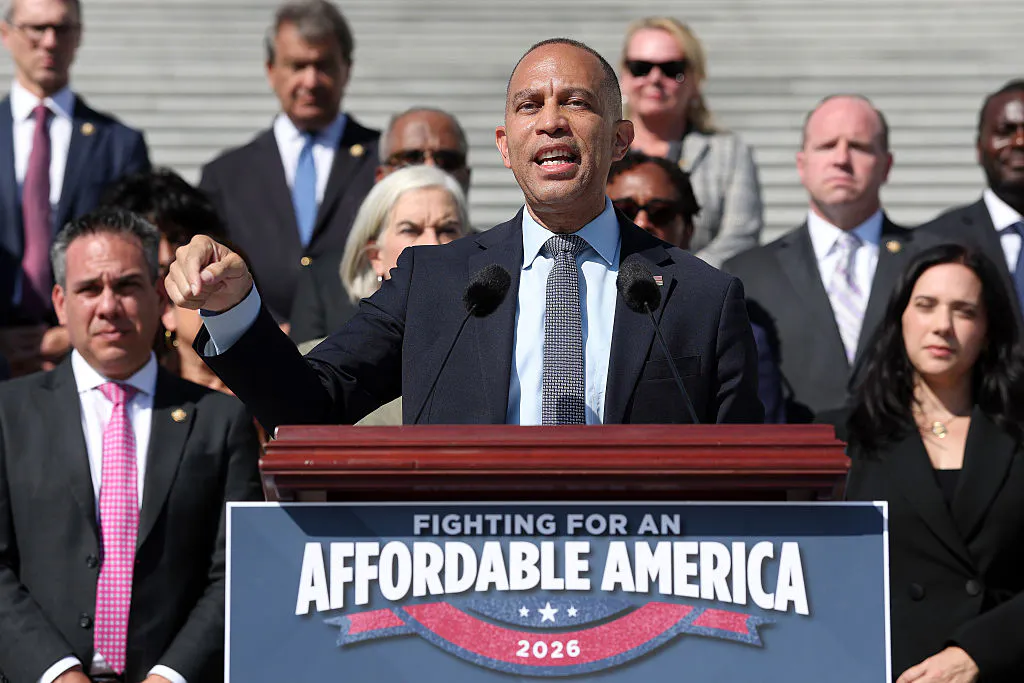
Which is why every Democrat running is promising to “lower costs” for families and focus on affordability.
The truth is Democrats have no plan to lower costs.
In fact, the Democrat agenda promises the opposite: Expensive, tax-hiking policies that will do anything but make it easier for American families to make ends meet.
Congressional Democrats recently released their top three health care proposals if they retake the House of Representatives.
Socialized, government-run health care, otherwise known as “Medicare for All,” made the list.
“Medicare for All” is estimated to cost $47 trillion over the next 10 years. Over 65% of U.S. households would end up worse financially, and the income tax would increase at least 20% for every working American, according to the Heritage Foundation.
Democrats are also openly campaigning on raising federal taxes.
What Democrats call “repealing President Trump’s One Big Beautiful Bill” (OBBB) is, in reality, repealing the largest tax cut in American history.
Across the country, in every single state, families save thousands of dollars every single year thanks to the OBBB.
Repealing it, which nearly every Democrat candidate promises to do, means raising taxes on working families.
Then there are the policies Democrats aren’t openly discussing ahead of November.
Again, Democrats aren’t stupid, which is why “climate hushing,” or not openly discussing expensive energy policies, is the new midterm strategy for the Left.
Are we to believe that once Democrats are in power, they will not pursue their beloved, tax-hiking Green New Deal?
I’d sooner believe Joe Biden was doing handstands and jumping jacks on the White House lawn at 5 am and running circles around his staff.
What about the counterargument from conservatives who feel frustrated with a Republican majority that hasn’t done enough to tackle high prices?
First, President Trump closed the border as one of his first actions in his second term. In 2024, the House Budget Committee estimated the cost of an open border to taxpayers at over $150 billion, with state and local governments absorbing the biggest financial blows, primarily through K-12 public education costs. Closing the border means saving billions of taxpayer dollars.
Second: High gas prices.
This goes back to the United States’ dependence on foreign oil, and Democrats’ war on domestic oil and gas. No Democrat will support opening up federal lands to drilling.
Only Republicans acknowledge the necessity of clean coal, which currently generates nearly half of America’s electricity. Democrats are intent upon getting rid of coal completely, which means higher electricity bills for American families.
Reforming the slow federal permitting process for pipelines and natural gas facilities is also a must. Domestic energy is practically worthless if American households cannot access it.
For example, New England sits near North America’s largest natural gas field, the Marcellus, but limited pipeline capacity in the region leaves it more dependent on imported liquefied natural gas from foreign adversaries.
These reforms will only happen under a Republican-controlled Congress.
Third, the harsh reality of inflation is that even if it is coming down, and even if wages are rising (both are happening now), that does not instantly translate to lower prices.
It’s more complex and has roots in the COVID-19 manufacturing shutdowns and state lockdowns (which Democrats hailed) that disrupted both the demand side (i.e., spending) and supply chains. Production shortages caused prices to rise. Our leaders’ solution was to print and spend trillions of dollars we did not have, including through the American Rescue Plan Act and the so-called Inflation Reduction Act. Then came the war in Ukraine in 2022, which exacerbated the problem.
Part of the solution, rightly identified by President Trump, is for the Federal Reserve to lower interest rates.
But it also requires a government that is intent upon spending less and returning more to the American people — and not in the form of more stimulus checks.
That will only happen with Republican majorities.
Lastly, this is not your grandparents’ Democrat Party.
This is the Democratic Socialist of America (DSA) that is committed to pursuing a $212 trillion agenda.
The DSA occupies a space further Left than America has ever gone before. Such a swing all but guarantees irreversible damage to our nation and the economy with their so-called “progressive” (read: regressive) agenda.
Is the Right’s argument that we should not vote for Republicans, thereby allowing Democrats unchecked power in Washington, the path forward? Would a Congress controlled by the DSA be more likely to deliver lower taxes, lower prices, and lower costs for working families?
The answer, of course, is a resounding no.
Republicans may not be perfect, but there is not one Republican candidate who is open to the tax-hiking DSA agenda.
We must be honest about what Democrats will actually do for the next two years once in power: Resume the tired play of attempting to impeach President Donald Trump.
Should Democrats retake the majority in Congress, they will spend the last two years of Trump’s presidency with hundreds of non-stop, pointless hearings that do nothing but generate clicks from their basement-dwelling far-Left base on social media — all at the taxpayers’ expense.
Voters would do well to think clearly about the two paths being presented.
One leads to paying more for everything. For us today, and for our kids, grandkids, and future generations of Americans.
The other presents a chance to keep prices low and make life more affordable.
The media should also do its part.
Ask each Democrat candidate if raising taxes is a part of their affordability plan to lower costs for families.
That should help clear things up.
***
Carly Bird is a Republican strategist and founder and president of Bird’s Eye Consulting. She previously served as the national spokeswoman for Ron DeSantis’ presidential campaign.











 New Posts (Home)
 ChatBox
 Popular Posts
  Game Zone
 Top PodCasts